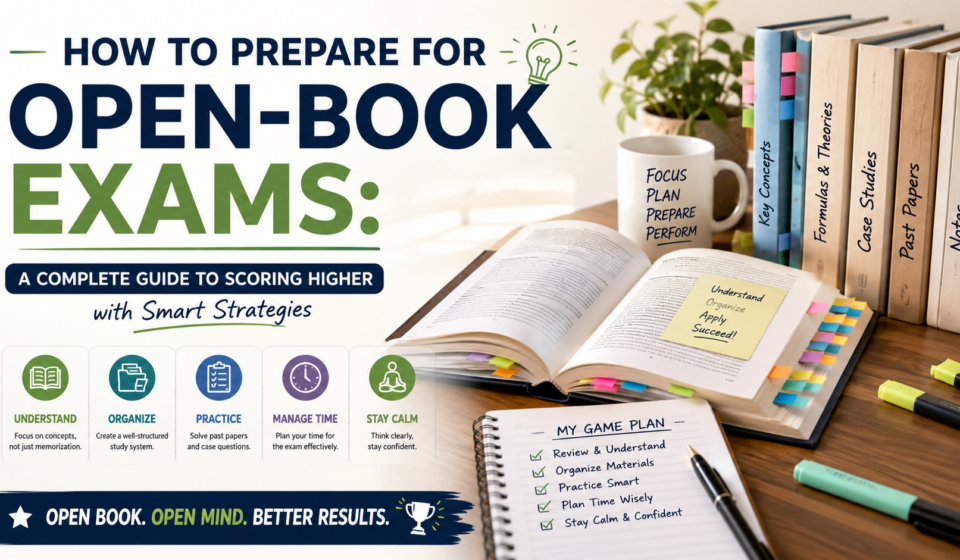

Learn how to prepare for open-book exams with proven study techniques, effective note organization, time management strategies, and expert tips. Discover how to maximize your performance and achieve better results.
Learn how to prepare for open-book exams with proven study techniques, effective note organization, time management strategies, and expert tips. Discover how to maximize your performance and achieve better results.
Open-book exams are becoming increasingly popular in schools, colleges, and universities worldwide. Unlike traditional closed-book tests, open-book exams allow students to access textbooks, notes, and reference materials while answering questions. However, many students mistakenly assume that open-book exams require less preparation.
The reality is quite different. Open-book exams often test your understanding, analytical thinking, and problem-solving abilities rather than your ability to memorize information. Proper preparation is essential for success.
This comprehensive guide will help you understand how to prepare effectively for open-book exams and maximize your chances of achieving excellent grades.
Understanding Open-Book Exams
Before preparing for an open-book exam, it is important to understand its purpose. Open-book examinations are designed to evaluate a student’s ability to locate, analyze, and apply information rather than simply recall facts.
In most open-book exams, questions are more complex and require critical thinking. Students must interpret concepts, compare ideas, solve problems, and justify their answers using supporting information.
Common types of open-book exams include:
- Restricted open-book exams
- Unrestricted open-book exams
- Online open-book assessments
- Case-study-based examinations
- Research-oriented tests
Understanding the exam format helps you prepare more strategically.
Why Open-Book Exams Can Be Challenging
Many students underestimate open-book exams because they assume they can simply search for answers during the test.
However, challenges often include:
- Limited exam time
- Complex analytical questions
- Large volumes of study materials
- Difficulty locating information quickly
- Need for critical thinking and application
Without proper preparation, students may spend too much time searching through notes and textbooks, resulting in incomplete answers.
Start Preparing Early
One of the biggest mistakes students make is postponing preparation until the last moment.
Even though you can use resources during the exam, early preparation helps you:
- Understand key concepts thoroughly
- Create organized notes
- Develop confidence
- Reduce exam anxiety
- Improve time management
Begin preparing several weeks before the exam whenever possible.
Focus on Understanding Concepts Instead of Memorization
The primary goal of open-book exam preparation should be conceptual understanding.
Instead of memorizing definitions word-for-word, focus on:
- Understanding theories
- Learning practical applications
- Identifying relationships between concepts
- Analyzing real-world examples
- Recognizing patterns and trends
When you truly understand a topic, answering complex questions becomes much easier.
Create Well-Organized Notes
Well-organized notes can save valuable time during the exam.
Your notes should include:
- Key concepts
- Definitions
- Important formulas
- Case studies
- Examples
- Summary points
Use headings, bullet points, and color coding to improve navigation.
Consider creating a master summary sheet containing the most important information from each chapter.
Use Tabs and Bookmarks
If physical textbooks are allowed, use sticky tabs or bookmarks to mark important sections.
Label sections such as:
- Definitions
- Formulas
- Case studies
- Diagrams
- Important chapters
This allows you to locate information instantly during the exam.
Develop a Quick Reference Guide
A quick reference guide acts as a roadmap for your study materials.
Include:
- Chapter summaries
- Important page numbers
- Formula locations
- Key theories
- Frequently used references
Having this guide can significantly reduce the time spent searching for information.
Practice Applying Knowledge
Open-book exams often require application rather than recall.
Practice by:
- Solving case studies
- Answering scenario-based questions
- Writing analytical responses
- Comparing concepts
- Evaluating arguments
The more application-based questions you practice, the better prepared you will be.
Solve Previous Exam Papers
Past exam papers provide valuable insights into:
- Question formats
- Difficulty levels
- Time requirements
- Common topics
Practicing previous papers helps you identify weak areas and improve exam performance.
Improve Information Retrieval Skills
One of the most important skills for open-book exams is finding information quickly.
Practice locating:
- Important chapters
- Definitions
- Examples
- Supporting evidence
- Formulas
The faster you retrieve information, the more time you have to develop strong answers.
Create Concept Maps
Concept maps help visualize relationships between ideas.
Benefits include:
- Better understanding
- Improved retention
- Easier revision
- Faster problem-solving
Use diagrams, arrows, and visual connections to organize information logically.
Manage Your Time Effectively
Time management is critical in open-book exams.
Many students lose marks because they spend too much time searching through materials.
A recommended approach:
- Read all questions first
- Allocate time per question
- Answer easier questions first
- Leave difficult questions for later
- Reserve time for review
Always monitor the clock during the exam.
Avoid Over-Reliance on Books
Your textbook should support your answers, not replace your understanding.
If you depend entirely on searching for answers:
- You may run out of time
- You may miss important details
- Your responses may lack depth
Aim to answer questions primarily from your knowledge and use resources for verification.
Practice Under Exam Conditions
Simulate actual exam conditions by:
- Setting a timer
- Using only permitted materials
- Avoiding distractions
- Completing full-length practice exams
This builds confidence and improves speed.
Organize Digital Resources for Online Open-Book Exams
Many institutions now conduct online open-book assessments.
To prepare effectively:
- Create organized folders
- Use searchable PDFs
- Rename files clearly
- Save important documents in one location
- Bookmark frequently used websites
Digital organization can significantly improve efficiency during online exams.
Learn Keyword Searching
When using digital materials, keyword searching can save time.
Practice using:
- Search functions
- Document indexing
- Highlighted notes
- Digital bookmarks
Efficient searching improves productivity during online assessments.
Strengthen Critical Thinking Skills
Critical thinking is one of the most valuable skills in open-book exams.
Develop the ability to:
- Analyze information
- Compare viewpoints
- Evaluate evidence
- Draw conclusions
- Support arguments logically
Strong critical thinking often distinguishes top-performing students.
Common Mistakes to Avoid
Students frequently make the following mistakes:
- Not studying before the exam
- Bringing disorganized notes
- Relying entirely on textbooks
- Spending too much time searching
- Ignoring time management
- Failing to practice beforehand
Avoiding these mistakes can significantly improve your performance.
Exam Day Preparation Tips
Before the exam:
- Review your summary notes
- Organize all materials
- Charge electronic devices
- Ensure internet stability for online exams
- Get adequate sleep
- Stay hydrated
Good preparation reduces stress and improves concentration.
Build Confidence Through Preparation
Confidence comes from preparation, not luck.
Students who:
- Understand concepts
- Organize materials
- Practice regularly
- Manage time effectively
are far more likely to perform well in open-book exams.
Benefits of Open-Book Exams
Open-book exams encourage:
- Deep learning
- Analytical thinking
- Problem-solving abilities
- Practical application of knowledge
- Reduced memorization pressure
These skills are valuable not only in academics but also in professional careers.
Sources
https://www.edutopia.org
https://www.coursera.org
Conclusion
Open-book exams may seem easier than traditional examinations, but they require a different type of preparation. Success depends on understanding concepts, organizing study materials, practicing application-based questions, and managing time effectively.
Rather than relying solely on textbooks during the exam, focus on developing strong subject knowledge and efficient information retrieval skills. With proper preparation, open-book exams can become an excellent opportunity to demonstrate critical thinking, analytical abilities, and real-world problem-solving skills.
By following the strategies outlined in this guide, students can approach open-book exams with confidence and significantly improve their chances of achieving outstanding academic results.
FAQs
What is the best way to study for an open-book exam?
The best approach is to focus on understanding concepts, creating organized notes, and practicing application-based questions rather than memorizing information.
Do I need to study for an open-book exam?
Yes. Open-book exams often contain complex questions that require critical thinking and subject understanding. Simply relying on books during the exam is usually not enough.
How can I find information quickly during an open-book exam?
Use bookmarks, tabs, summary sheets, and organized notes to locate important information efficiently.
Are open-book exams easier than closed-book exams?
Not necessarily. Open-book exams often involve deeper analysis and application of knowledge, making them challenging in different ways.
How should I manage time during an open-book exam?
Read all questions first, allocate time for each section, avoid excessive searching, and reserve time for reviewing your answers.