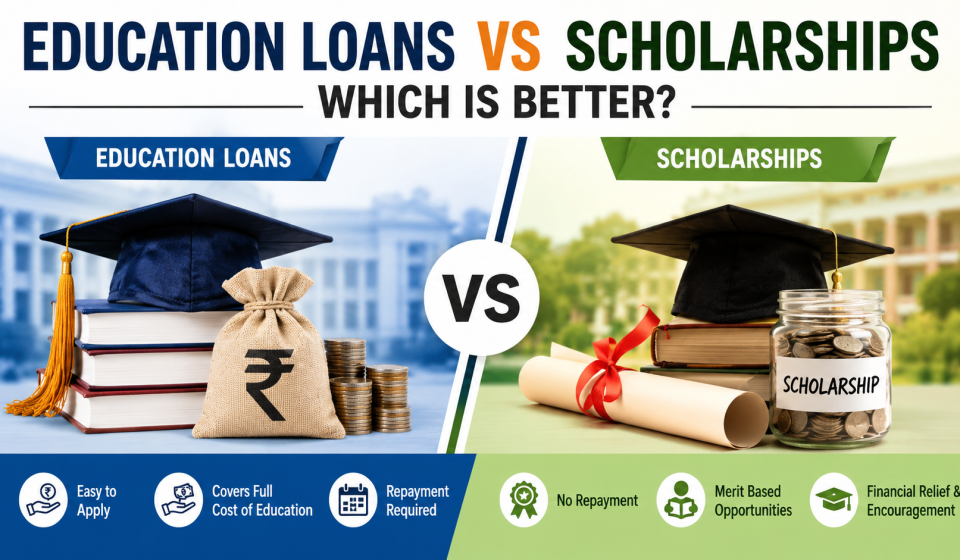

This guide compares education loans and scholarships, highlighting their advantages, disadvantages, eligibility, and key differences to help students make an informed financial decision.
Higher education is one of the most valuable investments in a person’s future, but it often comes with significant financial costs. Tuition fees, accommodation, books, travel, and living expenses can quickly add up, making college or university education expensive for many students. Fortunately, there are two common ways to finance higher education: education loans and scholarships.
While both options help students achieve their academic goals, they work very differently. Scholarships provide financial assistance that usually doesn’t need to be repaid, whereas education loans offer borrowed money that must be repaid with interest after graduation. Choosing between these options depends on your financial situation, academic achievements, career plans, and long-term goals.
What Is an Education Loan?
An education loan is money borrowed from a bank, financial institution, or government-backed lender to pay for educational expenses.
These loans generally cover:
- Tuition fees
- Hostel or accommodation charges
- Books and study materials
- Laptop and equipment
- Living expenses
- Travel costs for international students
Most education loans include a repayment period that begins after graduation or after a specified moratorium period.
What Is a Scholarship?
A scholarship is financial assistance awarded to students based on merit, financial need, talent, leadership, community service, sports achievements, or other criteria.
Unlike loans, scholarships generally do not require repayment.
Scholarships may cover:
- Full tuition fees
- Partial tuition fees
- Living expenses
- Books
- Research funding
- Travel expenses
- Accommodation
Scholarships are offered by governments, universities, private organizations, NGOs, foundations, and corporations.
Key Differences Between Education Loans and Scholarships
| Feature | Scholarships | Education Loans |
|---|---|---|
| Repayment | No repayment required | Must be repaid |
| Interest | None | Interest applicable |
| Eligibility | Merit, need, talent, etc. | Financial eligibility and lender approval |
| Financial Burden | None after graduation | Monthly repayments after study |
| Availability | Competitive and limited | Widely available |
| Coverage | Partial or full | Usually covers complete expenses |
Advantages of Scholarships
Scholarships remain the preferred option for most students because they reduce financial stress.
Benefits include:
No Debt
Students graduate without worrying about loan repayments.
Lower Financial Stress
Graduates can focus on career development instead of immediate financial obligations.
Merit Recognition
Winning scholarships enhances academic and professional profiles.
Encourages Academic Excellence
Many scholarships reward strong academic performance and leadership.
Better Return on Investment
Students receive education funding without sacrificing future income.
Disadvantages of Scholarships
Although scholarships are highly beneficial, they also have limitations.
Some challenges include:
- Highly competitive application process
- Limited number of awards
- Strict eligibility criteria
- Deadlines can be difficult to manage
- Some scholarships only cover partial tuition
Students often need multiple scholarship applications before receiving funding.
Advantages of Education Loans
Education loans remain an excellent option for students who cannot secure scholarships.
Benefits include:
Accessible Funding
Many students qualify even without exceptional academic records.
Covers Complete Educational Costs
Loans often finance tuition, accommodation, books, and living expenses.
Flexible Repayment
Many lenders offer repayment after course completion.
Builds Financial Responsibility
Responsible repayment helps establish a positive credit history.
Enables International Education
Education loans make overseas education possible for many students.
Disadvantages of Education Loans
Loans also come with financial responsibilities.
Some drawbacks include:
Interest Payments
Students repay more than the borrowed amount.
Long-Term Debt
Repayment can continue for several years after graduation.
Financial Pressure
Monthly installments may become challenging during the early career stage.
Credit Risk
Missed payments may negatively affect credit scores.
When Scholarships Are the Better Choice
Scholarships are generally ideal if you:
- Have excellent academic performance
- Demonstrate leadership skills
- Excel in sports or arts
- Meet financial need requirements
- Want to graduate debt-free
- Plan to pursue research or higher education
Students should always prioritize scholarships before considering loans.
When Education Loans Make More Sense
Education loans may be suitable when:
- Scholarship opportunities are unavailable
- Tuition fees are extremely high
- Immediate funding is required
- Studying abroad requires larger financial support
- The expected future income justifies borrowing
Professional degrees with strong earning potential often make education loans worthwhile.
Can You Combine Scholarships and Education Loans?
Yes.
Many students successfully combine both funding sources.
For example:
- Scholarship covers tuition.
- Loan covers accommodation.
- Scholarship pays 50% of expenses.
- Loan finances remaining costs.
This strategy significantly reduces debt while ensuring sufficient funding.
Tips for Choosing the Right Option
Before deciding, consider these factors:
Compare Total Costs
Calculate tuition, accommodation, travel, and living expenses.
Research Scholarships First
Always explore available scholarships before applying for loans.
Understand Loan Terms
Review:
- Interest rates
- Repayment period
- Moratorium
- Processing fees
- Penalties
Consider Future Earnings
Estimate expected salary after graduation.
Apply Early
Scholarships and education loans both have application deadlines.
Common Mistakes Students Should Avoid
Many students make avoidable financial mistakes.
Avoid:
- Applying only for one scholarship
- Ignoring smaller scholarships
- Borrowing more than necessary
- Not comparing loan interest rates
- Missing scholarship deadlines
- Ignoring scholarship renewal requirements
Planning ahead saves money over the long term.
How Parents Can Help
Parents can support students by:
- Researching funding opportunities
- Comparing loan providers
- Preparing financial documents
- Encouraging scholarship applications
- Creating realistic education budgets
Family involvement often improves financial planning.
Future Trends in Student Financing
Student funding is evolving rapidly.
Emerging trends include:
- AI-powered scholarship matching
- Income-share agreements
- Digital scholarship platforms
- Government funding expansion
- Employer-sponsored education programs
- Flexible education financing options
Students now have more funding opportunities than ever before.
source
https://l1nq.com/1lw2vlr
https://sl1nk.com/6kotg1e
https://sl1nk.com/fy1qd0o
https://l1nq.com/hj00cte
Conclusion
Both education loans and scholarships play an important role in making higher education accessible. Scholarships remain the ideal choice because they provide financial support without creating long-term debt, making them highly attractive for academically strong and deserving students. However, scholarships are competitive and may not always cover all educational expenses.
Education loans, on the other hand, offer reliable financial assistance when scholarships are unavailable or insufficient. While loans require repayment with interest, they allow students to pursue quality education without delaying their academic goals.
The smartest approach is often to apply for as many scholarships as possible and use education loans only to cover any remaining costs. Careful planning, thorough research, and informed financial decisions can help students achieve their educational dreams while minimizing future financial burdens.
Frequently Asked Questions (FAQs)
1. Are scholarships better than education loans?
Yes. Scholarships are generally better because they do not require repayment and reduce financial stress after graduation.
2. Can I receive both a scholarship and an education loan?
Yes. Many students combine scholarships with education loans to reduce borrowing and cover remaining educational expenses.
3. Do education loans cover living expenses?
Many education loans cover tuition fees, accommodation, books, travel, and other education-related costs, depending on the lender.
4. Who is eligible for scholarships?
Eligibility depends on the scholarship and may be based on academic merit, financial need, sports achievements, leadership, research, or community service.
5. Should I apply for scholarships before taking an education loan?
Absolutely. Applying for scholarships first can reduce or even eliminate the need to borrow money, lowering future financial obligations.