Government vs Private Colleges: Which One Is Better for Your Future? A Complete Comparison Guide

India has thousands of government and private colleges offering undergraduate, postgraduate, and professional programs in engineering, medicine, management, law, arts, science, commerce, and many other disciplines.
Choosing the right college is one of the most important decisions in a student’s academic journey. After completing 12th grade, students often face a common dilemma: should they choose a government college or a private college? Both types of institutions offer unique advantages and challenges, making the decision highly dependent on individual goals, financial circumstances, career aspirations, and educational preferences. Understanding the differences between government and private colleges can help students make an informed choice that supports their long-term success. While government colleges are often known for affordability and reputation, private colleges are recognized for modern infrastructure and industry-oriented education. This comprehensive guide compares government and private colleges across multiple factors including fees, placements, faculty, infrastructure, admissions, campus life, return on investment, and career opportunities to help students choose the best option for their future.
Understanding Government Colleges
Government colleges are educational institutions funded and managed by central or state governments. These institutions typically receive financial support from public funds, allowing them to offer education at lower costs.
Examples include:
- IITs
- NITs
- AIIMS
- Government Medical Colleges
- Central Universities
- State Universities
Government colleges often enjoy strong academic reputations and attract highly qualified students through competitive entrance examinations.
Understanding Private Colleges
Private colleges are funded and managed by private organizations, trusts, educational groups, or corporations. These institutions generally operate independently and rely primarily on tuition fees and private investments.
Examples include:
- VIT University
- SRM Institute
- Manipal University
- Amity University
- Symbiosis International University
- NMIMS
Private colleges often emphasize infrastructure development, industry collaboration, and modern teaching methodologies.
Difference Between Government and Private Colleges
Before making a decision, students should understand how these institutions differ in key areas.
Ownership
Government Colleges:
- Owned by central or state governments
- Publicly funded
Private Colleges:
- Owned by private trusts or organizations
- Funded through tuition fees and private investments
Ownership directly influences fees, facilities, and administrative policies.
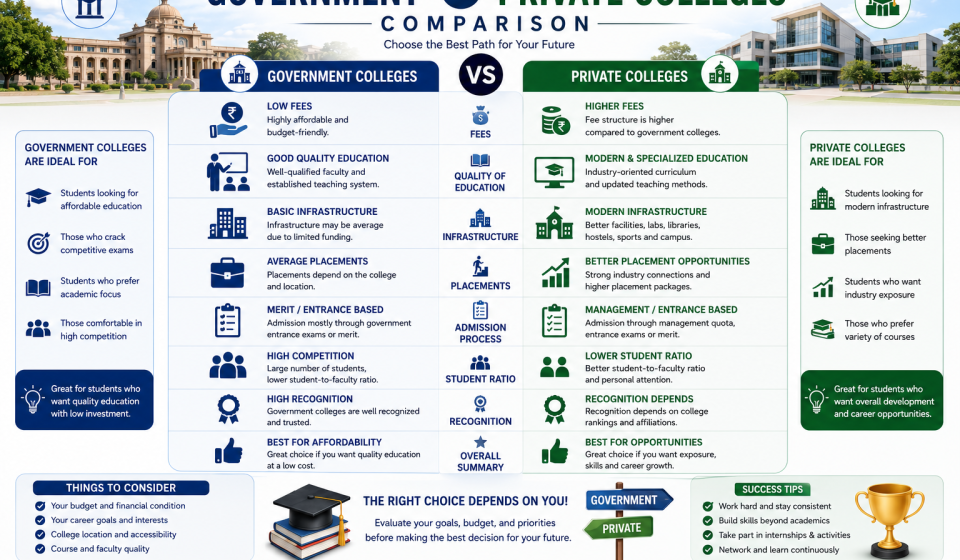
Fee Structure Comparison
One of the biggest differences between government and private colleges is the cost of education.
Government Colleges
Government colleges generally offer affordable education due to public funding.
Examples:
- Government engineering colleges often charge significantly lower tuition fees.
- Government medical colleges offer medical education at a fraction of the cost of private institutions.
Benefits:
- Affordable fees
- Reduced financial burden
- Better return on investment
Private Colleges
Private institutions typically charge higher fees.
Reasons include:
- Advanced infrastructure
- Modern facilities
- Private funding requirements
While some private colleges justify higher fees through strong placements and facilities, students should carefully evaluate affordability.
Admission Process Comparison
Government Colleges
Admissions are usually based on highly competitive entrance examinations.
Common exams include:
- JEE Main
- JEE Advanced
- NEET
- CUET
- GATE
Competition is often intense due to limited seats.
Private Colleges
Private institutions may admit students through:
- National entrance exams
- University-specific entrance tests
- Merit-based admissions
Admission processes may be relatively more flexible compared to government institutions.
Faculty Quality Comparison
Faculty members significantly influence educational outcomes.
Government Colleges
Advantages:
- Experienced professors
- Strong academic credentials
- Research-oriented teaching
Many faculty members are involved in advanced research and national projects.
Private Colleges
Advantages:
- Industry professionals as faculty
- Practical learning approaches
- Industry-focused curriculum
Top private institutions increasingly recruit highly qualified faculty to strengthen academic standards.
Infrastructure and Campus Facilities
Infrastructure plays a vital role in the learning experience.
Government Colleges
Traditional government institutions often possess:
- Large campuses
- Established libraries
- Research laboratories
However, infrastructure quality may vary depending on funding and institution age.
Private Colleges
Private colleges typically invest heavily in:
- Smart classrooms
- Modern laboratories
- Wi-Fi-enabled campuses
- Advanced technology facilities
- Contemporary hostels
Many students prefer private colleges because of their modern learning environments.
Placement Opportunities
Placements are among the most important factors for students.
Government Colleges
Top government institutions often have exceptional placement records.
Examples:
- IITs
- NITs
- AIIMS
- Top government universities
Advantages:
- Strong employer reputation
- High salary packages
- Established alumni networks
Private Colleges
Leading private colleges also offer strong placements.
Examples:
- VIT
- Manipal
- SRM
- NMIMS
Many private institutions maintain extensive corporate partnerships and placement cells.
Research Opportunities
Research exposure is essential for students interested in higher education and innovation.
Government Colleges
Government institutions generally excel in:
- Research funding
- Government-sponsored projects
- Publications
- Innovation programs
Many research grants are available through government agencies.
Private Colleges
Private institutions are increasingly investing in research infrastructure and collaborations.
However, research opportunities may vary considerably across institutions.
Student Diversity
Government Colleges
Students often come from diverse social, cultural, and economic backgrounds due to affordable fees and nationwide entrance examinations.
Private Colleges
Private colleges also attract students from different regions and countries, particularly institutions with international collaborations.
Both environments offer valuable networking opportunities.
Industry Exposure
Government Colleges
Top government institutions maintain strong industry relationships through:
- Internship programs
- Research collaborations
- Industry projects
Private Colleges
Private colleges frequently focus on:
- Industry partnerships
- Corporate training
- Skill development workshops
- Guest lectures
Industry exposure is often integrated into the curriculum.
Campus Life Comparison
Government Colleges
Campus life may include:
- Cultural festivals
- Technical events
- Student organizations
- Sports competitions
Many government institutions have rich traditions and strong alumni cultures.
Private Colleges
Private colleges often emphasize:
- Modern student amenities
- International events
- Innovation hubs
- Entrepreneurship programs
Students enjoy diverse extracurricular opportunities.
Return on Investment (ROI)
ROI is a crucial consideration for students and parents.
Government Colleges
Advantages:
- Lower fees
- Strong placements
- Reduced educational debt
Government institutions often provide exceptional ROI.
Private Colleges
ROI depends on:
- College reputation
- Placement outcomes
- Program quality
Top private institutions can also deliver excellent ROI despite higher fees.
Global Recognition
Government Colleges
Institutions such as IITs and AIIMS enjoy strong international recognition.
Graduates frequently secure:
- International jobs
- Research opportunities
- Admissions to top global universities
Private Colleges
Leading private universities are increasingly building international partnerships and recognition.
Global opportunities depend largely on institutional reputation.
Entrepreneurship Support
Government Colleges
Many government institutions operate:
- Startup incubators
- Innovation centers
- Entrepreneurship cells
Private Colleges
Private colleges often invest significantly in startup ecosystems and innovation programs.
Entrepreneurial students can find support in both sectors.
Scholarships and Financial Assistance
Government Colleges
Government colleges typically offer:
- Merit scholarships
- Reserved category benefits
- Government-funded financial aid
Private Colleges
Many private institutions provide:
- Merit scholarships
- Sports scholarships
- Need-based assistance
Students should research scholarship opportunities before making decisions.
Career Opportunities After Graduation
Both government and private colleges can lead to successful careers.
Success depends on:
- Academic performance
- Skill development
- Internships
- Networking
- Personal initiative
The institution matters, but student effort plays an equally important role.
Common Myths About Government and Private Colleges
Myth 1: Government Colleges Are Always Better
Reality:
Not all government colleges outperform top private institutions.
Myth 2: Private Colleges Guarantee Placements
Reality:
Placement success depends on student skills and institutional quality.
Myth 3: High Fees Mean Better Education
Reality:
Expensive education does not automatically guarantee superior outcomes.
Myth 4: Government Colleges Have Poor Infrastructure
Reality:
Many government institutions possess world-class facilities.
How to Choose Between Government and Private Colleges
Students should evaluate:
- Academic goals
- Financial budget
- Preferred course
- Placement records
- Infrastructure
- Faculty quality
- Campus environment
- Location
- Return on investment
The best choice varies from student to student.
Source Links
https://www.ugc.gov.in
https://www.nirfindia.org
https://www.aicte-india.org
https://www.education.gov.in
Conclusion
The debate between government and private colleges does not have a one-size-fits-all answer. Government colleges generally offer affordable education, strong academic reputations, excellent return on investment, and competitive placements. Private colleges often provide modern infrastructure, industry-focused learning, flexible admission processes, and extensive student facilities. Students should compare colleges based on course quality, faculty, placements, fees, infrastructure, industry exposure, and career goals rather than relying solely on public perception. Ultimately, the right college is one that aligns with a student’s aspirations, financial situation, and long-term objectives.
FAQ
1- Which is better, a government college or a private college?
Both can be excellent choices. The best option depends on factors such as course quality, fees, placements, infrastructure, and career goals.
2- Are government colleges cheaper than private colleges?
Yes. Government colleges are generally much more affordable because they receive public funding.
3- Do private colleges provide better infrastructure?
Many private colleges offer modern infrastructure, advanced laboratories, smart classrooms, and contemporary campus facilities.
4- Which colleges have better placements?
Top government institutions such as IITs and NITs often have exceptional placements, but leading private colleges also maintain strong placement records.
5- Are private college degrees valid?
Yes. Degrees from recognized and accredited private colleges are valid and accepted by employers and universities.
6- Which option provides better return on investment?
Government colleges often offer higher ROI due to lower fees and strong placement opportunities.
7- Can students receive scholarships in private colleges?
Yes. Many private institutions offer merit-based, sports-based, and need-based scholarships.
8- What should students prioritize when choosing a college?
Students should prioritize academic quality, accreditation, faculty expertise, placement performance, affordability, infrastructure, and career opportunities.