Complete Guide to College Admission Process: Step-by-Step Roadmap to Secure Your Dream College

Getting admission into the right college is one of the most important milestones in a student’s academic journey. Whether you are planning to pursue engineering, medicine, management, law, arts, commerce, science, or any other professional course, understanding the college admission process can significantly improve your chances of securing a seat in your preferred institution. Every year, millions of students apply to colleges across India, making the admission process highly competitive and sometimes confusing. Proper planning, awareness, and timely action are essential for a smooth admission experience.
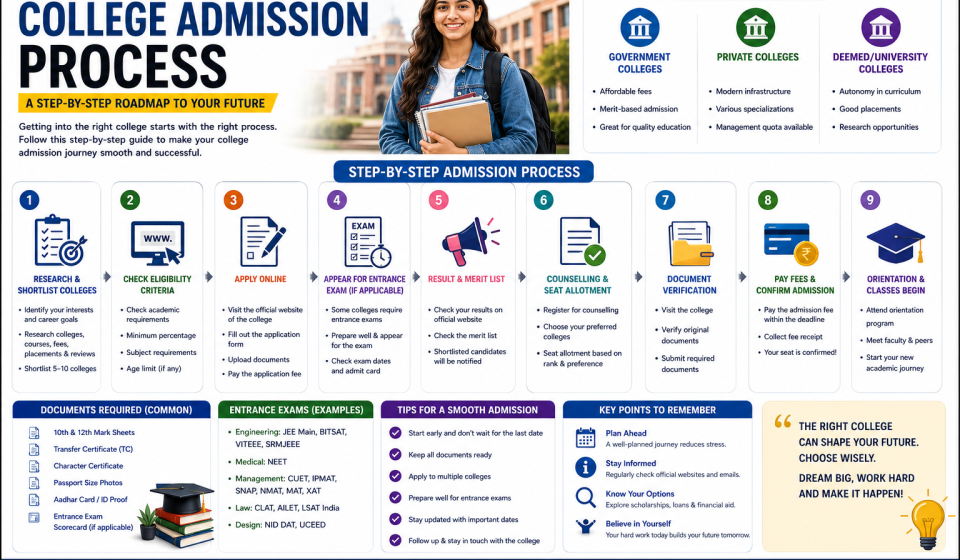
The college admission process involves several stages, including researching colleges, meeting eligibility criteria, appearing for entrance examinations, filling out application forms, participating in counseling sessions, submitting documents, and completing fee payments. Missing deadlines or misunderstanding requirements can lead to missed opportunities. This comprehensive guide explains every aspect of the college admission process, helping students and parents navigate admissions confidently and successfully.
Why Understanding the College Admission Process is Important
A clear understanding of the admission process helps students:
- Avoid common mistakes
- Meet important deadlines
- Select suitable colleges
- Prepare for entrance exams
- Organize necessary documents
- Increase admission chances
- Reduce stress during admissions
- Make informed decisions
Students who begin planning early are generally better positioned to secure admissions in reputed institutions.
Step 1: Identify Your Career Goals
Before applying to colleges, students should determine their academic interests and long-term career objectives.
Questions to ask yourself:
- Which subjects do I enjoy?
- What career do I want to pursue?
- What are my strengths?
- Which industries interest me?
- Do I want to pursue professional or academic courses?
Understanding career goals helps narrow down college and course options.
Step 2: Choose the Right Course
Selecting the right course is often more important than selecting a particular college.
Popular courses after 12th include:
Science Stream
- B.Tech
- MBBS
- BDS
- B.Pharm
- B.Sc
- Biotechnology
Commerce Stream
- B.Com
- BBA
- CA
- CS
- Economics
Arts Stream
- BA
- Journalism
- Psychology
- Sociology
- Law
- Design
Students should choose courses aligned with their interests and career aspirations.
Step 3: Research Colleges Thoroughly
After selecting a course, students should prepare a list of colleges.
Important factors to evaluate include:
- Accreditation
- Recognition
- Rankings
- Faculty quality
- Placement records
- Infrastructure
- Fees
- Location
- Industry exposure
Creating a shortlist helps streamline the application process.
Step 4: Understand Eligibility Criteria
Every college has specific admission requirements.
Common eligibility criteria include:
- Minimum percentage in 12th grade
- Subject-specific requirements
- Entrance examination scores
- Age criteria for certain programs
Students should verify eligibility before applying.
Step 5: Learn About Different Admission Types
Colleges generally offer admissions through multiple methods.
Merit-Based Admissions
Selection depends on academic performance in qualifying examinations.
Entrance Exam-Based Admissions
Admission depends on entrance examination scores.
Management Quota Admissions
Some private institutions reserve seats under management quotas.
Direct Admissions
Certain colleges offer direct admission based on eligibility criteria.
Understanding admission types helps students prepare accordingly.
Step 6: Prepare for Entrance Examinations
Many colleges require entrance exam scores for admission.
Popular entrance exams include:
Engineering
- JEE Main
- JEE Advanced
- BITSAT
- VITEEE
Medical
- NEET
Law
- CLAT
- AILET
Management
- CAT
- MAT
- CMAT
Universities
- CUET
Strong preparation can significantly improve admission prospects.
Step 7: Register for Entrance Exams
Students should complete exam registrations within prescribed deadlines.
Important considerations:
- Application dates
- Eligibility requirements
- Registration fees
- Examination centers
Keeping track of notifications helps avoid missed opportunities.
Step 8: Gather Required Documents
Document preparation is a critical part of the admission process.
Commonly required documents include:
- Class 10 marksheet
- Class 12 marksheet
- Transfer certificate
- Character certificate
- Entrance exam scorecard
- Passport-size photographs
- Identity proof
- Category certificate (if applicable)
- Domicile certificate (if applicable)
Maintaining both physical and digital copies is advisable.
Step 9: Fill Out College Application Forms
Most colleges now provide online application systems.
Tips for completing applications:
- Read instructions carefully
- Enter accurate information
- Upload documents correctly
- Review details before submission
Errors in application forms can lead to rejection.
Step 10: Pay Application Fees
Many colleges require application fees.
Students should:
- Use secure payment methods
- Save payment receipts
- Verify successful submission
Application fees vary across institutions.
Step 11: Track Application Status
After submission, students should regularly monitor application portals.
Track:
- Application confirmation
- Admit cards
- Entrance exam schedules
- Merit lists
- Counseling notifications
Regular monitoring prevents missed updates.
Step 12: Attend Entrance Examinations
Entrance examinations play a decisive role in admissions.
Preparation strategies include:
- Following a study schedule
- Practicing mock tests
- Reviewing previous papers
- Improving time management
Good performance improves admission opportunities.
Step 13: Check Merit Lists and Results
Colleges release admission results through:
- Merit lists
- Rank lists
- Scorecards
Students should verify:
- Ranking
- Eligibility status
- Counseling schedules
Results determine the next stage of admission.
Step 14: Participate in Counseling Process
Many professional programs require counseling.
Counseling involves:
- Choice filling
- Seat allocation
- Document verification
- Admission confirmation
Examples include:
- JoSAA Counseling
- NEET Counseling
- State Counseling Authorities
Careful participation is essential for securing preferred colleges.
Step 15: Choice Filling and Locking
Students must select preferred colleges and courses.
Tips:
- Prioritize preferred institutions
- Research cutoff trends
- Consider backup options
Thoughtful choice filling can improve seat allocation outcomes.
Step 16: Seat Allotment
Based on rankings and preferences, students receive seat allotments.
Possible outcomes:
- Seat allotted
- Waitlisted
- Upgraded seat
- No allotment
Students should carefully review allotment instructions.
Step 17: Document Verification
Colleges verify submitted documents before final admission.
Verification may include:
- Academic records
- Identity proof
- Entrance scores
- Reservation certificates
Providing accurate documentation is crucial.
Step 18: Pay Admission Fees
After seat confirmation, students must pay admission fees within specified deadlines.
Fee payment confirms acceptance of the allotted seat.
Students should:
- Save payment receipts
- Review refund policies
- Confirm enrollment status
Step 19: Complete Final Enrollment
Final enrollment includes:
- Student registration
- Hostel applications
- Orientation participation
- Academic scheduling
Students officially become part of the institution after completing enrollment requirements.
Step 20: Apply for Scholarships
Scholarships can reduce educational expenses significantly.
Popular scholarship categories include:
- Merit scholarships
- Need-based scholarships
- Government scholarships
- Minority scholarships
- Sports scholarships
Students should explore all available financial assistance options.
Common Mistakes During College Admissions
Students should avoid:
- Missing deadlines
- Incomplete applications
- Incorrect information
- Ignoring eligibility criteria
- Not researching colleges
- Delaying document preparation
- Overlooking counseling instructions
Avoiding these mistakes improves admission success.
Tips for Parents During Admissions
Parents can support students by:
- Assisting with research
- Tracking deadlines
- Organizing documents
- Discussing financial planning
- Providing emotional support
Collaborative decision-making often leads to better outcomes.
Online vs Offline Admission Process
Online Admissions
Advantages:
- Convenience
- Faster processing
- Easy tracking
Offline Admissions
Advantages:
- Personal assistance
- Direct interaction
Most institutions now primarily use online admission systems.
Importance of Accreditation and Recognition
Students should verify college approvals from:
- UGC
- AICTE
- NMC
- PCI
- NAAC
Recognized institutions provide valid degrees and better career opportunities.
Future Trends in College Admissions
Admissions are becoming increasingly technology-driven.
Emerging trends include:
- Digital applications
- Online counseling
- AI-based admission systems
- Virtual campus tours
- Digital document verification
Students should stay informed about evolving admission procedures.
Source
https://www.ugc.gov.in
https://www.aicte-india.org
https://www.nirfindia.org
https://www.education.gov.in
https://josaa.nic.in
https://nta.ac.in
Conclusion
The college admission process can seem complex, but with proper planning and preparation, students can navigate it successfully. From identifying career goals and selecting the right course to preparing for entrance examinations, participating in counseling, and completing enrollment, each step plays a crucial role in securing admission to a preferred institution. Students should remain organized, stay informed about deadlines, verify eligibility criteria, and carefully evaluate colleges before making decisions. A well-planned approach not only increases admission chances but also lays the foundation for a successful academic and professional future.
FAQ
1- When should students start preparing for college admissions?
Students should ideally begin researching colleges and admission requirements during Class 11 or early in Class 12.
2- What documents are commonly required for college admission?
Common documents include Class 10 and 12 marksheets, transfer certificates, identity proof, photographs, entrance exam scorecards, and category certificates if applicable.
3- Are entrance exams mandatory for all colleges?
No. Some colleges offer merit-based admissions, while others require entrance examination scores.
4- What is the purpose of counseling in admissions?
Counseling helps allocate seats based on entrance exam ranks, student preferences, and seat availability.
5- Can students apply to multiple colleges simultaneously?
Yes. Applying to multiple colleges increases admission opportunities and provides backup options.
6- How important are college rankings during admissions?
Rankings can provide useful insights, but students should also evaluate faculty, placements, infrastructure, fees, and course quality.
7- What happens if a student misses an admission deadline?
Missing a deadline may result in losing eligibility for that admission cycle, making it important to track all dates carefully.
8- Why is accreditation important when choosing a college?
Accreditation ensures educational quality, degree validity, and recognition by employers and higher education institutions.