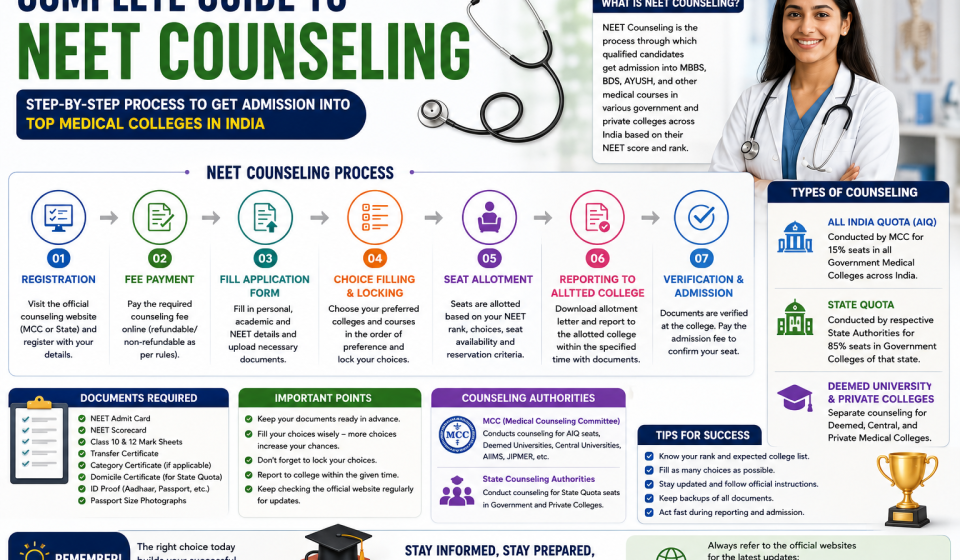
Complete Guide to NEET Counseling 2026: Step-by-Step Process, Registration, Choice Filling, Seat Allotment & Admission

The counseling process that follows plays an equally important role in determining which college and course a candidate ultimately receives.
The National Eligibility cum Entrance Test (NEET) is the gateway to undergraduate medical and dental education in India. Every year, millions of students appear for the examination with the dream of securing admission to prestigious medical colleges across the country. However, qualifying for NEET is only the first step in the journey. Understanding the NEET counseling process thoroughly can significantly improve a student’s chances of securing a desired seat. NEET counseling is a structured process through which eligible candidates are allotted seats in medical, dental, AYUSH, and other healthcare-related courses based on their NEET scores, rank, category, preferences, and seat availability. Since the counseling procedure involves multiple stages such as registration, choice filling, seat allotment, document verification, and admission confirmation, students must stay informed about each step. This complete guide explains everything about NEET counseling, helping candidates navigate the process confidently and avoid common mistakes.
What is NEET Counseling?
NEET counseling is the centralized admission process conducted for allocating seats in MBBS, BDS, BAMS, BHMS, BUMS, BSMS, and other healthcare programs offered by medical institutions across India. The counseling process ensures that admissions are carried out transparently and based on merit.
The counseling process is conducted after the declaration of NEET results and includes multiple rounds of seat allocation. Candidates participate in counseling based on their rank and eligibility criteria.
Who Conducts NEET Counseling?
Different authorities conduct counseling for various categories of seats.
Medical Counseling Committee (MCC)
The Medical Counseling Committee conducts counseling for:
15% All India Quota (AIQ) seats
Deemed Universities
Central Universities
ESIC Colleges
AFMS Institutions
AIIMS
JIPMER
State Counseling Authorities
Individual states conduct counseling for:
85% State Quota seats
Private medical colleges
State government medical colleges
State-specific institutions
Students can participate in both All India and State counseling if eligible.
Types of Seats Available Through NEET Counseling
Understanding seat categories helps candidates make informed decisions.
All India Quota Seats
15% of government medical college seats are reserved under the All India Quota.
Benefits include:
Access to colleges across India
Higher flexibility in college selection
Centralized counseling process
State Quota Seats
85% of seats in government medical colleges are reserved for state domicile candidates.
These seats generally offer better opportunities for local students.
Deemed University Seats
Deemed universities conduct admissions through MCC counseling based on NEET scores.
Central University Seats
Institutions such as BHU and AMU offer seats through centralized counseling.
AIIMS and JIPMER Seats
Admissions to AIIMS and JIPMER institutions are also conducted through NEET counseling.
Eligibility for NEET Counseling
Candidates must fulfill certain requirements to participate in counseling.
General Eligibility Criteria:
Qualified NEET examination.
Obtained minimum qualifying percentile.
Fulfilled age requirements.
Met eligibility conditions prescribed by respective institutions.
Possessed required academic qualifications.
Meeting eligibility criteria does not guarantee admission but allows participation in counseling.
NEET Counseling Process Step-by-Step
Step 1: Registration
Candidates must register online through the counseling portal.
During registration, students provide:
Personal details
NEET roll number
Application number
Contact information
Category details
Accurate information is essential to avoid complications later.
Step 2: Payment of Counseling Fee
After registration, candidates must pay counseling and security fees.
Payment options generally include:
Debit card
Credit card
Net banking
UPI
Digital payment gateways
Fee structures vary depending on institution categories.
Step 3: Choice Filling
Choice filling is one of the most critical stages of counseling.
Candidates select:
Preferred colleges
Preferred courses
Institution priorities
Students should research colleges thoroughly before making selections.
Step 4: Choice Locking
After finalizing preferences, candidates must lock their choices before the deadline.
Once locked, choices generally cannot be modified.
Step 5: Seat Allotment
Authorities process allotments based on:
NEET rank
Category
Reservation criteria
Seat availability
Candidate preferences
The allotment result determines the institution assigned to the candidate.
Step 6: Download Allotment Letter
Candidates receiving seats must download the allotment letter from the counseling portal.
This document is required during admission and verification procedures.
Step 7: Reporting to College
Candidates must report to the allotted institution within the specified timeframe.
Failure to report may result in cancellation of the allotted seat.
Step 8: Document Verification
Colleges verify candidate credentials before confirming admission.
Students should carry all required original documents.
Step 9: Admission Confirmation
After successful verification and fee payment, admission is confirmed.
The candidate officially secures the allotted seat.
NEET Counseling Rounds
NEET counseling generally consists of multiple rounds.
Round 1
Initial seat allocation based on candidate choices and rank.
Round 2
Available seats after Round 1 are filled during the second round.
Candidates may upgrade their allotted seats.
Mop-Up Round
Remaining vacant seats are allocated during the Mop-Up Round.
Stray Vacancy Round
The final stage fills any remaining vacant seats in participating institutions.
Each round provides additional opportunities for admission.
Understanding Choice Filling Strategy
Choice filling significantly impacts seat allotment outcomes.
Important Considerations:
Rank and expected cutoff
College reputation
Location preferences
Fee structure
Infrastructure
Clinical exposure
Faculty quality
Hostel facilities
A balanced list of aspirational, achievable, and safe choices is recommended.
Reservation Policy in NEET Counseling
Reservation policies play a major role in seat allocation.
Common Categories Include:
Scheduled Castes (SC)
Scheduled Tribes (ST)
Other Backward Classes (OBC)
Economically Weaker Sections (EWS)
Persons with Disabilities (PwD)
Each category has designated seat reservations according to government guidelines.
Documents Required for NEET Counseling
Candidates should prepare all required documents in advance.
Essential Documents:
NEET Admit Card
NEET Scorecard
Class 10 Certificate
Class 12 Mark Sheet
Transfer Certificate
Migration Certificate
Identity Proof
Passport-size Photographs
Category Certificate
Domicile Certificate
PwD Certificate (if applicable)
Incomplete documentation can delay admission.
Government Medical Colleges vs Private Medical Colleges
Government Medical Colleges
Lower tuition fees
Strong clinical exposure
High patient inflow
Competitive admissions
Private Medical Colleges
Higher fee structures
Additional seat availability
Modern infrastructure
Flexible admission opportunities
Students should evaluate both options carefully.
Common Mistakes During NEET Counseling
Not registering on time.
Ignoring counseling schedules.
Incorrect choice filling.
Failing to lock choices.
Missing document verification.
Not checking allotment results regularly.
Providing inaccurate information.
Avoiding these mistakes improves admission chances.
How Seat Allotment Works
Seat allotment is based on multiple factors.
NEET rank
Candidate category
Reservation policies
College preference order
Availability of seats
Higher-ranked candidates generally receive priority.
Tips for Successful NEET Counseling
Research colleges thoroughly.
Keep all documents ready.
Monitor official websites regularly.
Understand cutoff trends.
Participate in every eligible counseling round.
Seek guidance when necessary.
Choose colleges strategically.
Stay aware of deadlines.
Preparation and awareness are crucial for success.
NEET Counseling for AYUSH Courses
NEET scores are also used for admission to AYUSH programs.
Courses Include:
BAMS
BHMS
BUMS
BSMS
These courses provide alternative pathways into healthcare professions.
Importance of NEET Counseling
Counseling ensures a fair, transparent, and merit-based admission process. It helps distribute seats efficiently while providing equal opportunities to qualified candidates. Understanding the counseling system enables students to make informed decisions and maximize their chances of securing desirable medical seats.
Future Trends in NEET Counseling
The counseling process continues to evolve with increasing digitization and transparency. Future improvements may include enhanced online systems, better seat allocation mechanisms, real-time vacancy updates, and streamlined verification procedures. These developments aim to make the admission process more efficient and student-friendly.
Source
https://mcc.nic.in
https://neet.nta.nic.in
https://www.nmc.org.in
https://www.education.gov.in
Conclusion
NEET counseling is a crucial stage in the medical admission journey and requires careful planning, timely action, and informed decision-making. From registration and choice filling to seat allotment and document verification, each step contributes to the final admission outcome. Students who understand the counseling process, prepare their documents in advance, monitor official updates, and adopt a strategic approach to choice filling can significantly improve their chances of securing admission to their preferred medical college. Staying informed and proactive throughout the counseling process is the key to achieving success.
FAQ
1. What is NEET counseling?
NEET counseling is the centralized admission process used to allocate seats in medical, dental, and AYUSH courses based on NEET scores and ranks.
2. Who conducts NEET counseling?
The Medical Counseling Committee (MCC) conducts All India Quota counseling, while individual states conduct counseling for state quota seats.
3. Can I participate in both AIQ and State counseling?
Yes, eligible candidates can generally participate in both All India Quota and State counseling processes.
4. How many rounds are conducted in NEET counseling?
Typically, counseling includes Round 1, Round 2, Mop-Up Round, and Stray Vacancy Round.
5. What documents are required for counseling?
Candidates need their NEET scorecard, admit card, academic certificates, identity proof, photographs, and category certificates if applicable.
6. What happens if I do not report after seat allotment?
Failure to report within the specified deadline may result in cancellation of the allotted seat.
7. Can I upgrade my seat during counseling?
Yes, candidates may be eligible for seat upgradation in subsequent counseling rounds depending on availability and rules.
8. Is NEET counseling mandatory for MBBS admission?
Yes, qualifying candidates must participate in counseling to secure admission to MBBS and other eligible medical courses.