Ultimate Study Abroad Guide for Indian Students: Admissions, Scholarships, Visa Process, Costs & Career Opportunities

Studying abroad has become a dream for millions of Indian students who aspire to gain a world-class education, international exposure, and better career opportunities.
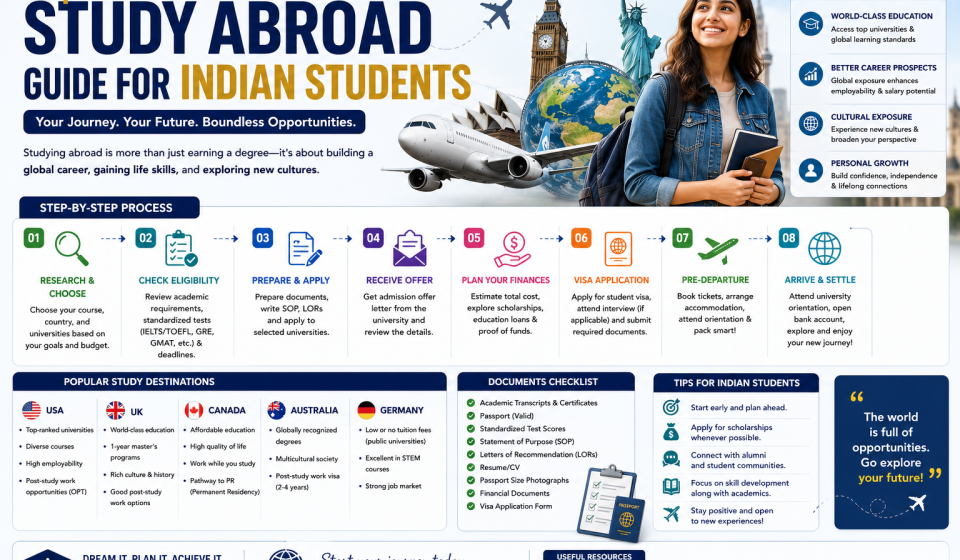
With globalization transforming education and employment markets, students are increasingly choosing universities in countries such as the United States, Canada, the United Kingdom, Australia, Germany, New Zealand, and Ireland. International education not only provides access to advanced academic programs but also helps students develop global perspectives, cultural awareness, and valuable professional skills that are highly sought after by employers worldwide. However, the journey of studying abroad involves much more than simply applying to a university. Students must carefully research countries, select suitable programs, prepare for entrance examinations, arrange finances, apply for scholarships, obtain student visas, and adapt to a new environment. Understanding every step of the process can make the transition smoother and increase the chances of success. This comprehensive study abroad guide for Indian students covers everything from choosing a destination and applying to universities to managing expenses and building a successful international career.
Why Study Abroad?
Studying abroad offers numerous academic, personal, and professional benefits that can significantly enhance a student’s future prospects.
Some key advantages include:
Access to globally recognized universities
Exposure to advanced teaching methods
International career opportunities
Development of communication skills
Cultural diversity and global networking
Research and innovation opportunities
Higher earning potential
Personal growth and independence
An international degree often provides a competitive edge in today’s global job market.
Popular Study Abroad Destinations for Indian Students
United States
The United States remains one of the most preferred destinations for international students.
Advantages:
Top-ranked universities
Wide range of courses
Strong research opportunities
Excellent career prospects
Popular Universities:
Harvard University
Stanford University
Massachusetts Institute of Technology
University of California System
Carnegie Mellon University
Popular Fields:
Computer Science
Engineering
Business
Data Science
Medicine
Artificial Intelligence
Canada
Canada has become increasingly popular among Indian students due to affordable education and favorable immigration policies.
Benefits:
High-quality education
Post-study work opportunities
Safe environment
Multicultural society
Popular Institutions:
University of Toronto
University of British Columbia
McGill University
University of Alberta
University of Waterloo
United Kingdom
The UK offers globally respected degrees and shorter course durations.
Advantages:
Prestigious universities
Strong academic reputation
One-year master’s programs
Post-study work visa opportunities
Popular Universities:
University of Oxford
University of Cambridge
Imperial College London
University College London
University of Edinburgh
Australia
Australia attracts students with its quality education system and excellent lifestyle.
Benefits:
Globally recognized degrees
Work opportunities during studies
Strong job market
Research-focused education
Popular Institutions:
University of Melbourne
Australian National University
University of Sydney
Monash University
University of Queensland
Germany
Germany is known for affordable education and strong engineering programs.
Advantages:
Low or no tuition fees at public universities
Strong industrial connections
High-quality technical education
Research opportunities
Popular Fields:
Engineering
Computer Science
Automotive Technology
Business
Applied Sciences
Ireland
Ireland has emerged as a leading destination for technology and business education.
Benefits:
Growing technology sector
English-speaking environment
Strong employment opportunities
Welcoming international community
How to Choose the Right Country
Choosing the right destination depends on several factors.
Students should consider:
Academic goals
Course availability
Tuition fees
Living expenses
Scholarship opportunities
Visa policies
Post-study work options
Employment prospects
Language requirements
Quality of life
Careful research helps students make informed decisions.
Selecting the Right Course
Course selection should align with career aspirations and personal interests.
Popular Courses Among Indian Students:
Computer Science
Artificial Intelligence
Business Administration
Engineering
Data Science
Medicine
Finance
Law
Cybersecurity
Digital Marketing
Choosing a course with strong industry demand can improve future career opportunities.
Eligibility Requirements
Eligibility criteria vary by country and institution.
Common Requirements Include:
Academic transcripts
English language proficiency scores
Letters of recommendation
Statement of purpose
Resume or CV
Passport
Financial documents
Certain programs may require additional examinations or interviews.
English Language Proficiency Tests
Most international universities require proof of English language proficiency.
Popular Tests:
IELTS
TOEFL
PTE Academic
Duolingo English Test
Students should verify score requirements for their target institutions.
Standardized Entrance Examinations
Some universities and programs require standardized test scores.
Common Exams Include:
SAT
ACT
GRE
GMAT
MCAT
LSAT
Preparation for these exams should begin well in advance.
Application Process for Studying Abroad
Research Universities
Students should create a shortlist of universities based on rankings, programs, costs, and career outcomes.
Prepare Required Documents
Common documents include:
Academic transcripts
Test scores
Statement of Purpose
Letters of Recommendation
Passport
Resume
Financial documents
Submit Applications
Applications are generally submitted through university portals or centralized admission systems.
Receive Admission Decisions
Universities evaluate applications and issue offer letters to selected candidates.
Accept the Offer
Students must confirm acceptance and fulfill admission requirements.
Understanding the Statement of Purpose (SOP)
The SOP is one of the most important components of an international application.
An effective SOP should explain:
Academic background
Career goals
Reasons for choosing the course
Reasons for selecting the university
Future aspirations
A strong SOP can significantly improve admission chances.
Importance of Letters of Recommendation
Recommendation letters provide insights into a student’s abilities and character.
They are typically written by:
Teachers
Professors
Employers
Supervisors
Strong recommendations enhance application credibility.
Scholarships for Indian Students
Scholarships can reduce financial burdens significantly.
Popular Scholarships Include:
Fulbright-Nehru Scholarships
Chevening Scholarships
Commonwealth Scholarships
Erasmus Mundus Scholarships
Australia Awards Scholarships
DAAD Scholarships
University-specific scholarships
Students should apply early because scholarship competition is often intense.
Cost of Studying Abroad
Major expenses include:
Tuition fees
Accommodation
Food
Transportation
Health insurance
Books and supplies
Personal expenses
Costs vary significantly depending on country, institution, and lifestyle.
Education Loans for International Studies
Many Indian students finance education through loans.
Loan Providers Include:
Nationalized banks
Private banks
Non-banking financial institutions
International lenders
Students should compare interest rates and repayment terms carefully.
Student Visa Process
Obtaining a student visa is a crucial step.
General Visa Requirements:
Valid passport
University admission letter
Financial proof
Medical examinations
Visa application forms
Photographs
Biometric information
Students should apply well before their course commencement date.
Accommodation Options
Students typically choose from:
University dormitories
Shared apartments
Private rentals
Homestays
University housing often provides convenience and community support for newcomers.
Part-Time Work Opportunities
Many countries allow international students to work part-time during studies.
Benefits Include:
Additional income
Work experience
Professional networking
Skill development
Students should understand local regulations regarding employment.
Adjusting to Life Abroad
Moving to another country can be challenging initially.
Tips for adaptation:
Learn local customs
Improve communication skills
Build social connections
Manage finances responsibly
Maintain a healthy lifestyle
Seek support when needed
Adaptability contributes significantly to a successful international experience.
Career Opportunities After Graduation
Many countries offer post-study work opportunities.
Popular Career Fields:
Information Technology
Healthcare
Engineering
Finance
Consulting
Data Science
Marketing
Research
International education often enhances employability and earning potential.
Challenges Faced by Indian Students Abroad
Common challenges include:
Homesickness
Cultural adjustment
Academic pressure
Financial management
Language barriers
Weather differences
Understanding these challenges helps students prepare effectively.
Benefits of International Exposure
Studying abroad offers much more than academic knowledge.
Students gain:
Global perspectives
Cross-cultural communication skills
Independence
Problem-solving abilities
International networks
Leadership skills
These qualities contribute to long-term professional success.
Future Trends in Overseas Education
The future of international education continues to evolve with technological advancements, hybrid learning models, growing global mobility, and increasing international collaboration. Emerging fields such as Artificial Intelligence, Data Science, Renewable Energy, Cybersecurity, and Biotechnology are attracting students worldwide. As global employers increasingly value international experience, studying abroad will remain a powerful pathway to academic excellence and career advancement.
Source
https://www.educationusa.state.gov
https://www.studyin-canada.com
https://www.britishcouncil.org
https://www.daad.de
Conclusion
Studying abroad is a life-changing experience that provides students with access to world-class education, global exposure, and exceptional career opportunities. While the process involves careful planning, research, financial preparation, and adaptation to new environments, the long-term benefits often outweigh the challenges. By selecting the right country, course, and university, preparing strong applications, securing financial support, and embracing international experiences, Indian students can build successful academic and professional futures. A well-planned study abroad journey can open doors to opportunities that extend far beyond the classroom.
FAQ
1. Which country is best for Indian students to study abroad?
Popular destinations include the United States, Canada, the United Kingdom, Australia, Germany, and Ireland, depending on academic goals and budget.
2. What exams are required for studying abroad?
Common exams include IELTS, TOEFL, PTE, SAT, GRE, GMAT, and other program-specific tests.
3. Can Indian students get scholarships for international education?
Yes, numerous government, university, and private scholarships are available for eligible students.
4. How much does studying abroad cost?
Costs vary by country and institution but generally include tuition fees, accommodation, food, transportation, and personal expenses.
5. Is it possible to work while studying abroad?
Many countries allow international students to work part-time during their studies, subject to visa regulations.
6. What documents are required for overseas university applications?
Students usually need academic transcripts, test scores, SOP, recommendation letters, passport, and financial documents.
7. How long does the student visa process take?
Processing times vary by country, so students should apply several months before their course start date.
8. Does studying abroad improve career opportunities?
Yes, international education often enhances employability, professional skills, global networking, and earning potential.