Soft Skills Every College Student Needs: Essential Abilities for Academic Success, Career Growth, and Professional Excellence

Colleges and universities provide valuable opportunities to develop soft skills through academic projects, extracurricular activities, internships, leadership roles, and community involvement.
In today’s highly competitive academic and professional environment, possessing technical knowledge alone is no longer enough to guarantee success. Employers, educators, and industry leaders increasingly emphasize the importance of soft skills—personal attributes and interpersonal abilities that enable individuals to communicate effectively, collaborate with others, solve problems, and adapt to changing circumstances. For college students preparing to enter the workforce, developing strong soft skills is just as important as earning good grades or acquiring technical expertise. These skills help students build meaningful relationships, perform effectively in teams, and navigate challenges both during college and throughout their careers. Soft skills influence nearly every aspect of personal and professional life. From participating in classroom discussions and delivering presentations to attending job interviews and working in corporate environments, students rely on these abilities to achieve their goals.Understanding and cultivating these essential competencies can significantly improve employability, career advancement, and long-term success. This comprehensive guide explores the most important soft skills every college student needs and provides practical strategies for developing them.
What Are Soft Skills?
Soft skills are personal qualities, behavioral traits, and interpersonal abilities that help individuals interact effectively with others and perform successfully in various situations.
Unlike technical or hard skills, which are job-specific and measurable, soft skills focus on how people communicate, collaborate, manage emotions, and solve problems.
Examples include:
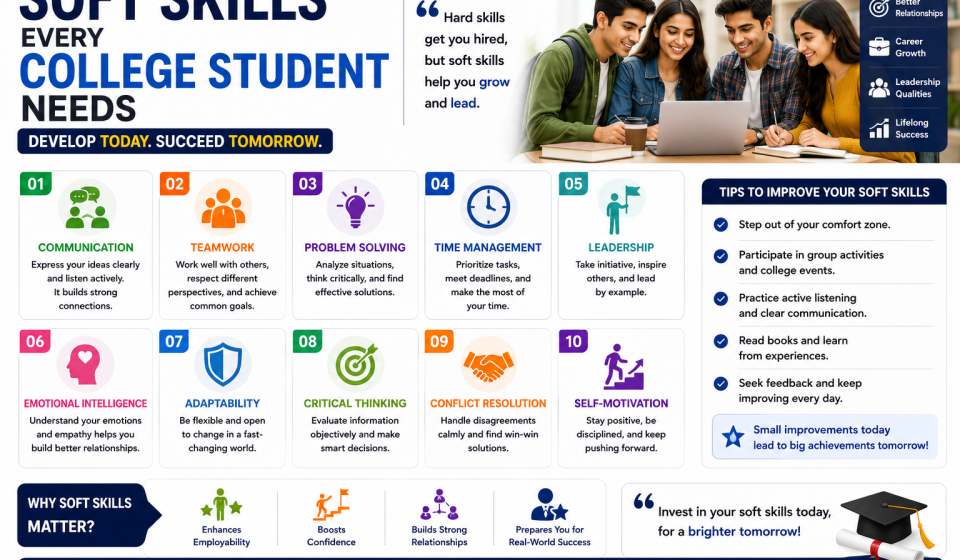
Communication
Leadership
Teamwork
Adaptability
Time management
Problem-solving
Critical thinking
Emotional intelligence
These skills are transferable across industries and professions.
Why Soft Skills Are Important for College Students
Soft skills help students succeed academically, socially, and professionally.
Benefits include:
Improved academic performance
Better teamwork and collaboration
Stronger leadership capabilities
Enhanced employability
Greater confidence
Professional growth opportunities
Effective relationship building
Adaptability in changing environments
Employers consistently rank soft skills among the most desirable qualities in job candidates.
Communication Skills
Communication is one of the most important soft skills for college students.
It involves:
Speaking clearly
Listening actively
Writing effectively
Presenting ideas confidently
Interpersonal communication
Strong communication skills help students participate in discussions, deliver presentations, write assignments, and perform well in interviews.
How to Improve Communication Skills
Practice public speaking.
Participate in group discussions.
Read regularly.
Improve writing abilities.
Seek constructive feedback.
Join debate or communication clubs.
Effective communication builds confidence and credibility.
Time Management
College life often involves balancing academics, extracurricular activities, internships, social commitments, and personal responsibilities.
Time management helps students:
Meet deadlines
Reduce stress
Improve productivity
Maintain work-life balance
Prioritize tasks effectively
Strategies for Better Time Management
Use planners or calendars.
Create daily schedules.
Set realistic goals.
Avoid procrastination.
Break large tasks into smaller steps.
Good time management contributes to academic and professional success.
Teamwork and Collaboration
Most academic and workplace environments require collaboration with others.
Teamwork involves:
Cooperation
Respect
Communication
Shared responsibility
Conflict resolution
Students who work effectively in teams are often better prepared for professional environments.
Benefits of Teamwork
Improved problem-solving
Enhanced creativity
Exposure to diverse perspectives
Better project outcomes
Stronger interpersonal relationships
Group projects and extracurricular activities provide valuable teamwork experience.
Leadership Skills
Leadership is the ability to guide, motivate, and influence others toward achieving common goals.
Leadership opportunities for students include:
Student organizations
Club leadership roles
Volunteer programs
Project management
Event coordination
Characteristics of Effective Leaders
Integrity
Confidence
Responsibility
Decision-making ability
Communication skills
Empathy
Leadership skills are highly valued by employers across industries.
Problem-Solving Skills
Problem-solving involves identifying challenges and finding effective solutions.
Students regularly encounter situations that require analytical thinking and decision-making.
Examples include:
Academic assignments
Research projects
Team conflicts
Technical issues
Workplace challenges
Developing Problem-Solving Skills
Analyze situations carefully.
Consider multiple solutions.
Gather relevant information.
Evaluate outcomes.
Learn from experiences.
Strong problem-solving abilities improve adaptability and innovation.
Critical Thinking
Critical thinking enables students to evaluate information objectively and make informed decisions.
It involves:
Analysis
Reasoning
Evaluation
Logical thinking
Independent judgment
Critical thinkers are better equipped to handle complex situations and make sound decisions.
Benefits of Critical Thinking
Better academic performance
Improved decision-making
Enhanced creativity
Greater intellectual independence
Employers value employees who can think critically and solve problems effectively.
Adaptability and Flexibility
The modern world changes rapidly, requiring individuals to adapt continuously.
Adaptability helps students:
Handle uncertainty
Learn new skills
Adjust to different environments
Embrace change positively
Flexible individuals are often more resilient and successful.
How to Develop Adaptability
Remain open-minded.
Accept feedback.
Learn continuously.
Step outside comfort zones.
View challenges as opportunities.
Adaptability is essential in today’s dynamic workplace.
Emotional Intelligence
Emotional intelligence refers to the ability to understand, manage, and respond effectively to emotions.
Components include:
Self-awareness
Self-regulation
Empathy
Motivation
Social skills
Students with strong emotional intelligence build healthier relationships and manage stress more effectively.
Importance of Emotional Intelligence
Improved communication
Better teamwork
Enhanced leadership
Conflict resolution
Professional success
Emotional intelligence often distinguishes exceptional professionals from average performers.
Decision-Making Skills
Students make decisions daily regarding academics, careers, finances, and personal development.
Effective decision-making requires:
Information gathering
Risk assessment
Critical thinking
Confidence
Responsibility
Strong decision-making abilities contribute to long-term success.
Creativity and Innovation
Creativity involves generating new ideas and approaching challenges from unique perspectives.
Benefits include:
Improved problem-solving
Innovation
Entrepreneurial success
Adaptability
Creative thinking is increasingly valued across industries.
Ways to Enhance Creativity
Explore new experiences.
Engage in brainstorming.
Read diverse materials.
Practice curiosity.
Experiment with new ideas.
Creativity supports personal and professional growth.
Conflict Resolution Skills
Conflicts can arise in academic, social, and professional settings.
Conflict resolution involves:
Active listening
Empathy
Negotiation
Communication
Problem-solving
Students who manage conflicts effectively maintain positive relationships and productive environments.
Networking Skills
Professional networking helps students build valuable relationships.
Networking opportunities include:
Career fairs
Industry events
Alumni interactions
Internships
Benefits of Networking
Career opportunities
Mentorship
Industry insights
Professional growth
Building strong professional connections can significantly impact future success.
Public Speaking Skills
Public speaking is an essential competency for academic and professional environments.
Benefits include:
Increased confidence
Improved communication
Leadership development
Professional credibility
Students can develop public speaking skills through presentations, competitions, and speaking clubs.
Negotiation Skills
Negotiation is useful in various situations, including projects, internships, and professional roles.
Effective negotiators:
Communicate clearly
Listen actively
Seek mutually beneficial solutions
Remain professional
Negotiation skills contribute to successful relationships and outcomes.
Professionalism
Professionalism reflects a person’s attitude, behavior, and work ethic.
Characteristics include:
Responsibility
Reliability
Respect
Integrity
Accountability
Professional behavior creates positive impressions and career opportunities.
Resilience and Stress Management
College students often face academic pressure, career uncertainty, and personal challenges.
Resilience helps individuals:
Recover from setbacks
Manage stress
Maintain motivation
Stay focused on goals
Strategies for Building Resilience
Develop healthy habits.
Seek support when needed.
Practice mindfulness.
Maintain positive relationships.
Learn from failures.
Resilience contributes to long-term success and well-being.
Importance of Soft Skills in Campus Placements
Recruiters evaluate soft skills throughout the hiring process.
Areas assessed include:
Communication
Leadership
Teamwork
Adaptability
Confidence
Problem-solving
Students with strong soft skills often perform better during interviews and workplace interactions.
Soft Skills and Career Advancement
Technical expertise may help secure a job, but soft skills often determine long-term career progression.
Professionals with strong soft skills are more likely to:
Receive promotions
Lead teams
Build professional networks
Manage clients effectively
Navigate organizational challenges
Soft skills play a crucial role in leadership and management positions.
How Colleges Help Develop Soft Skills
Educational institutions provide numerous opportunities for skill development.
Examples include:
Student clubs
Group projects
Internships
Seminars
Workshops
Volunteer activities
Leadership programs
Active participation enhances personal and professional growth.
Future Importance of Soft Skills
As automation, artificial intelligence, and technology continue to transform workplaces, uniquely human abilities such as communication, empathy, creativity, leadership, and emotional intelligence will become even more valuable. Employers increasingly seek individuals who can collaborate effectively, adapt to change, and contribute positively to organizational culture. Students who invest in developing strong soft skills today will be better prepared to succeed in future careers and leadership roles.
Source Links:
https://www.indeed.com/career-advice
https://www.linkedin.com/learning
https://www.coursera.org
https://www.naceweb.org
Conclusion
Soft skills are essential for academic achievement, personal development, and professional success. While technical knowledge and academic qualifications remain important, employers increasingly prioritize communication, leadership, teamwork, adaptability, emotional intelligence, and problem-solving abilities. College students who actively develop these competencies through coursework, extracurricular activities, internships, and real-world experiences gain a significant advantage in today’s competitive environment. By continuously improving soft skills, students can enhance their employability, build meaningful relationships, achieve career growth, and prepare for long-term success in an ever-changing world.
FAQ
1. What are soft skills?
Soft skills are personal and interpersonal abilities such as communication, teamwork, leadership, adaptability, and emotional intelligence that help individuals interact effectively with others.
2. Why are soft skills important for college students?
Soft skills improve academic performance, employability, teamwork, leadership potential, and overall professional success.
3. Which soft skill is most important for students?
Communication skills are often considered the most important because they influence academic, social, and professional interactions.
4. How can students improve their soft skills?
Students can develop soft skills through extracurricular activities, internships, leadership roles, group projects, workshops, and continuous practice.
5. Do employers value soft skills?
Yes, employers consistently rank soft skills among the most important qualities they seek in candidates.
6. What is emotional intelligence?
Emotional intelligence is the ability to understand, manage, and respond effectively to emotions while building positive relationships.
7. Can soft skills help during campus placements?
Absolutely. Recruiters assess communication, leadership, teamwork, adaptability, and confidence throughout the placement process.
8. Are soft skills important for career growth?
Yes, soft skills often determine long-term professional advancement, leadership opportunities, and workplace success.