
Preparing for a college interview can feel exciting and stressful at the same time. Whether you are applying for an undergraduate course, a postgraduate program, a scholarship, or a professional degree, the interview is an important opportunity to present your personality, academic interests, skills, and future goals. A strong interview performance can help the admission team understand who you are beyond your marks and application form.
The good news is that you do not need to memorize perfect answers or become an expert speaker to perform well. With proper research, regular practice, clear communication, and confidence, you can prepare effectively for almost any college interview. This guide explains the most important steps to help you make a positive impression and answer questions naturally.
Understand the Purpose of a College Interview
Before preparing your answers, understand why the college has invited you for an interview. Colleges may use interviews to evaluate your interest in the chosen course, communication skills, academic motivation, personality, achievements, and future plans.
The interviewer may also want to know whether the course and college are suitable for your interests and career goals. In some programs, such as medicine, nursing, teaching, social work, arts, or design, the interview may also assess your practical understanding, empathy, creativity, or professional attitude.
Remember that a college interview is not only a test. It is also a conversation that allows you to learn more about the institution, course structure, campus life, facilities, and career opportunities.
Research the College and Your Chosen Course
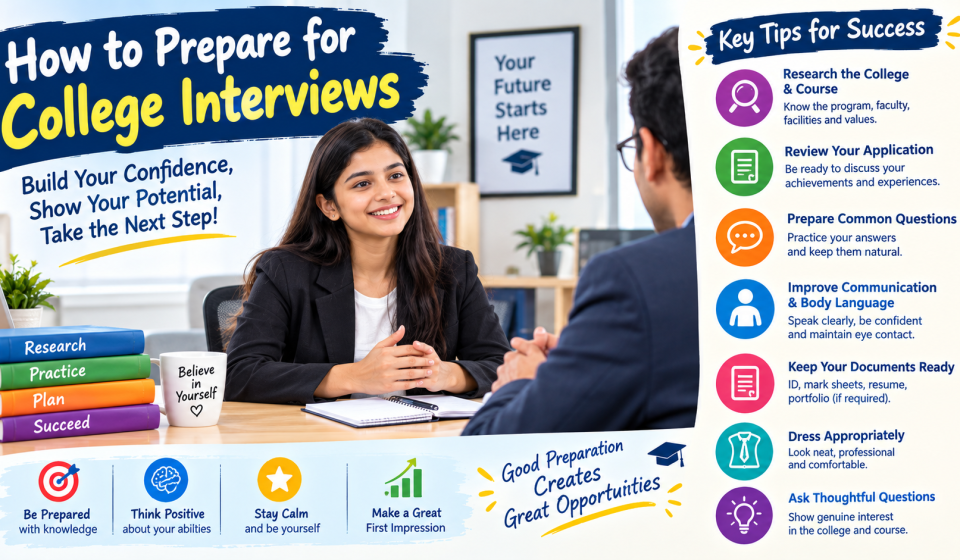
One of the most important college interview preparation tips is to research the institution thoroughly. Interviewers can easily recognize whether a student is genuinely interested in the college or has applied without learning anything about it.
Visit the official college website and collect information about:
- The college’s history, mission, and values
- Your chosen course and its subjects
- Faculty members and teaching methods
- Internship and placement opportunities
- Campus facilities and student activities
- Scholarships and financial support
- Clubs, societies, and extracurricular activities
- Special features that make the college different
You should also understand why you selected the particular course. For example, if you are applying for a Bachelor of Computer Applications, be ready to explain your interest in programming, software development, databases, web development, or technology.
Prepare a clear answer to questions such as:
- Why do you want to study this course?
- Why did you choose this college?
- What do you know about our program?
- How will this course support your career goals?
Your answers should be based on genuine interests rather than statements copied from the college website.
Review Your Application and Academic Background
Many college interview questions are based on information already included in your application, personal statement, resume, or academic records. Therefore, read your application carefully before the interview.
Review your:
- Academic achievements
- Favorite subjects
- Projects and assignments
- Internships or work experience
- Volunteer activities
- Sports and extracurricular activities
- Awards and certificates
- Personal interests and hobbies
- Career goals
Be prepared to explain any important achievement or experience mentioned in your application. For example, if you have listed a college project, the interviewer may ask about your role, the challenges you faced, and what you learned from it.
Do not exaggerate your achievements. Interviewers may ask detailed follow-up questions, and honesty is always better than giving an impressive but inaccurate answer.
Prepare for Common College Interview Questions
Although every college has its own interview style, some questions are frequently asked. Preparing the main points of your answers can help you remain calm and organized.
Common questions include:
Tell Me About Yourself
Prepare a short and clear introduction. Mention your name, educational background, interests, strengths, achievements, and academic goals. Avoid sharing unnecessary personal details.
A simple structure is:
- Your name and current education
- Your academic interests
- Your skills or achievements
- Why you are applying for the course
Why Did You Choose This Course?
Explain what interests you about the subject. You can mention a favorite school subject, a project, a personal experience, or a career goal that influenced your decision.
Why Do You Want to Join Our College?
Talk about specific features of the college, such as its course structure, faculty, facilities, practical learning, student activities, or placement opportunities.
What Are Your Strengths and Weaknesses?
Choose strengths that are relevant to academic life, such as teamwork, discipline, problem-solving, communication, creativity, or time management. When discussing a weakness, explain how you are working to improve it.
What Are Your Future Goals?
You do not need to have your entire career planned. Explain your current interests and how the chosen course may help you develop the knowledge and skills required for your future.
What Is Your Favorite Subject?
Choose a subject you genuinely enjoy and explain why. Be ready to answer basic questions about it.
What Do You Do Outside Your Studies?
Discuss hobbies, sports, reading, volunteering, creative activities, online courses, or other interests. These activities help the interviewer understand your personality and time-management skills.
Practice Your Answers Without Memorizing Them
Practice is one of the best ways to improve your interview confidence. However, avoid memorizing complete answers word for word. Memorized responses can sound unnatural, and you may become nervous if the interviewer asks the question differently.
Instead, prepare important points for each question and practice explaining them in your own words.
You can practice by:
- Speaking in front of a mirror
- Recording your answers on your phone
- Practicing with a friend or family member
- Asking a teacher or mentor for feedback
- Participating in mock interviews
- Practicing answers within a time limit
Try to keep most answers clear and focused. A short answer of one or two minutes is often better than a long response that loses its main point.
During practice, focus on speaking clearly, maintaining a natural tone, avoiding unnecessary filler words, and explaining your ideas confidently.
Improve Your Communication and Body Language
Communication includes more than the words you speak. Your facial expressions, posture, eye contact, hand movements, and tone of voice can also influence the interviewer’s impression.
Follow these communication tips:
- Sit upright and maintain good posture.
- Make comfortable eye contact.
- Smile naturally when appropriate.
- Listen carefully before answering.
- Speak clearly and at a moderate speed.
- Avoid interrupting the interviewer.
- Keep your answers relevant.
- Show interest through your facial expressions.
- Avoid looking at your phone or appearing distracted.
If you do not understand a question, politely ask the interviewer to repeat or explain it. It is better to request clarification than to give an unrelated answer.
If you do not know something, be honest. You can say, “I am not completely sure about that, but I would like to learn more about it.” This shows maturity and a willingness to learn.
Prepare Your Documents and Interview Details
Good preparation also includes organizing practical details. Carefully read the interview invitation and confirm the date, time, location, interview format, and documents required.
For an in-person interview, prepare:
- A copy of your application or resume
- Academic mark sheets or certificates, if required
- Identification documents
- Portfolio or project samples, if applicable
- A notebook and pen
- Interview invitation details
For an online interview, check:
- Your internet connection
- Camera and microphone
- Laptop or phone battery
- Video-conferencing software
- Lighting and background
- Quiet interview space
- Username and display name
Log in early for an online interview. If the interview is in person, plan your travel route and arrive early so that you have enough time to settle down.
Dress Properly and Maintain a Professional Appearance
You do not always need to wear expensive formal clothing for a college interview. The most important things are cleanliness, comfort, and a presentable appearance.
Choose neat and appropriate clothing. Avoid outfits that are too casual, uncomfortable, or distracting. Keep your hairstyle tidy and use simple accessories.
Your appearance should show that you take the interview seriously. At the same time, remain comfortable and authentic. Wearing something that makes you feel confident can help you communicate better.
Prepare Questions to Ask the Interviewer
A college interview is a two-way conversation. At the end, the interviewer may ask whether you have any questions. Saying “no” is not always wrong, but asking thoughtful questions can demonstrate genuine interest.
You may ask:
- What practical learning opportunities are available in this course?
- Are students encouraged to participate in internships?
- What kind of academic support is available?
- Are there clubs or activities related to my subject?
- How does the college help students prepare for careers?
- What qualities do successful students in this course usually have?
- Can you explain more about the course projects or placement support?
Avoid asking questions whose answers are clearly available on the college website. Choose questions that help you understand the student experience and academic opportunities.
Stay Calm and Be Yourself During the Interview
It is normal to feel nervous before a college interview. Instead of trying to eliminate nervousness completely, focus on managing it.
Before the interview, take a few slow breaths, drink water, and remind yourself that the interview is an opportunity to introduce yourself. Listen carefully to every question and take a moment to think before responding.
Do not try to give answers that you believe the interviewer wants to hear. Speak honestly about your interests, goals, experiences, and challenges. Colleges are interested in understanding your potential, not just hearing perfect answers.
If you make a small mistake, do not panic. Correct yourself politely and continue. A calm and positive attitude can leave a better impression than a flawless but artificial performance.
Follow Up After the Interview
After the interview, take a few minutes to reflect on your performance. Think about which questions you answered well and which areas you could improve.
If appropriate, send a short thank-you email to the interviewer or admission team. Thank them for their time and express your continued interest in the college or course.
You can also write down the questions asked during the interview. This will help you prepare better for future interviews, scholarships, internships, or admission processes.
Source Links
- UCAS: How to Prepare for a University Interview — https://www.ucas.com/international/international-students/applying-university-international-student/how-prepare-uni-interview
- Nottingham Trent University: How to Prepare for a University Interview — https://www.ntu.ac.uk/study-and-courses/undergraduate/applying-to-ntu/preparing-for-your-ntu-interview
- University of California, Davis: Interview Questions and How to Prepare — https://careercenter.ucdavis.edu/interviews-and-offers/questions-and-prep
- Cornell Career Network: Prepare for an Interview — https://career.cornell.edu/channels/prepare-for-an-interview/
Conclusion
Preparing for a college interview becomes easier when you follow a clear plan. Research the college and course, review your application, prepare for common questions, practice speaking naturally, organize your documents, and focus on positive body language. Most importantly, be honest and show genuine interest in learning.
A college interview is not only about proving that you are qualified. It is also about showing your motivation, curiosity, personality, and willingness to grow. With consistent practice and the right mindset, you can enter the interview room with greater confidence and make a strong impression.
Frequently Asked Questions
1. How early should I start preparing for a college interview?
Ideally, begin preparing at least one or two weeks before the interview. This gives you enough time to research the college, practice common questions, organize documents, and improve your communication skills.
2. What should I wear to a college interview?
Wear clean, neat, comfortable, and presentable clothing. Smart-casual or formal clothing is usually suitable. Avoid outfits that are too casual, distracting, or uncomfortable.
3. What if I do not know the answer to an interview question?
Stay calm and be honest. You can politely say that you are unsure and would like to learn more. Avoid making up information because the interviewer may ask additional questions.
4. How long should my interview answers be?
Most answers should be clear and focused, usually around one or two minutes. More detailed questions may require longer answers, but avoid unnecessary information.
5. Is it necessary to prepare a self-introduction?
Yes. A self-introduction is one of the most common opening questions. Prepare a short introduction that includes your education, interests, strengths, achievements, and reason for applying.
6. Can I ask questions during a college interview?
Yes. Asking relevant questions is encouraged because it shows that you are interested in the course and college. Prepare two or three thoughtful questions in advance.
7. How can I reduce interview nervousness?
Practice regularly, prepare your documents early, arrive on time, take deep breaths, and focus on listening carefully. Remember that the interviewer wants to understand you, not frighten you.
8. Should I memorize my interview answers?
No. Memorize important points instead of complete sentences. Speaking naturally will make your answers more genuine and help you handle unexpected questions.