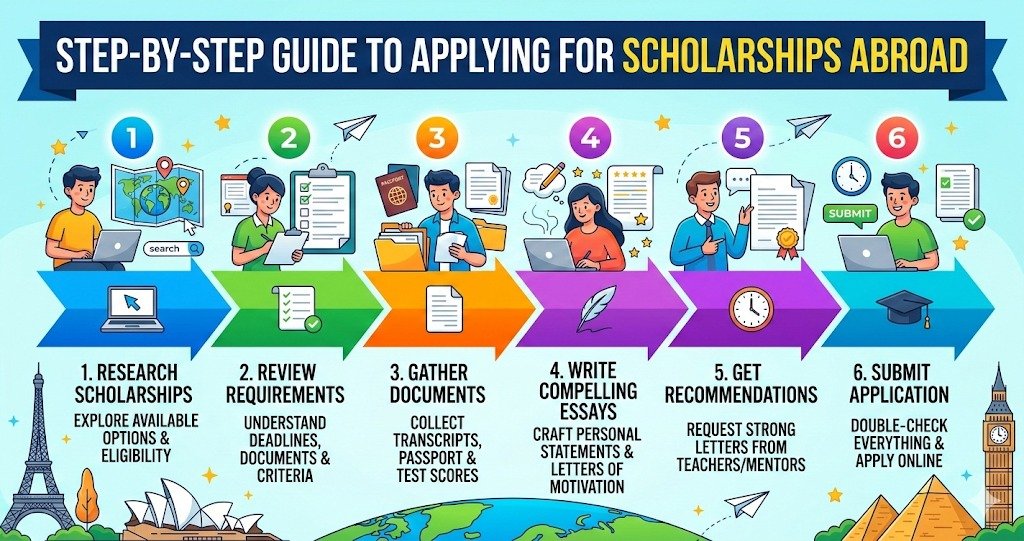
Learn how to apply for scholarships abroad with this complete step-by-step guide. Discover eligibility requirements, documents needed, application tips, and expert advice to increase your chances of getting a fully funded scholarship.
Step-by-Step Guide to Applying for Scholarships Abroad
Studying abroad is a dream for many students, but the cost of tuition, accommodation, and living expenses can make it difficult. Scholarships help students reduce or completely cover these costs. Thousands of international scholarships are available every year for undergraduate, master’s, and PhD programs.
However, many students miss these opportunities simply because they do not know the correct application process.
This guide explains the complete step-by-step process to apply for scholarships abroad, including how to find scholarships, prepare documents, and submit successful applications.
Step 1: Decide Your Study Destination and Course
The first step is choosing which country and course you want to study.
Different countries offer different types of scholarships. Popular destinations for international students include:
- USA
- Canada
- UK
- Australia
- Germany
- Netherlands
When selecting a course, consider:
- Your academic background
- Career goals
- University rankings
- Job opportunities after graduation
Choosing the right course helps you find scholarships that match your profile.
Step 2: Research Available Scholarships
Once you decide your destination, start searching for scholarships.
Scholarships are generally offered by:
- Governments
- Universities
- Private organizations
- NGOs
- International foundations
Common types of scholarships include:
- Fully funded scholarships
- Partial scholarships
- Merit-based scholarships
- Need-based scholarships
- Country-specific scholarships
Always check:
- Eligibility criteria
- Application deadline
- Required documents
- Scholarship benefits
Create a list of scholarships that match your qualifications.
Step 3: Check Eligibility Requirements
Before applying, carefully read the scholarship eligibility requirements.
Typical requirements include:
- Academic performance (GPA or percentage)
- English language proficiency
- Leadership or extracurricular activities
- Work experience (for some programs)
- Specific nationality requirements
Common English language tests include:
- IELTS
- TOEFL
- PTE
Meeting the eligibility criteria increases your chances of getting selected.
Step 4: Prepare Required Documents
Most scholarship applications require several important documents.
Common documents include:
- Academic transcripts
- Degree certificates
- Resume or CV
- Statement of Purpose (SOP)
- Letters of Recommendation (LOR)
- English language test scores
- Passport copy
Make sure all documents are clear, updated, and professionally formatted.
Step 5: Write a Strong Statement of Purpose (SOP)
The Statement of Purpose (SOP) is one of the most important parts of your application.
Your SOP should explain:
- Your academic background
- Why you want to study abroad
- Why you chose that university
- Your career goals
- Why you deserve the scholarship
A strong SOP can significantly increase your chances of winning a scholarship.
Step 6: Request Letters of Recommendation
Most scholarships require 2–3 Letters of Recommendation (LOR).
These letters should be written by:
- Professors
- Academic advisors
- Employers
A good recommendation letter highlights:
- Your academic achievements
- Your leadership qualities
- Your dedication and potential
Always request recommendation letters at least 1–2 months before the deadline.
Step 7: Apply to Universities
Many scholarships require students to first apply to the university program.
Steps include:
- Create a university application account
- Upload required documents
- Pay application fee (if required)
- Submit your application
Once you receive an admission offer, you can proceed with scholarship applications.
Step 8: Submit Scholarship Application
After preparing all documents, submit your scholarship application before the deadline.
Tips for successful submission:
- Follow instructions carefully
- Double-check documents
- Avoid missing information
- Submit early to avoid technical issues
Late or incomplete applications are usually rejected.
Step 9: Prepare for Scholarship Interviews
Some scholarships require an interview.
The interview may focus on:
- Your academic goals
- Leadership skills
- Career plans
- Motivation for studying abroad
Practice common interview questions and prepare confident answers.
Step 10: Track Application Results
After submitting your application, regularly check:
- Email notifications
- Scholarship portals
- University updates
If selected, you will receive an official scholarship offer detailing:
- Tuition coverage
- Living allowance
- Travel expenses
- Insurance benefits
Accept the offer and begin preparing for your study abroad journey.
Common Mistakes to Avoid
Many students lose scholarship opportunities due to simple mistakes.
Avoid these errors:
- Applying after the deadline
- Submitting incomplete documents
- Writing a weak SOP
- Applying for scholarships without checking eligibility
- Not proofreading applications
Proper preparation greatly improves your chances of success.
Conclusion
Applying for scholarships abroad may seem difficult, but with the right preparation and strategy, it becomes much easier. By carefully selecting your destination, researching scholarships, preparing strong documents, and submitting applications on time, you can significantly increase your chances of studying abroad with financial support.
Start researching early, stay organized, and apply to multiple scholarships to maximize your opportunities. With dedication and proper planning, your dream of studying abroad can become a reality.
FAQs
1. When should I start applying for scholarships to study abroad?
You should start searching and preparing scholarship applications at least 12–18 months before your intended study program begins.
2. Can I study abroad with a fully funded scholarship?
Yes, many scholarships cover tuition fees, living expenses, travel costs, and health insurance.
3. Do I need IELTS for scholarships abroad?
Many scholarships require IELTS or TOEFL scores, but some universities offer IELTS-free programs.
4. How many scholarships should I apply for?
It is recommended to apply for at least 5–10 scholarships to increase your chances of success.
5. What GPA is required for international scholarships?
Most scholarships require a minimum GPA of 3.0 or equivalent, but top scholarships may require higher scores.
6. Are scholarships available for undergraduate students?
Yes, many universities and governments offer scholarships for bachelor’s degree programs.
7. Can I apply for multiple scholarships at the same time?
Yes, students are usually allowed to apply for multiple scholarships simultaneously.
8. What is the most important document for scholarship applications?
The Statement of Purpose (SOP) and Letters of Recommendation (LOR) are often the most influential documents.
9. Do scholarships cover living expenses?
Fully funded scholarships typically cover accommodation, food, and daily living costs.
10. How can I increase my chances of getting a scholarship?
You can improve your chances by maintaining good academic scores, writing a strong SOP, participating in extracurricular activities, and applying early.
