
Learn how to prepare for open-book exams with proven study techniques, effective note organization, time management strategies, and exam-day tips. Discover how to maximize your performance and achieve better results.
Many students assume that open-book exams are easier than traditional tests because they allow access to textbooks, notes, and study materials during the exam. However, this assumption often leads to poor preparation and disappointing results.
Open-book exams are designed to test your understanding, analytical skills, critical thinking abilities, and application of concepts rather than simple memorization. Students who enter an open-book exam without proper preparation often struggle with time management and finding information quickly.
To perform well, you need a strategic study plan, organized notes, and a clear understanding of the subject matter. This guide will explain everything you need to know about preparing effectively for open-book exams and maximizing your chances of success.
Understanding Open-Book Exams
Open-book exams allow students to use approved resources during the examination. Depending on the institution, these resources may include:
- Textbooks
- Class notes
- Printed study guides
- Reference materials
- Formula sheets
- Research articles
The primary goal of open-book exams is not to test memory but to evaluate how well students can apply knowledge to solve problems and analyze situations.
Common formats include:
- Case studies
- Problem-solving questions
- Essay questions
- Scenario-based questions
- Data interpretation exercises
Understanding the exam format is the first step toward effective preparation.
Why Open-Book Exams Still Require Serious Preparation
Many students make the mistake of studying less because they can bring materials into the exam room. This approach often backfires.
During an open-book exam, there is rarely enough time to search for every answer. Students who rely entirely on their books spend valuable minutes flipping pages and often fail to complete the paper.
Benefits of proper preparation include:
- Faster answer writing
- Better understanding of concepts
- Improved confidence
- Effective time management
- Higher accuracy
The key is to know where information is located before the exam begins.
Know the Exam Pattern and Requirements
Before creating a study plan, gather details about the examination.
Important questions to ask include:
- What materials are allowed?
- How much time is available?
- What type of questions will appear?
- Is the exam online or offline?
- Are there restrictions on notes?
Review previous question papers if available. Analyzing past exams helps identify recurring themes and commonly tested concepts.
Understanding the pattern allows you to prepare more effectively and prioritize important topics.
Build Strong Conceptual Understanding
Open-book exams reward understanding rather than memorization.
Focus on:
- Understanding theories
- Learning key principles
- Connecting concepts
- Applying knowledge to real-world situations
When studying, ask yourself:
- Why does this concept matter?
- How is it applied?
- What problems can it solve?
- What are its limitations?
Students who understand concepts deeply can answer analytical questions much more effectively than those who rely solely on notes.
Organize Your Study Materials
One of the most important preparation steps is organizing your resources.
Create a system that helps you find information quickly.
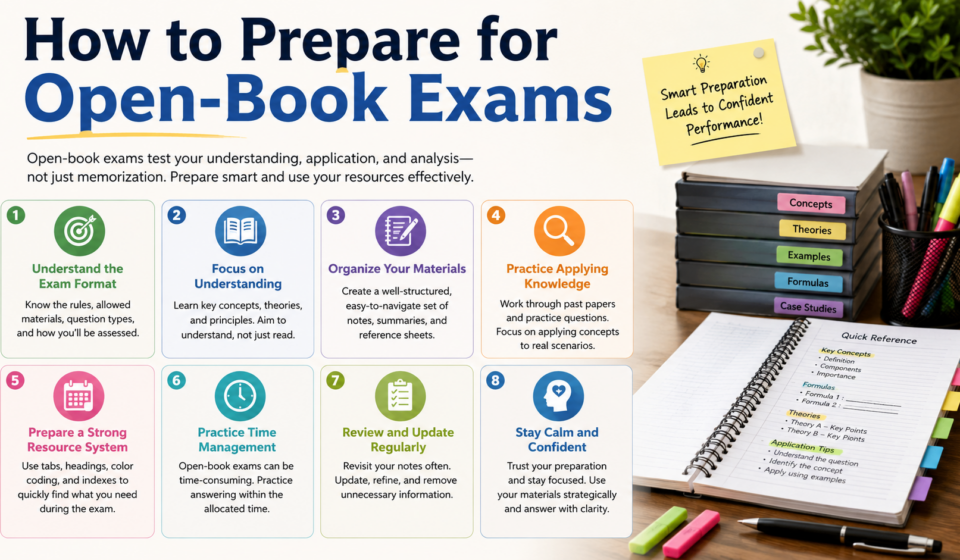
Use Color-Coded Tabs
Mark different sections using colored sticky notes.
Example:
- Blue: Definitions
- Green: Formulas
- Yellow: Case studies
- Pink: Important theories
This reduces search time during the exam.
Create a Topic Index
Prepare a master index containing:
| Topic | Page Number |
|---|---|
| Marketing Concepts | 15 |
| Financial Ratios | 42 |
| Business Ethics | 67 |
| SWOT Analysis | 89 |
An index acts as a roadmap and helps locate information instantly.
Highlight Key Information
Highlight:
- Definitions
- Important formulas
- Models
- Frameworks
- Key examples
Avoid excessive highlighting because it reduces effectiveness.
Prepare Summary Notes
Summary notes are extremely valuable during open-book exams.
Create concise notes covering:
- Major concepts
- Definitions
- Frameworks
- Formula sheets
- Important examples
A good summary sheet allows you to review information quickly without searching through entire textbooks.
Keep summaries clear and easy to scan.
Practice Application-Based Questions
Most open-book exams focus on applying knowledge rather than recalling facts.
Practice questions such as:
- Analyze a case study.
- Recommend a solution.
- Compare two theories.
- Interpret data.
- Evaluate a business strategy.
The more application-based questions you solve, the more confident you become.
Create Quick Reference Sheets
Quick reference sheets save valuable time.
Include:
- Key formulas
- Important dates
- Theories
- Definitions
- Process diagrams
- Frequently used concepts
These sheets should be concise and easy to access.
Think of them as your personal exam navigation tool.
Develop Time Management Skills
Time management often determines exam success.
Many students spend too much time searching for answers.
Try this approach:
First Reading
Spend a few minutes reviewing all questions.
Easy Questions First
Answer questions you know immediately.
Use References Strategically
Only consult materials when necessary.
Reserve Review Time
Keep the last 10–15 minutes for checking answers.
Good time management reduces stress and improves performance.
Practice with Open Materials
Simulate actual exam conditions.
Choose practice questions and complete them using:
- Your textbook
- Notes
- Reference sheets
Time yourself while answering.
This exercise helps you learn:
- Where information is located
- How quickly you can retrieve it
- Which materials are most useful
Practice exams often reveal weaknesses in organization and preparation.
Improve Analytical Thinking
Open-book exams frequently test higher-order thinking skills.
Focus on:
- Analysis
- Evaluation
- Comparison
- Problem-solving
- Decision-making
For example, instead of memorizing a theory, understand:
- Advantages
- Disadvantages
- Applications
- Real-world examples
This deeper understanding helps you answer complex questions effectively.
Learn How to Answer Case Study Questions
Case studies are common in open-book exams.
A strong approach includes:
Identify the Problem
Understand the core issue.
Apply Relevant Concepts
Use theories and frameworks from your course.
Provide Evidence
Support your answer with examples and reasoning.
Recommend Solutions
Offer practical and logical recommendations.
A structured answer usually scores higher than a lengthy but disorganized response.
Avoid Common Open-Book Exam Mistakes
Many students lose marks because of preventable errors.
Over-Reliance on Textbooks
Do not expect to find every answer during the exam.
Poor Organization
Unorganized notes waste time.
Lack of Practice
Preparation remains essential.
Writing Too Much
Focus on quality rather than quantity.
Ignoring Instructions
Always read question requirements carefully.
Avoiding these mistakes can significantly improve your score.
Exam-Day Preparation Tips
Before the exam:
Check Allowed Materials
Verify what resources are permitted.
Organize Everything
Arrange books and notes logically.
Sleep Well
Adequate rest improves concentration.
Arrive Prepared
Keep all materials ready beforehand.
Stay Calm
Confidence helps you think clearly and make better decisions.
A calm and organized approach often leads to better results.
Digital Open-Book Exam Tips
Many institutions now conduct online open-book exams.
For online exams:
- Organize files into folders.
- Use descriptive file names.
- Bookmark important documents.
- Keep reference materials accessible.
- Ensure a stable internet connection.
- Charge devices fully.
Digital organization is just as important as physical organization.
Best Study Plan for Open-Book Exams
2–3 Weeks Before Exam
- Review all topics.
- Create summary notes.
- Organize resources.
1 Week Before Exam
- Practice application questions.
- Build quick-reference sheets.
- Review weak areas.
2–3 Days Before Exam
- Conduct mock exams.
- Refine organization system.
- Focus on high-priority topics.
Exam Day
- Stay calm.
- Follow time limits.
- Use references strategically.
This structured timeline can significantly improve exam performance.
Benefits of Effective Open-Book Exam Preparation
Students who prepare strategically often experience:
- Higher scores
- Better understanding
- Reduced exam stress
- Improved confidence
- Faster answer completion
- Stronger analytical skills
Open-book exams can become an opportunity to demonstrate true knowledge rather than simple memorization.
Sources
https://sl1nk.com/dv0o8ke
https://l1nq.com/unu770m
Conclusion
Open-book exams are not easier than traditional exams—they simply require a different approach. Success depends on understanding concepts, organizing materials effectively, practicing application-based questions, and managing time wisely.
Rather than relying on textbooks during the exam, focus on building a strong foundation of knowledge and creating a system that allows you to access information quickly when needed. With proper preparation, open-book exams can become an excellent opportunity to showcase your critical thinking and problem-solving abilities.
Students who combine conceptual understanding with organized study materials are far more likely to achieve excellent results and perform confidently under exam conditions.
Frequently Asked Questions (FAQs)
What is an open-book exam?
An open-book exam allows students to use approved study materials such as textbooks, notes, and reference guides while answering questions.
Are open-book exams easier than closed-book exams?
Not necessarily. Open-book exams often focus on analysis, critical thinking, and application of concepts, making them challenging in different ways.
How should I study for an open-book exam?
Focus on understanding concepts, organizing notes, creating summaries, and practicing application-based questions rather than memorizing information.
Can I rely entirely on my textbook during the exam?
No. Searching for every answer wastes time. You should already understand the material and use references only when needed.
What should I bring to an open-book exam?
Bring all permitted materials, including textbooks, notes, summary sheets, formula sheets, and organized reference guides.