
Learn how to study efficiently in a library with proven strategies for better focus, time management, note-taking, and productivity. Discover practical tips to make every library session more effective.
Libraries have long been one of the best environments for learning and academic success. Whether you are a high school student, college student, competitive exam aspirant, or lifelong learner, a library offers a distraction-free atmosphere that can significantly improve concentration and productivity.
However, simply sitting in a library does not guarantee effective studying. To truly benefit from the library environment, you need the right strategies, study techniques, and habits. Understanding how to study efficiently in a library can help you retain information better, complete assignments faster, and achieve your academic goals.
In this guide, we will explore practical methods to maximize your library study sessions and make every hour count.
Why Studying in a Library Is Effective
Libraries are specifically designed to support learning and concentration. Unlike studying at home, where distractions such as television, social media, or household activities can interfere with focus, libraries provide a dedicated space for academic work.
Some benefits of studying in a library include:
- Quiet and distraction-free environment
- Access to books, journals, and research materials
- Better concentration and focus
- Increased motivation from being surrounded by other learners
- Availability of study rooms and resources
- Improved study discipline and routine
These advantages make libraries an ideal location for productive studying.
Set Clear Study Goals Before Arriving
One of the biggest mistakes students make is entering the library without a plan.
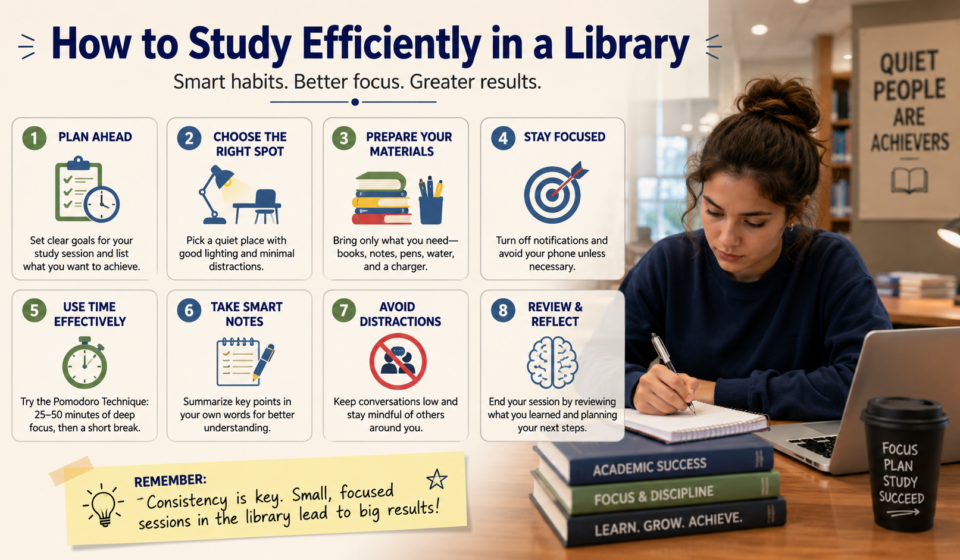
Before your study session, define exactly what you want to accomplish. Clear goals help you stay focused and avoid wasting time.
Examples of study goals include:
- Completing two chapters of a textbook
- Reviewing lecture notes
- Solving 30 mathematics problems
- Writing an essay draft
- Preparing for an upcoming exam
Having a specific objective provides direction and improves efficiency.
Choose the Right Study Spot
Your study location inside the library can significantly affect your productivity.
Different areas serve different purposes:
Quiet Zones
Ideal for:
- Reading
- Exam preparation
- Memorization
- Deep concentration tasks
Group Study Areas
Best for:
- Project discussions
- Team assignments
- Collaborative learning
Individual Study Cubicles
Perfect for:
- Long study sessions
- Online learning
- Research-intensive work
Select a space that matches your study needs to maximize concentration.
Organize Your Study Materials
Arriving prepared saves valuable time.
Bring only the materials you need, such as:
- Textbooks
- Notebooks
- Pens and highlighters
- Laptop or tablet
- Charger
- Water bottle
- Study planner
A clutter-free workspace reduces distractions and helps maintain focus.
Use the Pomodoro Technique
The Pomodoro Technique is one of the most effective study methods for maintaining concentration.
The process is simple:
- Study for 25 minutes.
- Take a 5-minute break.
- Repeat four times.
- Take a longer 15–30-minute break.
This method prevents mental fatigue and improves productivity throughout your library session.
Benefits include:
- Better concentration
- Reduced procrastination
- Improved time management
- Increased motivation
Eliminate Digital Distractions
Smartphones are among the biggest obstacles to productive studying.
To stay focused:
- Turn off unnecessary notifications
- Use “Do Not Disturb” mode
- Keep your phone in your bag
- Use website blockers if needed
- Avoid social media during study sessions
Research consistently shows that minimizing interruptions improves learning and information retention.
Create a Study Schedule
A structured schedule keeps your study session organized.
Example:
| Time | Activity |
|---|---|
| 9:00–10:00 AM | Review lecture notes |
| 10:00–10:15 AM | Break |
| 10:15–11:15 AM | Practice problems |
| 11:15–11:30 AM | Break |
| 11:30–12:30 PM | Reading and summarizing |
A schedule helps maintain momentum and ensures balanced progress across subjects.
Take Effective Notes
Good note-taking improves understanding and retention.
Popular note-taking methods include:
Cornell Method
Divide your page into sections for:
- Notes
- Keywords
- Summary
Mind Mapping
Useful for:
- Visual learners
- Complex topics
- Brainstorming sessions
Outline Method
Best for:
- Structured subjects
- Lecture reviews
- Chapter summaries
Choose the technique that matches your learning style.
Utilize Library Resources
Many students overlook valuable library resources beyond books.
Take advantage of:
- Academic journals
- Research databases
- Reference materials
- E-books
- Study guides
- Librarian assistance
These resources can significantly improve the quality of your research and assignments.
Practice Active Learning
Reading passively is often ineffective.
Instead, engage in active learning techniques such as:
Self-Testing
Ask yourself questions about the material.
Teaching Others
Explain concepts as if teaching someone else.
Summarization
Write key ideas in your own words.
Flashcards
Excellent for:
- Vocabulary
- Definitions
- Formulas
- Historical dates
Active learning strengthens memory and understanding.
Stay Hydrated and Maintain Energy
Mental performance depends heavily on physical well-being.
Bring healthy snacks such as:
- Nuts
- Fruits
- Protein bars
- Yogurt
Drink sufficient water throughout your study session.
Avoid excessive consumption of:
- Sugary drinks
- Junk food
- High-caffeine beverages
Balanced nutrition helps maintain energy and concentration.
Take Advantage of Study Rooms
Many libraries offer private study rooms.
These rooms are useful for:
- Group discussions
- Presentation practice
- Online classes
- Interview preparation
If available, reserve study rooms in advance to ensure access.
Review What You Learned
Before leaving the library, spend 10–15 minutes reviewing your work.
Ask yourself:
- What did I learn today?
- Which topics remain difficult?
- What should I study next?
This review process reinforces learning and helps prepare for future study sessions.
Develop Consistent Study Habits
Consistency is more important than occasional intensive studying.
Successful students often:
- Study at the same time each day
- Visit the library regularly
- Follow structured routines
- Set weekly goals
- Track their progress
Over time, these habits improve productivity and academic performance.
Common Mistakes to Avoid While Studying in a Library
Many students unintentionally reduce their efficiency through poor habits.
Avoid these common mistakes:
Studying Without a Plan
Always have clear objectives before starting.
Multitasking
Focus on one task at a time.
Spending Too Much Time on Easy Topics
Balance your attention across all subjects.
Ignoring Breaks
Short breaks improve focus and prevent burnout.
Using Your Phone Frequently
Limit unnecessary screen time during study sessions.
Recognizing these mistakes can help you make better use of library time.
Best Tools for Productive Library Study Sessions
Several tools can improve your study efficiency:
Note-Taking Apps
- Evernote
- Notion
- OneNote
Flashcard Apps
- Anki
- Quizlet
Focus Apps
- Forest
- Focus To-Do
- Freedom
These tools can help organize information, improve concentration, and track progress.
How Libraries Support Academic Success
Libraries play a crucial role in academic achievement by providing:
- Access to quality learning materials
- Quiet study environments
- Research support
- Technology resources
- Learning assistance programs
Students who regularly use library resources often develop stronger study habits and achieve better academic outcomes.
Sources
https://sl1nk.com/xyhd9ee
https://sl1nk.com/zwt4oi1
Conclusion
Studying efficiently in a library is about more than simply finding a quiet place to sit. It requires planning, organization, focus, and effective study techniques. By setting clear goals, choosing the right study environment, using active learning strategies, managing distractions, and maintaining a consistent routine, you can significantly improve your productivity and learning outcomes.
Libraries provide an excellent environment for academic growth, but success depends on how effectively you use the available resources and your study time. With the right approach, every library visit can bring you closer to your educational goals.
FAQs
How long should I study in a library at one time?
Most students benefit from studying in focused sessions of 1–3 hours with regular breaks to maintain concentration and prevent fatigue.
What is the best place to sit in a library for studying?
Quiet zones and individual study cubicles are generally the best options for focused learning and minimizing distractions.
How can I avoid distractions while studying in a library?
Turn off phone notifications, avoid social media, use focus apps, and choose a quiet study area away from busy sections.
Is studying in a library better than studying at home?
For many students, libraries provide fewer distractions, better concentration, and access to academic resources, making them more effective than studying at home.
What should I bring to a library study session?
Bring textbooks, notebooks, pens, a laptop if needed, chargers, water, healthy snacks, and a study plan.