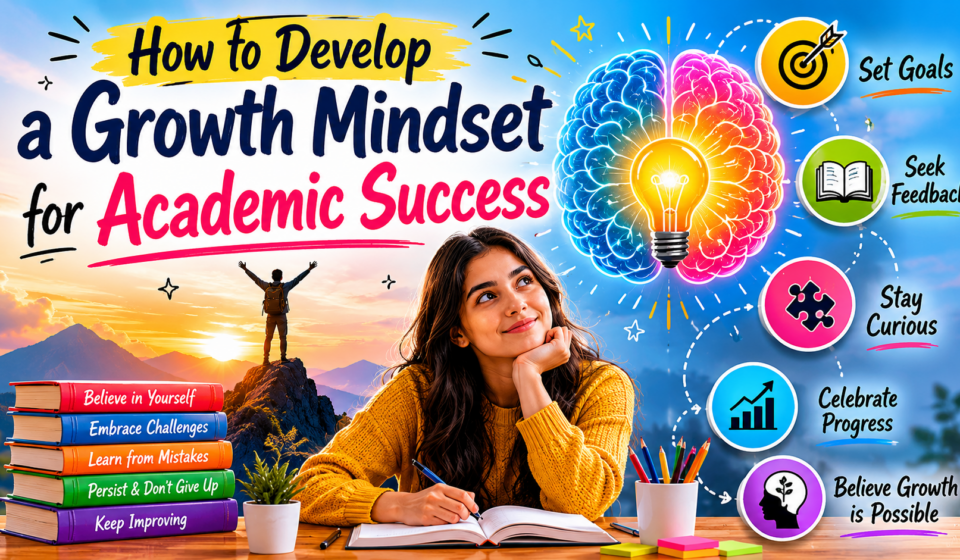

Learn how to develop a growth mindset for academic success. Discover practical strategies, benefits, study techniques, and habits that help students improve learning, overcome challenges, and achieve better academic results.
Academic success is not determined solely by intelligence or natural talent. Many students believe that being smart is something people are born with, but research has shown that abilities can be developed through effort, learning, and persistence. This belief is known as a growth mindset.
A growth mindset helps students view challenges as opportunities to learn rather than obstacles to avoid. It encourages resilience, continuous improvement, and a positive attitude toward learning. Students who develop a growth mindset are more likely to overcome setbacks, stay motivated, and achieve long-term academic success.
In this guide, we will explore what a growth mindset is, why it matters, and practical ways students can develop it to excel in their academic journey.
Understanding the Growth Mindset
The term “growth mindset” was introduced by psychologist Carol Dweck. It refers to the belief that intelligence, abilities, and skills can be developed through dedication, hard work, and effective learning strategies.
Students with a growth mindset believe:
- Intelligence can improve over time.
- Mistakes are opportunities to learn.
- Challenges help them grow.
- Effort leads to improvement.
- Feedback is valuable for development.
On the other hand, students with a fixed mindset believe their abilities are permanent and cannot be significantly changed. They may avoid challenges, fear failure, and give up easily when faced with difficulties.
Why a Growth Mindset Matters for Academic Success
A growth mindset plays a vital role in educational achievement because it influences how students respond to challenges and learning opportunities.
Improves Motivation
Students with a growth mindset are more motivated to learn because they believe their efforts will lead to improvement.
Enhances Problem-Solving Skills
Instead of becoming frustrated by difficult tasks, growth-minded students approach problems with curiosity and determination.
Builds Confidence
As students see progress through consistent effort, their confidence naturally increases.
Encourages Lifelong Learning
A growth mindset promotes continuous learning and adaptability, skills that remain valuable throughout life.
Reduces Fear of Failure
Students learn to see failure as part of the learning process rather than a sign of incompetence.
Signs of a Growth Mindset
You may already have a growth mindset if you:
- Enjoy learning new things.
- Accept constructive criticism.
- Keep trying after setbacks.
- View challenges as opportunities.
- Celebrate progress rather than perfection.
- Learn from mistakes instead of avoiding them.
Recognizing these traits can help you strengthen and expand your growth mindset.
Practical Ways to Develop a Growth Mindset
Embrace Challenges
Many students avoid difficult subjects or assignments because they fear failure. However, growth occurs when you step outside your comfort zone.
Try to:
- Take on challenging assignments.
- Participate in difficult discussions.
- Learn topics that seem complex.
Every challenge is an opportunity to strengthen your skills and understanding.
Change Your Self-Talk
The language you use influences your mindset.
Instead of saying:
- “I can’t do this.”
- “I’m not smart enough.”
Try saying:
- “I can’t do this yet.”
- “I can improve with practice.”
Adding the word “yet” creates room for growth and possibility.
Learn from Mistakes
Mistakes are valuable learning experiences.
When you make an error:
- Analyze what went wrong.
- Identify what you can improve.
- Apply the lesson in future situations.
Successful students understand that mistakes are stepping stones toward mastery.
Focus on the Learning Process
Many students become obsessed with grades. While grades are important, focusing solely on outcomes can create unnecessary stress.
Instead, focus on:
- Understanding concepts.
- Improving study habits.
- Developing critical thinking skills.
- Building knowledge over time.
When learning becomes the priority, better results often follow naturally.
Set Realistic Learning Goals
Goal setting helps maintain motivation and track progress.
Examples include:
- Reading one chapter daily.
- Practicing math problems for 30 minutes.
- Learning five new vocabulary words each day.
- Completing assignments before deadlines.
Small goals create momentum and lead to larger achievements.
Accept Constructive Feedback
Feedback is one of the most powerful tools for growth.
Instead of viewing feedback as criticism, see it as guidance for improvement.
Ask yourself:
- What can I learn from this feedback?
- How can I apply these suggestions?
- What specific areas need improvement?
Students who welcome feedback often experience faster academic growth.
Develop Effective Study Habits
A growth mindset is strengthened when students use effective learning strategies.
Helpful study habits include:
- Creating a study schedule.
- Taking regular breaks.
- Using active recall techniques.
- Practicing spaced repetition.
- Reviewing notes consistently.
Strong study habits support continuous improvement and reinforce the belief that effort leads to success.
Celebrate Progress
Many students only celebrate major achievements, such as high grades or awards.
However, recognizing small improvements can boost motivation.
Celebrate:
- Better test scores.
- Improved understanding of difficult concepts.
- Consistent study habits.
- Completion of challenging tasks.
Acknowledging progress reinforces positive learning behaviors.
Overcoming Common Growth Mindset Challenges
Fear of Failure
Failure is often viewed negatively, but it provides valuable learning opportunities.
Remember:
- Every successful person has experienced setbacks.
- Failure provides feedback.
- Learning comes from trying, not from being perfect.
Comparing Yourself to Others
Comparisons can damage confidence and motivation.
Instead of comparing yourself to classmates, focus on your own progress.
Ask:
- Am I improving?
- What have I learned recently?
- What can I do better next time?
Personal growth is more meaningful than competition.
Lack of Patience
Growth takes time.
Students sometimes expect immediate improvement and become discouraged when results are slow.
Keep in mind:
- Skills develop gradually.
- Consistency matters more than speed.
- Long-term effort produces lasting results.
Patience is an essential component of a growth mindset.
Growth Mindset Strategies for Different Subjects
Mathematics
- Practice regularly.
- Break complex problems into smaller steps.
- Review mistakes carefully.
- Seek help when needed.
Science
- Conduct experiments.
- Ask questions.
- Explore additional resources.
- Connect theories with real-world examples.
Language Learning
- Practice speaking daily.
- Read regularly.
- Expand vocabulary.
- Learn from communication mistakes.
Writing
- Draft and revise your work.
- Accept feedback.
- Read quality content.
- Practice consistently.
Each subject provides opportunities to apply growth mindset principles.
The Role of Teachers and Parents
Teachers and parents play a significant role in developing a student’s mindset.
They can encourage growth by:
- Praising effort rather than intelligence.
- Supporting perseverance.
- Encouraging curiosity.
- Normalizing mistakes as part of learning.
- Providing constructive feedback.
Positive support helps students build confidence and resilience.
Long-Term Benefits of a Growth Mindset
Developing a growth mindset offers advantages beyond academic success.
These benefits include:
- Greater resilience.
- Improved confidence.
- Better problem-solving skills.
- Enhanced adaptability.
- Increased motivation.
- Stronger leadership qualities.
- Lifelong learning habits.
These qualities contribute to success in education, careers, and personal development.
Daily Habits to Strengthen a Growth Mindset
To continuously develop a growth mindset, practice these habits daily:
- Read something educational every day.
- Reflect on lessons learned.
- Set achievable goals.
- Challenge yourself regularly.
- Learn from mistakes.
- Stay curious.
- Seek feedback.
- Practice gratitude for progress.
Small daily actions can create significant long-term growth.
Sources
https://sl1nk.com/iub0rs6
https://sl1nk.com/iiots3o
Conclusion
A growth mindset is one of the most powerful tools students can develop for academic success. By believing that abilities can improve through effort, persistence, and effective learning strategies, students become more resilient, motivated, and confident.
Developing a growth mindset involves embracing challenges, learning from mistakes, accepting feedback, and focusing on continuous improvement rather than perfection. While the journey may require patience and dedication, the rewards are substantial.
Students who cultivate a growth mindset not only perform better academically but also develop essential life skills that support success throughout their personal and professional lives. By making growth a daily habit, every student can unlock their full potential and achieve meaningful academic success.
Frequently Asked Questions (FAQs)
What is a growth mindset in education?
A growth mindset is the belief that intelligence, skills, and abilities can be improved through effort, learning, and persistence rather than being fixed traits.
How does a growth mindset help students succeed academically?
It encourages students to embrace challenges, learn from mistakes, stay motivated, and continuously improve their learning abilities.
Can a growth mindset improve grades?
Yes. Students with a growth mindset often develop better study habits, persistence, and problem-solving skills, which can lead to improved academic performance.
How can parents encourage a growth mindset?
Parents can praise effort, encourage persistence, support learning from mistakes, and focus on progress rather than perfection.
Is a growth mindset useful beyond academics?
Yes. A growth mindset helps individuals develop resilience, adaptability, confidence, and lifelong learning skills that benefit careers and personal growth.