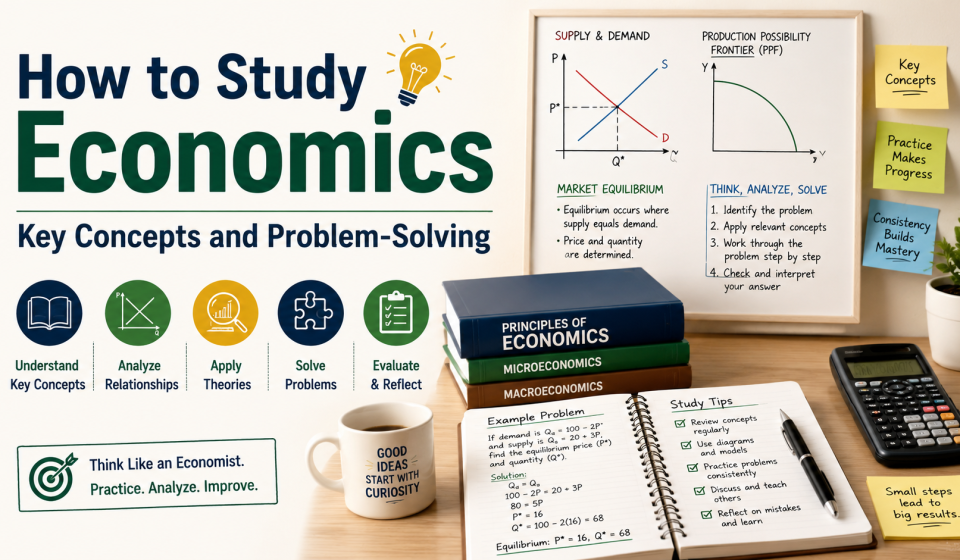

Learn how to study economics effectively with key concepts, practical problem-solving techniques, and study strategies. A complete guide for students to improve understanding and score better in economics exams.
Economics is one of the most fascinating subjects because it helps us understand how individuals, businesses, and governments make decisions about resources, money, and opportunities. Whether it is understanding inflation, unemployment, taxation, or international trade, economics plays a major role in our daily lives.
However, many students find economics challenging because it combines theory, graphs, mathematical calculations, and analytical thinking. Unlike subjects that rely heavily on memorization, economics requires a deep understanding of concepts and the ability to apply them to real-world situations.
The good news is that economics becomes much easier when you focus on understanding core concepts and practice problem-solving regularly. This guide will explain the key concepts of economics and provide practical study techniques that can help students learn more effectively and perform better in exams.
Why Economics Is Important
Economics helps us answer questions such as:
- Why do prices increase?
- How do businesses decide what to produce?
- What causes unemployment?
- How does government spending affect economic growth?
- Why do countries trade with each other?
By studying economics, students develop critical thinking, analytical skills, and decision-making abilities that are valuable in academics and professional careers.
Understanding the Two Main Branches of Economics
Before diving into advanced topics, students should understand the two major branches of economics.
1. Microeconomics
Microeconomics focuses on individual consumers, businesses, and markets. It studies how people make choices and how firms determine prices and production levels.
Key topics include:
- Demand and supply
- Consumer behavior
- Market structures
- Production costs
- Price determination
- Competition and monopoly
For example, when the price of petrol increases, people may reduce their fuel consumption. This relationship between price and consumer behavior is studied in microeconomics.
2. Macroeconomics
Macroeconomics studies the economy as a whole.
Important topics include:
- National income
- Inflation
- Unemployment
- Economic growth
- Monetary policy
- Fiscal policy
For instance, when the government reduces taxes to stimulate spending during an economic slowdown, economists analyze the impact using macroeconomic principles.
Key Concepts Every Economics Student Must Understand
Demand and Supply
Demand refers to the quantity of goods consumers are willing to buy at different prices.
Supply refers to the quantity producers are willing to sell at different prices.
Understanding demand and supply is essential because most economic problems revolve around these concepts.
For example, if the demand for smartphones rises while supply remains constant, prices are likely to increase.
Opportunity Cost
Opportunity cost is the value of the next best alternative that is given up when making a decision.
Suppose a student spends two hours watching a movie instead of studying. The opportunity cost is the study time and potential academic improvement lost.
This concept helps explain decision-making in economics.
Scarcity
Scarcity means resources are limited while human wants are unlimited.
Because resources are scarce, societies must make choices regarding production, consumption, and distribution.
Scarcity forms the foundation of economic theory.
Elasticity
Elasticity measures how much demand or supply changes when factors such as price change.
Products like luxury goods generally have elastic demand, while necessities often have inelastic demand.
Understanding elasticity helps students analyze consumer behavior and market responses.
Inflation
Inflation refers to the general increase in prices over time.
When inflation rises, the purchasing power of money decreases.
For example, if a meal costs ₹100 today and ₹110 next year, inflation has increased the price level.
Gross Domestic Product (GDP)
GDP measures the total value of goods and services produced within a country during a specific period.
It is one of the most important indicators of economic performance.
A rising GDP generally indicates economic growth and increased production.
Effective Strategies for Studying Economics
Focus on Conceptual Understanding
Many students make the mistake of memorizing definitions without understanding their meaning.
Instead of simply remembering that demand decreases when price increases, understand why consumers behave this way.
When concepts are clear, solving problems becomes easier.
Connect Economics with Real-Life Events
Economics is happening around us every day.
Try connecting classroom concepts with current events.
For example:
- Rising fuel prices can help explain inflation.
- Interest rate changes demonstrate monetary policy.
- Government budgets illustrate fiscal policy.
This approach makes learning more engaging and memorable.
Create Summary Notes
Prepare concise notes after each chapter.
Include:
- Important definitions
- Key formulas
- Graph explanations
- Examples
- Diagrams
Short notes are extremely useful during revision periods.
Master Economic Graphs
Graphs are a significant part of economics.
Students should practice drawing:
- Demand curves
- Supply curves
- Cost curves
- Revenue curves
- Aggregate demand and supply curves
Understanding graph movements and shifts can improve exam performance significantly.
Practice Numerical Problems
Many economics topics involve calculations.
Examples include:
- Elasticity calculations
- National income accounting
- Index numbers
- Cost and revenue analysis
Regular practice builds confidence and improves accuracy.
Solve Previous Year Papers
Past exam papers help students understand:
- Question patterns
- Frequently tested concepts
- Time management
- Exam expectations
Students often notice recurring topics that deserve extra attention.
Problem-Solving Techniques in Economics
Step 1: Read Carefully
Many students lose marks because they misunderstand the question.
Identify:
- What is being asked
- Relevant concepts
- Available information
Careful reading prevents unnecessary mistakes.
Step 2: Identify the Economic Principle
Every problem relates to a specific economic concept.
Ask yourself:
- Is this about demand and supply?
- Does it involve inflation?
- Is it a market structure question?
- Is opportunity cost relevant?
Correct identification is the first step toward solving the problem.
Step 3: Use Diagrams When Appropriate
Graphs often provide clearer explanations than lengthy paragraphs.
Whenever possible:
- Draw relevant diagrams
- Label axes correctly
- Explain shifts and movements
Diagrams can help secure additional marks in examinations.
Step 4: Apply Logic
Economics is based on logical relationships.
For example:
If demand increases while supply remains unchanged, prices tend to rise.
By understanding these relationships, students can solve unfamiliar questions more confidently.
Step 5: Support Answers with Examples
Examples make answers stronger and demonstrate understanding.
For instance, when discussing inflation, students can refer to rising food or fuel prices.
Real-world examples often impress examiners and improve answer quality.
Common Mistakes Students Should Avoid
Memorizing Without Understanding
Economics requires comprehension, not rote learning.
Students who only memorize definitions often struggle with application-based questions.
Ignoring Graphs
Graphs are essential in economics.
Skipping graph practice can result in significant mark losses.
Neglecting Current Affairs
Economic events provide practical examples of theoretical concepts.
Reading business news regularly can strengthen understanding.
Avoiding Numerical Questions
Many students fear calculations and focus only on theory.
Balanced preparation should include both theory and numerical practice.
Poor Revision Habits
Economics contains interconnected concepts.
Regular revision helps maintain clarity and prevents confusion.
Sources
https://sl1nk.com/re97piq
https://sl1nk.com/d5ki830
Conclusion
Economics is much more than a subject filled with theories and graphs. It is a practical discipline that explains how the world functions and how decisions affect individuals, businesses, and entire economies. Students can master economics by focusing on conceptual understanding, practicing numerical problems, analyzing graphs, and connecting theories with real-world situations. Consistent study habits, regular revision, and active problem-solving are the keys to success. With the right approach, economics becomes not only easier to understand but also highly rewarding and relevant to everyday life.
FAQs
1. What is the best way to study economics?
The best way is to understand concepts thoroughly, practice graphs and numerical problems regularly, and relate theories to real-life economic events.
2. Is economics more about mathematics or theory?
Economics combines both theory and mathematics. While some topics involve calculations, conceptual understanding is equally important.
3. How can I improve my economics problem-solving skills?
Practice previous exam papers, solve numerical questions regularly, analyze graphs, and focus on applying concepts rather than memorizing them.
4. Why are graphs important in economics?
Graphs visually explain economic relationships and help students understand changes in demand, supply, costs, and overall market behavior.
5. How often should I revise economics topics?
Weekly revision is ideal. Regular review helps reinforce concepts and improves long-term retention.