
Learn how to deal with information overload when studying with practical strategies, time-management techniques, and smart learning habits. Discover effective ways to stay focused, improve retention, and reduce study stress.
In today’s digital age, students have access to more information than ever before. A simple search online can provide thousands of articles, videos, study notes, and tutorials within seconds. While having access to knowledge is beneficial, too much information can sometimes become a problem. Many students struggle with information overload, a situation where the brain receives more information than it can effectively process.
Information overload often leads to confusion, stress, reduced productivity, and difficulty remembering important concepts. Students preparing for board exams, competitive exams, college entrance tests, or professional certifications frequently experience this challenge.
The good news is that information overload can be managed with the right strategies. By learning how to organize study materials, prioritize information, and focus on what truly matters, students can improve their learning efficiency and achieve better academic results.
What Is Information Overload?
Information overload occurs when a person is exposed to more information than they can effectively understand, process, or remember. Instead of helping learning, excessive information can make studying more difficult.
For example, imagine a student preparing for an important exam. They collect multiple textbooks, online notes, YouTube lectures, PDFs, coaching materials, and study guides. Instead of feeling prepared, they become overwhelmed because they do not know where to start or which resource is most important.
This situation often causes mental fatigue and decreases learning effectiveness.
Signs That You Are Experiencing Information Overload
Many students do not realize they are suffering from information overload. Here are some common signs:
- Constantly switching between study resources.
- Difficulty focusing on one topic.
- Feeling stressed or anxious while studying.
- Spending more time collecting materials than studying.
- Forgetting concepts shortly after learning them.
- Feeling overwhelmed before exams.
- Procrastinating because there is too much information to handle.
Recognizing these signs is the first step toward solving the problem.
Why Information Overload Happens
1. Unlimited Online Resources
The internet offers countless educational resources. While this is helpful, students often feel pressured to read everything available, which creates confusion and reduces focus.
2. Fear of Missing Out (FOMO)
Many students worry that they might miss important information if they do not study from every available source. As a result, they collect excessive materials without fully using them.
3. Poor Study Planning
Without a clear study plan, students jump from one topic to another and struggle to prioritize information effectively.
4. Social Media Distractions
Educational content mixed with entertainment content can create constant distractions, making it harder to focus on learning.
Effective Strategies to Deal with Information Overload
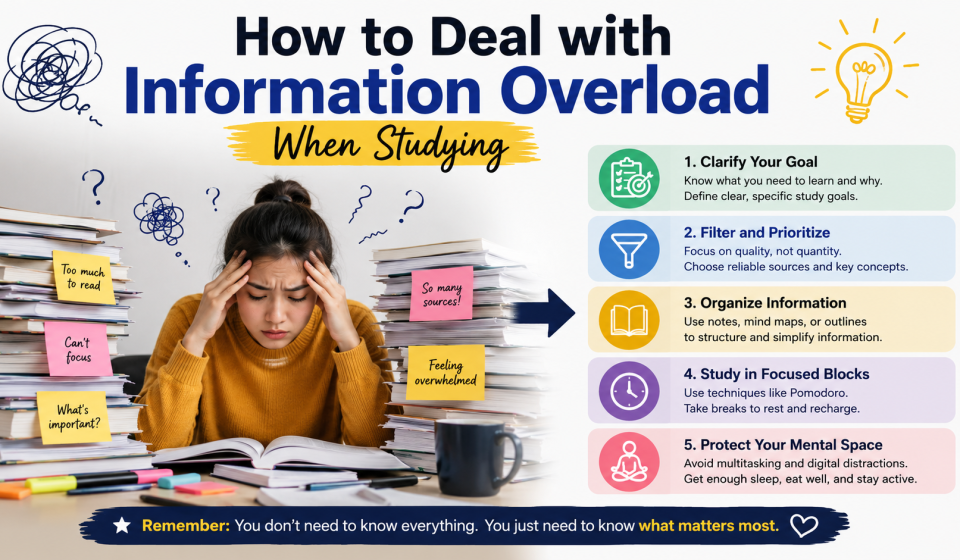
Set Clear Learning Goals
Before starting a study session, define exactly what you want to achieve.
For example, instead of saying, “I will study Biology today,” set a goal such as, “I will complete photosynthesis and respiration chapters today.”
Specific goals help narrow your focus and prevent unnecessary information consumption.
Choose Reliable Study Resources
One of the biggest mistakes students make is using too many resources.
Select:
- One primary textbook
- One trusted reference guide
- One reliable online learning platform
Using fewer high-quality resources is often more effective than using many average-quality resources.
Prioritize Important Topics
Not all information carries the same importance.
Focus on:
- Frequently asked exam topics
- High-weightage chapters
- Core concepts
- Important formulas and definitions
This strategy helps maximize learning efficiency while reducing mental overload.
Create a Study Schedule
A structured study plan helps students stay organized and avoid last-minute stress.
A simple daily study schedule might include:
- 2 hours of focused study
- 25-minute study sessions
- 5-minute breaks
- Revision time at the end of the day
Planning your studies reduces uncertainty and improves productivity.
Use the Pomodoro Technique
The Pomodoro Technique is one of the most effective ways to manage concentration.
Here’s how it works:
- Study for 25 minutes.
- Take a 5-minute break.
- Repeat four times.
- Take a longer break of 15–20 minutes.
This method prevents mental exhaustion and improves focus.
Take Organized Notes
Instead of copying everything, summarize important points in your own words.
Effective note-taking methods include:
- Bullet points
- Mind maps
- Flashcards
- Summary sheets
Organized notes make revision easier and reduce the need to revisit multiple sources.
Practice Active Learning
Many students simply read information repeatedly, which is not always effective.
Active learning involves:
- Solving practice questions
- Teaching concepts to someone else
- Creating summaries
- Self-testing
These techniques improve understanding and long-term memory retention.
Reduce Digital Distractions
Modern students face constant distractions from smartphones, notifications, and social media platforms.
To stay focused:
- Turn off notifications.
- Use focus mode applications.
- Keep your phone away during study sessions.
- Limit social media usage.
Even small reductions in distractions can significantly improve concentration.
Learn to Filter Information
Not every piece of information deserves your attention.
Ask yourself:
- Is this relevant to my exam?
- Will this help me achieve my study goal?
- Is this information from a trustworthy source?
Filtering unnecessary content helps maintain focus and prevents overload.
The Importance of Regular Revision
Many students try to learn new topics continuously without revising previous lessons.
Regular revision:
- Strengthens memory.
- Improves understanding.
- Reduces exam anxiety.
- Prevents forgetting important concepts.
A good strategy is to review key points at the end of each day and revisit major topics weekly.
Real-Life Example
Consider Riya, a college student preparing for competitive exams. Initially, she downloaded dozens of PDFs, watched multiple YouTube channels, and collected countless study materials.
Despite spending many hours studying, she felt overwhelmed and struggled to remember concepts.
After simplifying her approach, she selected one textbook, one coaching resource, and one online platform. She created a study schedule, used the Pomodoro Technique, and revised regularly.
Within a few months, her productivity improved significantly, and she felt more confident about her preparation.
This example shows that studying smarter often produces better results than studying harder.
Maintain a Healthy Lifestyle
Mental performance is closely connected to physical health.
Students should:
- Get 7–8 hours of sleep.
- Stay hydrated.
- Exercise regularly.
- Eat nutritious foods.
- Take short breaks during study sessions.
A healthy lifestyle improves concentration, memory, and overall academic performance.
Sources
https://sl1nk.com/xmi499t
https://sl1nk.com/vi56au3
Conclusion
Information overload has become a common challenge for students in today’s digital world. With countless books, websites, videos, notes, and online resources available, it is easy to feel overwhelmed and lose focus. The good news is that studying smarter is more important than studying harder.
By setting clear learning goals, prioritizing important topics, organizing study materials, using active learning techniques, and limiting distractions, students can manage information effectively. Breaking study sessions into smaller chunks and taking regular breaks also helps improve concentration and memory retention.
Remember, successful studying is not about consuming as much information as possible. It is about understanding, retaining, and applying what truly matters. A focused study plan combined with healthy habits can significantly reduce stress and boost academic performance. Whether you are preparing for school exams, competitive tests, or higher education entrance exams, managing information overload can help you learn more efficiently and achieve better results.
FAQs
1. What is information overload in studying?
Information overload occurs when students receive more information than they can effectively process, understand, or remember, leading to confusion, stress, and reduced productivity.
2. How can I avoid information overload while preparing for exams?
Focus on a study plan, use trusted resources, prioritize important topics, take regular breaks, and avoid collecting too many study materials from different sources.
3. Does information overload affect memory?
Yes. Too much information at once can overwhelm the brain, making it harder to retain and recall important concepts during exams.
4. What is the best study technique to manage large amounts of information?
Techniques such as the Pomodoro Method, active recall, spaced repetition, note summarization, and mind mapping are highly effective for managing information overload.
5. Can social media contribute to information overload?
Absolutely. Constant notifications, endless content consumption, and frequent multitasking can overload the brain and reduce focus during study sessions.