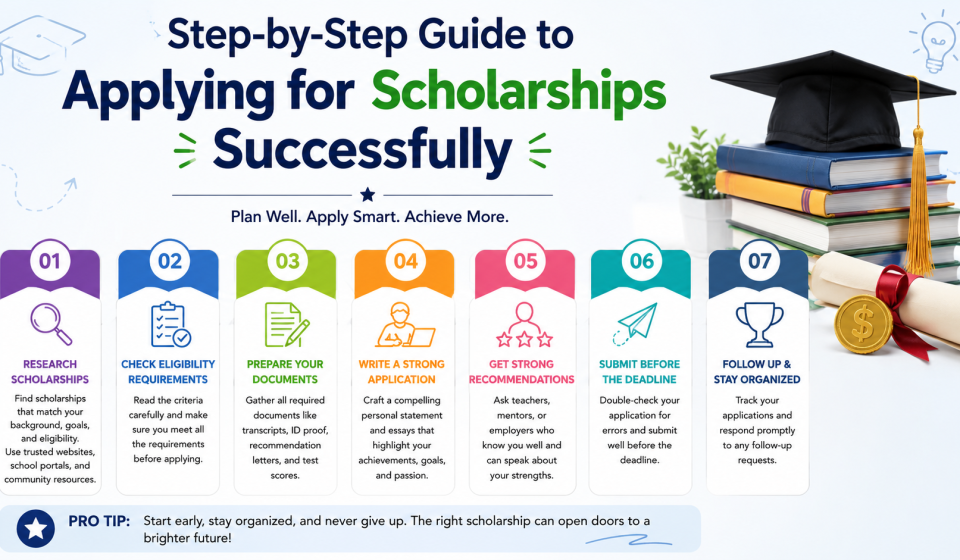

Learn how to apply for scholarships successfully with this complete step-by-step guide. Discover eligibility requirements, application tips, common mistakes to avoid, and expert strategies to improve your chances of winning scholarships.
Scholarships are one of the best ways to reduce the financial burden of education. Whether you are planning to study in India or abroad, scholarships can help cover tuition fees, accommodation costs, books, and other educational expenses. However, many students miss scholarship opportunities because they do not know where to find them or how to apply correctly.
Applying for scholarships may seem complicated at first, but when broken down into simple steps, the process becomes much easier. From researching available scholarships to preparing documents and writing a strong application, every step plays an important role in increasing your chances of success.
This guide will walk you through the complete scholarship application process and provide practical tips to help you secure funding for your education.
Why Scholarships Matter
Scholarships offer more than just financial assistance. They can:
- Reduce student loan debt.
- Allow students to focus more on studies.
- Improve academic and career opportunities.
- Enhance resumes and university applications.
- Reward academic excellence, leadership, and extracurricular achievements.
For many students, scholarships make higher education possible when financial resources are limited.
Step 1: Identify Your Scholarship Goals
Before you start searching, determine what type of scholarship you need.
Consider the following:
- Undergraduate or postgraduate scholarship
- Domestic or international scholarship
- Merit-based scholarship
- Need-based scholarship
- Sports scholarship
- Research scholarship
- Minority or community-specific scholarship
Having a clear goal helps narrow your search and saves time.
Example
A student planning to pursue engineering abroad should focus on STEM scholarships, university-specific awards, and government-funded international scholarships.
Step 2: Research Scholarship Opportunities
The next step is finding scholarships that match your profile.
Where to Search
Government Scholarships
Many governments offer scholarships for deserving students.
Examples include:
- National Scholarship Portal (India)
- State Government Scholarships
- Commonwealth Scholarships
- Fulbright Program
University Scholarships
Most colleges and universities provide:
- Merit scholarships
- Need-based financial aid
- Department-specific scholarships
Visit the university’s official website regularly.
Private Organizations
Many companies, NGOs, and foundations offer scholarships based on academic performance, leadership, or community involvement.
Professional Associations
Industry-specific organizations often support students pursuing careers in their respective fields.
Step 3: Check Eligibility Requirements Carefully
One of the biggest mistakes students make is applying for scholarships without checking eligibility criteria.
Review requirements such as:
- Academic percentage or GPA
- Age restrictions
- Nationality requirements
- Family income limits
- Language proficiency scores
- Specific course requirements
Applying for scholarships where you clearly meet the requirements improves your success rate.
Pro Tip
Create a spreadsheet to track:
- Scholarship name
- Eligibility criteria
- Deadline
- Required documents
- Application status
This helps stay organized throughout the process.
Step 4: Gather Required Documents
Most scholarship applications require supporting documents.
Commonly requested documents include:
Academic Records
- Mark sheets
- Transcripts
- Certificates
Identity Documents
- Aadhaar Card
- Passport
- PAN Card (if applicable)
Income Proof
For need-based scholarships:
- Income certificate
- Salary slips
- Tax returns
Recommendation Letters
Letters from:
- Teachers
- Professors
- Employers
These letters should highlight your strengths, achievements, and potential.
Statement of Purpose (SOP)
An SOP explains:
- Your educational goals
- Career aspirations
- Why you deserve the scholarship
Resume or CV
Include:
- Academic achievements
- Internships
- Volunteer work
- Leadership roles
- Skills and certifications
Preparing these documents in advance helps avoid last-minute stress.
Step 5: Write a Strong Scholarship Essay
Many scholarships require an essay.
This is your opportunity to stand out from thousands of applicants.
What Scholarship Committees Look For
- Clear goals
- Authenticity
- Leadership qualities
- Community involvement
- Future impact
Tips for Writing an Excellent Essay
Be Personal
Share your experiences and challenges.
Tell a Story
Real-life examples make your essay memorable.
Focus on Achievements
Highlight accomplishments without exaggeration.
Show Future Vision
Explain how the scholarship will help achieve your goals.
Proofread Carefully
Grammar and spelling mistakes create a poor impression.
Example
Instead of writing:
“I need financial support.”
Write:
“Coming from a middle-income family, I have learned to balance academic excellence with financial responsibility. This scholarship would allow me to continue pursuing my engineering education while contributing to innovative solutions in renewable energy.”
Step 6: Obtain Strong Recommendation Letters
Recommendation letters significantly influence scholarship decisions.
Choose the Right Recommenders
Select people who know your abilities well, such as:
- Teachers
- Professors
- Mentors
- Supervisors
Give Them Enough Time
Request letters at least 3–4 weeks before the deadline.
Provide Supporting Information
Share:
- Resume
- Scholarship details
- Academic achievements
This helps recommenders write personalized letters.
Step 7: Complete the Application Form Carefully
Many applications are rejected because of avoidable mistakes.
Before Submitting
Double-check:
- Personal details
- Contact information
- Academic records
- Uploaded documents
- Essay responses
Common Mistakes
- Incomplete forms
- Incorrect documents
- Missing signatures
- Wrong file formats
- Late submissions
Attention to detail can make a significant difference.
Step 8: Submit Before the Deadline
Never wait until the last day.
Online systems may experience:
- Technical issues
- Website crashes
- Upload failures
Aim to submit at least one week before the deadline.
Benefits of Early Submission
- Reduces stress
- Allows time for corrections
- Demonstrates professionalism
Many successful scholarship winners submit applications well in advance.
Step 9: Prepare for Scholarship Interviews
Some scholarships include an interview stage.
Common Interview Questions
- Tell us about yourself.
- Why do you deserve this scholarship?
- What are your career goals?
- How will you contribute to society?
Interview Preparation Tips
Research the Organization
Understand the scholarship provider’s mission and values.
Practice Answers
Conduct mock interviews with friends or family.
Dress Professionally
First impressions matter.
Be Honest
Authenticity is more effective than memorized answers.
Step 10: Follow Up and Track Results
After submitting your application:
- Save confirmation emails.
- Monitor your email regularly.
- Check scholarship portals frequently.
Some organizations may request additional documents or clarifications.
Stay Positive
Scholarship selection is highly competitive.
Even if one application is unsuccessful, continue applying to other opportunities.
Many students receive scholarships only after applying multiple times.
Common Scholarship Application Mistakes to Avoid
Applying Without Reading Instructions
Always follow application guidelines carefully.
Missing Deadlines
Late applications are usually rejected automatically.
Using Generic Essays
Customize essays for each scholarship.
Ignoring Smaller Scholarships
Smaller awards often have fewer applicants and better chances of success.
Not Proofreading
Typos and grammatical errors can weaken your application.
Applying to Too Few Scholarships
Increase your chances by applying to multiple scholarships.
Tips to Increase Scholarship Approval Chances
Maintain Strong Academic Performance
Good grades remain an important selection factor.
Participate in Extracurricular Activities
Leadership, volunteering, and community service strengthen applications.
Build a Professional Resume
Keep track of achievements and certifications.
Apply Early
Early applications often receive more attention.
Stay Organized
Use calendars and spreadsheets to manage deadlines.
Develop Strong Communication Skills
Good writing and interview skills can set you apart from other candidates.
Sources
https://sl1nk.com/cpo44ey
https://l1nq.com/x63nj13
Conclusion
Applying for scholarships successfully requires preparation, organization, and persistence. By identifying suitable opportunities, understanding eligibility requirements, preparing strong documents, writing compelling essays, and submitting applications before deadlines, students can significantly improve their chances of receiving financial aid.
Remember that scholarship success rarely comes from a single application. The most successful students apply consistently, learn from their experiences, and continue searching for new opportunities. With dedication and the right strategy, scholarships can help make your educational dreams a reality while reducing financial stress for you and your family.
Frequently Asked Questions (FAQs)
1. When should I start applying for scholarships?
It is recommended to start searching and preparing applications at least 6–12 months before your course begins.
2. Can average students get scholarships?
Yes. Many scholarships consider financial need, leadership skills, extracurricular activities, and community involvement in addition to academic performance.
3. How many scholarships should I apply for?
Apply to as many relevant scholarships as possible. More applications generally increase your chances of receiving funding.
4. What is the most important part of a scholarship application?
A strong combination of academic records, a well-written essay, recommendation letters, and complete documentation usually has the biggest impact.
5. Can I apply for multiple scholarships at the same time?
Yes. Most students apply for multiple scholarships simultaneously to maximize their chances of receiving financial assistance.