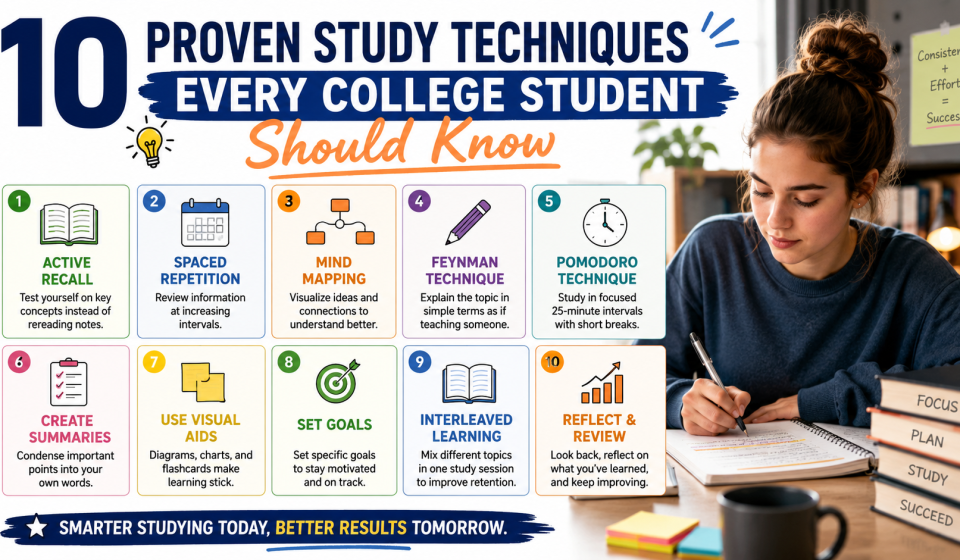

Discover 10 proven study techniques every college student should know. Learn effective study habits, time management tips, active recall, and exam preparation strategies to boost grades.
College life comes with exciting opportunities, new experiences, and academic challenges. Many students struggle to balance coursework, assignments, exams, extracurricular activities, and personal responsibilities. While hard work is important, studying effectively is what truly leads to academic success.
Create a Structured Study Schedule
One of the most effective ways to improve academic performance is by creating a consistent study schedule. Instead of cramming the night before exams, allocate specific times each day for studying.
A study schedule helps you:
- Manage your time effectively
- Reduce procrastination
- Build discipline and consistency
- Cover subjects systematically
Use a planner, calendar, or study app to organize your sessions. Break large tasks into smaller, manageable goals and prioritize difficult subjects when your energy levels are highest.
Use the Pomodoro Technique
The Pomodoro Technique is a time-management method that helps improve focus and productivity.
Here’s how it works:
- Study for 25 minutes without distractions.
- Take a 5-minute break.
- Repeat this cycle four times.
- After four sessions, take a longer break of 15–30 minutes.
This technique prevents mental fatigue and keeps your mind fresh throughout study sessions. It is especially useful for students who struggle with concentration or procrastination.
Practice Active Recall
Active recall is one of the most powerful learning techniques available. Instead of simply rereading notes, actively test your memory.
Examples include:
- Answering practice questions
- Using flashcards
- Covering notes and recalling information
- Explaining concepts from memory
Research shows that retrieving information strengthens memory pathways and improves long-term retention. Active recall forces your brain to work harder, making learning more effective.
Apply Spaced Repetition
Many students forget information shortly after learning it because they don’t review it regularly. Spaced repetition solves this problem by reviewing material at increasing intervals.
For example:
- Review after one day
- Review after three days
- Review after one week
- Review after two weeks
- Review after one month
This technique strengthens memory and reduces forgetting. It’s especially useful for subjects that require memorization, such as biology, history, law, and foreign languages.
Take Effective Notes
Good note-taking helps organize information and improves understanding.
Some popular note-taking methods include:
Cornell Method
Divide your page into sections for notes, cues, and summaries.
Outline Method
Organize information using headings and subheadings.
Mind Mapping
Create visual diagrams that connect ideas and concepts.
Focus on writing key points rather than copying everything word-for-word. Reviewing and summarizing notes shortly after class can significantly improve retention.
Eliminate Distractions
Distractions are one of the biggest obstacles to productive studying. Smartphones, social media, television, and noisy environments can reduce focus and efficiency.
To minimize distractions:
- Turn off unnecessary notifications
- Keep your phone away while studying
- Use website blockers if needed
- Study in a quiet environment
- Inform friends or family when you need uninterrupted time
Creating a distraction-free study environment allows you to concentrate fully and complete tasks more quickly.
Teach What You Learn
One of the best ways to master a topic is by teaching it to someone else. This method is often called the Feynman Technique.
Here’s how to use it:
- Choose a concept.
- Explain it in simple language.
- Identify areas where your explanation is weak.
- Review those areas and simplify again.
Teaching forces you to understand concepts deeply rather than memorizing them. If you can explain a topic clearly to another person, you likely understand it well.
Study in Multiple Formats
Different learning methods engage different parts of the brain. Instead of relying on a single approach, combine various learning formats.
Examples include:
- Reading textbooks
- Watching educational videos
- Listening to podcasts
- Participating in discussions
- Creating diagrams and charts
Using multiple formats can improve understanding and make studying more engaging. It also helps students with different learning preferences absorb information more effectively.
Prioritize Health and Sleep
Many college students sacrifice sleep to study longer, but this often leads to poorer performance. Sleep plays a critical role in memory consolidation and cognitive function.
To support academic success:
- Aim for 7–9 hours of sleep per night
- Stay physically active
- Drink enough water
- Eat balanced meals
- Take regular breaks
A healthy body supports a healthy mind. When you’re well-rested and energized, you’ll learn more efficiently and perform better during exams.
Practice with Past Papers and Mock Exams
Taking practice tests is one of the most effective ways to prepare for exams. It helps you become familiar with question formats and identify knowledge gaps.
Benefits include:
- Improved time management
- Better exam confidence
- Reduced test anxiety
- Stronger understanding of key concepts
Try to simulate real exam conditions by setting a timer and completing practice papers without notes. This approach helps you evaluate your readiness and focus on areas that need improvement.
Why Effective Study Techniques Matter
Many students mistakenly believe that success comes from studying longer hours. In reality, success comes from studying smarter. Effective study techniques improve learning efficiency, reduce stress, and help students retain information for longer periods.
By implementing methods such as active recall, spaced repetition, structured scheduling, and practice testing, students can achieve better academic results without feeling overwhelmed.
Developing these habits during college can also benefit your future career by improving problem-solving skills, discipline, and lifelong learning abilities.
Source
https://shorturl.at/d81Fe
https://shorturl.at/Kmygt
Conclusion
Academic success in college isn’t just about intelligence or effort—it’s about using the right strategies. The 10 proven study techniques discussed in this article can help students learn more effectively, stay organized, and perform better in exams.
Whether it’s creating a study schedule, using active recall, practicing spaced repetition, eliminating distractions, or prioritizing sleep, each technique contributes to better learning outcomes. Start by implementing one or two methods today and gradually incorporate the others into your routine.
With consistency and dedication, these study techniques can transform your academic performance and help you reach your educational goals.
Frequently Asked Questions (FAQs)
1. What is the most effective study technique for college students?
Active recall is widely considered one of the most effective study techniques because it strengthens memory by requiring students to retrieve information rather than simply rereading it.
2. How many hours should a college student study each day?
The ideal study time varies by course and workload, but many experts recommend studying 2–3 hours outside class for every hour spent in class.
3. Is studying at night better than studying in the morning?
It depends on personal preference and productivity levels. Some students focus better in the morning, while others are more productive at night.
4. How can I avoid procrastination while studying?
Creating a study schedule, using the Pomodoro Technique, setting small goals, and eliminating distractions can help reduce procrastination.
5. Why is sleep important for studying?
Sleep helps the brain process and store information. Lack of sleep can negatively affect concentration, memory, and academic performance.