
Looking for the best timetable to score higher marks? Learn how to create an effective study schedule, manage time wisely, improve focus, and achieve better academic results with proven strategies.
Every student dreams of scoring high marks in exams, but achieving that goal requires more than just studying hard. The secret lies in studying smart and following a well-planned timetable. A good timetable helps students manage their time efficiently, reduce stress, improve concentration, and maintain a healthy balance between studies and personal life.
Many students spend long hours studying but fail to achieve their desired results because they lack a structured study plan. On the other hand, students who follow a proper timetable often perform better because they know exactly what to study and when to study it.
In this article, we will discuss the best timetable for students to score higher marks, its benefits, effective time management techniques, and practical tips to maximize study productivity.
Why a Study Timetable Is Important
A study timetable acts as a roadmap for students. It helps organize daily activities and ensures that sufficient time is allocated to every subject.
Benefits of Following a Timetable
- Improves time management skills
- Reduces exam stress and anxiety
- Helps complete the syllabus on time
- Increases productivity and focus
- Ensures regular revision
- Creates discipline and consistency
- Prevents last-minute cramming
Students who follow a timetable are generally more confident during exams because they have prepared systematically.
Characteristics of the Best Study Timetable
An effective timetable should be:
1. Realistic
Avoid creating an unrealistic schedule that requires studying for 12–14 hours daily. Such plans often fail within a few days.
2. Flexible
Unexpected events can occur. Your timetable should allow small adjustments without affecting your overall study goals.
3. Balanced
Include study time, breaks, exercise, meals, sleep, and leisure activities.
4. Goal-Oriented
Set daily and weekly targets for each subject.
5. Personalized
Every student learns differently. Some prefer studying early in the morning, while others perform better at night.
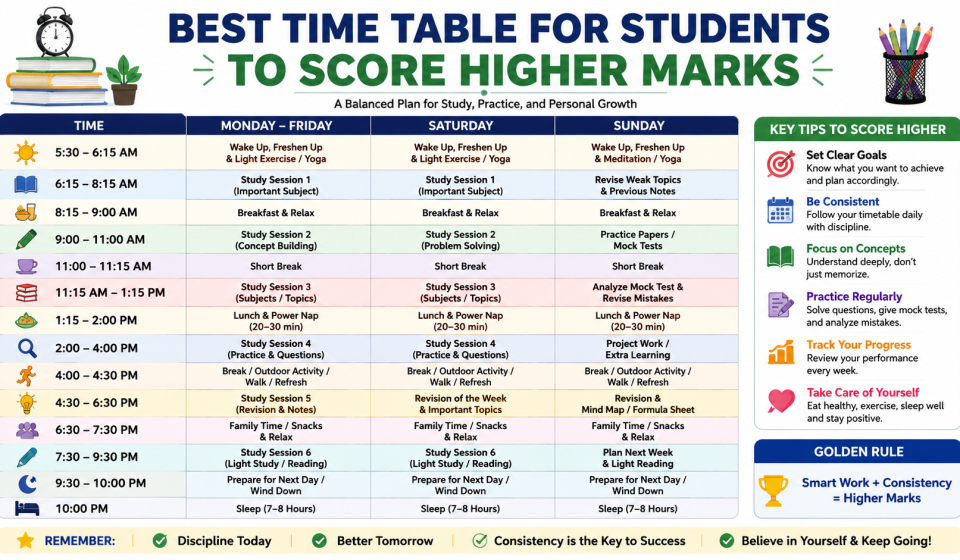
Best Time Table for Students to Score Higher Marks
Morning Study Schedule
5:30 AM – Wake Up
Start your day early. Morning hours are generally peaceful and distraction-free.
5:45 AM – 6:15 AM
Freshen up and do light exercise or meditation.
6:15 AM – 8:15 AM
Study difficult subjects such as Mathematics, Science, or subjects that require analytical thinking.
Morning concentration levels are usually at their highest.
8:15 AM – 9:00 AM
Breakfast and preparation for school or college.
School/College Hours
9:00 AM – 3:00 PM
Attend classes actively.
Tips:
- Take proper notes.
- Ask questions when concepts are unclear.
- Pay attention to important topics.
- Participate in discussions.
Effective classroom learning reduces the burden of self-study later.
Afternoon Schedule
3:00 PM – 4:00 PM
Lunch and relaxation.
Avoid immediately starting studies after returning home.
4:00 PM – 5:30 PM
Complete homework and assignments.
This prevents pending work from piling up.
Evening Schedule
5:30 PM – 6:00 PM
Take a short break or engage in physical activity.
Exercise improves memory and concentration.
6:00 PM – 8:00 PM
Study theory-based subjects such as History, Geography, Literature, or Social Science.
Use active learning techniques:
- Mind maps
- Flashcards
- Summarization
- Note-making
Night Schedule
8:00 PM – 8:30 PM
Dinner break.
8:30 PM – 10:00 PM
Revision session.
Review:
- Topics studied during the day
- Important formulas
- Definitions
- Diagrams
- Key concepts
10:00 PM – 10:30 PM
Plan the next day and relax.
10:30 PM
Sleep.
Students should aim for at least 7–8 hours of quality sleep every night.
Weekly Study Planning Strategy
Instead of focusing only on daily goals, students should also create weekly objectives.
Monday to Friday
- Complete regular studies
- Focus on current syllabus
- Finish assignments
Saturday
- Revise the week’s topics
- Solve sample papers
- Practice difficult questions
Sunday
- Take mock tests
- Analyze mistakes
- Prepare next week’s study plan
Weekly reviews help identify weak areas and improve performance.
Subject-Wise Study Time Allocation
Mathematics
Recommended: 1.5–2 hours daily
Focus on:
- Formula practice
- Problem-solving
- Previous year questions
Science
Recommended: 1.5 hours daily
Focus on:
- Concepts
- Diagrams
- Numerical questions
- Experiments
Languages
Recommended: 1 hour daily
Focus on:
- Grammar
- Vocabulary
- Writing practice
- Reading comprehension
Social Studies
Recommended: 1 hour daily
Focus on:
- Notes
- Maps
- Timelines
- Important events
Allocate more time to subjects where improvement is needed.
Best Study Techniques to Include in Your Timetable
Pomodoro Technique
Study for:
- 25 minutes
- Take a 5-minute break
After four cycles:
- Take a longer 15–20 minute break
This method improves concentration and prevents mental fatigue.
Active Recall
Instead of simply reading, test yourself regularly.
Example:
Read a chapter and then try explaining it without looking at the book.
Spaced Repetition
Revise topics at regular intervals:
- Day 1
- Day 3
- Day 7
- Day 15
- Day 30
This improves long-term memory retention.
Practice Testing
Solve:
- Mock exams
- Sample papers
- Previous year question papers
Practice testing is one of the most effective ways to improve exam performance.
Common Mistakes Students Should Avoid
Studying Without a Plan
Random studying often leads to poor time management.
Ignoring Revision
Learning new topics without revision results in forgetting information quickly.
Excessive Screen Time
Social media and mobile phones can significantly reduce study productivity.
Lack of Sleep
Many students sacrifice sleep before exams, which negatively affects memory and concentration.
Multitasking
Avoid studying while watching TV, using social media, or chatting.
Focus on one task at a time.
Tips to Stay Consistent With Your Timetable
Set Small Goals
Instead of studying an entire book, focus on completing one chapter at a time.
Track Progress
Maintain a study journal or checklist.
Reward Yourself
After achieving study goals, reward yourself with:
- A favorite snack
- A short walk
- Entertainment time
Keep Your Study Area Organized
A clean study environment improves concentration.
Stay Motivated
Remember your long-term academic goals and career aspirations.
Consistency is more important than studying for long hours occasionally.
How Parents Can Support Students
Parents play a crucial role in helping students maintain their timetable.
They can:
- Provide a quiet study environment
- Encourage healthy habits
- Avoid unnecessary pressure
- Appreciate progress
- Monitor screen usage
Positive support boosts a student’s confidence and motivation.
Sources
https://l1nq.com/1jxb46n
https://l1nq.com/9d1jnwy
Conclusion
A well-structured timetable is one of the most powerful tools for academic success. It helps students manage their time efficiently, stay organized, reduce stress, and improve focus. The best timetable is not necessarily the one with the most study hours but the one that balances learning, revision, breaks, exercise, and sleep.
Students should create a realistic schedule based on their strengths, weaknesses, and daily routine. By following a consistent study timetable, practicing active learning techniques, and regularly revising concepts, students can significantly improve their academic performance and score higher marks in exams.
Remember, success is not about studying harder every day—it is about studying smarter and staying consistent.
Frequently Asked Questions (FAQs)
1. What is the best time to study for higher marks?
The early morning hours are generally considered the best because the mind is fresh, alert, and free from distractions.
2. How many hours should a student study daily?
Most students can achieve excellent results by studying 4–6 focused hours daily along with regular school or college attendance.
3. Is it necessary to follow the same timetable every day?
Consistency is important, but your timetable can be adjusted based on exams, assignments, and personal commitments.
4. How often should students revise topics?
Students should revise regularly using spaced repetition, ideally revisiting topics after 1 day, 3 days, 1 week, and 1 month.
5. Can a timetable really improve exam scores?
Yes. A structured timetable improves discipline, ensures syllabus completion, promotes revision, and helps students prepare more effectively for exams.