The Complete Guide to College Admissions in India 2026: Eligibility, Entrance Exams, Admission Process & Expert Tips for Success

Understanding the complete admission process in advance can help students make informed decisions and improve their chances of securing admission to their preferred institutions.
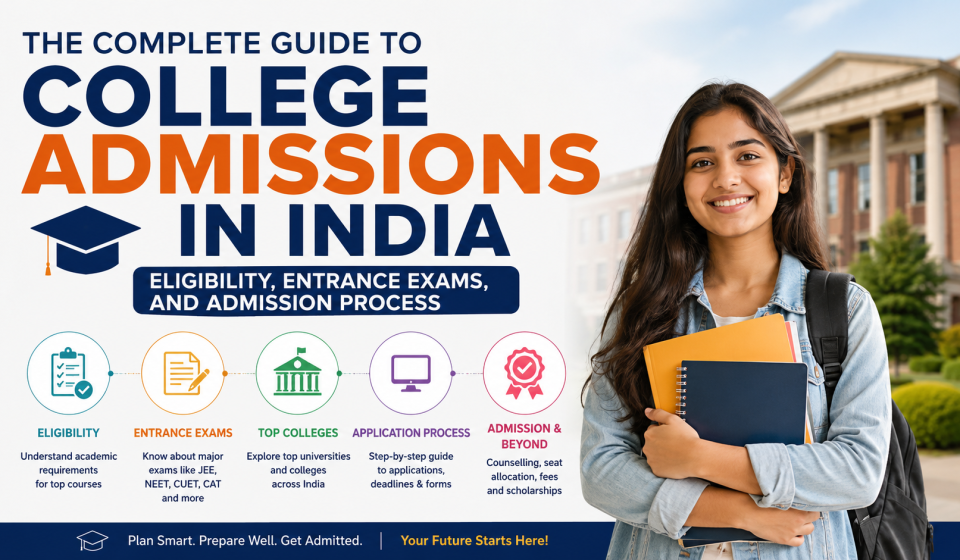
College admission is one of the most important milestones in a student’s academic journey. Every year, millions of students across India complete their Class 12 examinations and begin searching for the best colleges and universities to pursue higher education. With a wide variety of courses, entrance examinations, admission criteria, reservation policies, and counseling procedures, the college admission process can often seem confusing and overwhelming for students and parents alike. Whether you are planning to pursue engineering, medical sciences, management, law, arts, commerce, science, or any other professional course, having a clear understanding of eligibility requirements, entrance exams, application procedures, and counseling rounds is essential. This comprehensive guide explains everything you need to know about college admissions in India, including eligibility criteria, entrance examinations, admission processes, important documents, counseling procedures, and expert tips for successful admission.
Understanding the Indian Higher Education System
India has one of the largest higher education systems in the world. The country offers numerous educational opportunities through central universities, state universities, private universities, deemed universities, institutes of national importance, and autonomous colleges.
Students can choose from various undergraduate programs such as:
- Bachelor of Technology (B.Tech)
- Bachelor of Engineering (B.E.)
- Bachelor of Medicine and Bachelor of Surgery (MBBS)
- Bachelor of Dental Surgery (BDS)
- Bachelor of Business Administration (BBA)
- Bachelor of Commerce (B.Com)
- Bachelor of Arts (BA)
- Bachelor of Science (B.Sc)
- Bachelor of Computer Applications (BCA)
- Bachelor of Law (LLB)
- Bachelor of Design (B.Des)
The admission process varies depending on the institution and course selected.
Eligibility Criteria for College Admissions in India
Eligibility requirements differ from one course and institution to another. However, some common criteria apply to most undergraduate admissions.
Educational Qualification
Students must have successfully completed Class 12 or an equivalent examination from a recognized board such as:
- CBSE
- ICSE
- State Boards
- NIOS
Minimum Percentage Requirements
Many colleges specify minimum marks for admission. For example:
- General courses may require 45% to 60%.
- Professional courses may require 60% to 75%.
- Top institutions often have higher cutoffs.
Subject Requirements
Specific courses require students to have studied certain subjects in Class 12.
Examples:
- Engineering: Physics, Chemistry, Mathematics
- Medical: Physics, Chemistry, Biology
- Commerce: Mathematics or Commerce-related subjects (preferred)
- Arts: Open to students from most streams
Age Criteria
Certain courses, especially medical and defense-related programs, may have age restrictions.
Entrance Examination Qualification
Many institutions require students to qualify for entrance examinations before admission.
Types of College Admissions in India
Merit-Based Admissions
Many colleges admit students based on Class 12 board examination marks. Merit lists are prepared, and students are offered seats according to their scores.
Entrance Exam-Based Admissions
Many professional and prestigious institutions conduct admissions through entrance examinations.
Direct Admissions
Some private colleges offer direct admissions based on eligibility requirements and seat availability.
Management Quota Admissions
Certain private institutions reserve seats under management quota with separate admission procedures.
Major Entrance Exams for College Admissions in India
JEE Main
Joint Entrance Examination (JEE Main) is one of India’s most popular engineering entrance exams.
Courses:
- B.Tech
- B.E.
- B.Arch
- B.Planning
Conducted by:
National Testing Agency (NTA)
JEE Advanced
Students qualifying JEE Main can appear for JEE Advanced.
Admission Through:
- IITs
- Prestigious Engineering Institutes
NEET UG
National Eligibility cum Entrance Test (NEET) is mandatory for medical admissions.
Courses:
- MBBS
- BDS
- AYUSH Programs
- Veterinary Courses
CUET UG
Common University Entrance Test (CUET) is used by many central universities.
Popular Universities:
- Delhi University
- Banaras Hindu University
- Jawaharlal Nehru University
- Aligarh Muslim University
CLAT
Common Law Admission Test is conducted for law admissions.
Courses:
- BA LLB
- BBA LLB
- LLM
CAT
Although primarily for postgraduate studies, CAT becomes important for future MBA aspirants.
NIFT Entrance Exam
Conducted for admissions to fashion and design programs.
NID Entrance Exam
Used for admission to National Institute of Design programs.
NDA Exam
National Defence Academy examination for students interested in defense careers.
Step-by-Step College Admission Process in India
Step 1: Research Colleges and Courses
Students should carefully evaluate:
- Course curriculum
- Faculty
- Placement opportunities
- Infrastructure
- Accreditation
- Fees
Step 2: Check Eligibility Criteria
Review official eligibility requirements before applying.
Step 3: Register for Entrance Exams
Apply for relevant entrance examinations within the specified deadlines.
Step 4: Prepare for Entrance Exams
Create a structured study plan and practice previous years’ question papers.
Step 5: Appear for Entrance Examinations
Attend exams on scheduled dates and follow all instructions.
Step 6: Check Results
Download scorecards and verify ranks.
Step 7: Fill Application Forms
Submit applications to desired institutions.
Step 8: Participate in Counseling
Many admissions involve centralized counseling processes.
Step 9: Seat Allotment
Seats are allotted based on:
- Rank
- Category
- Preferences
- Availability
Step 10: Document Verification
Students must submit required documents.
Step 11: Fee Payment
Admission is confirmed after fee payment.
Counseling Process Explained
Counseling plays a major role in college admissions.
Online Counseling
Most counseling processes are conducted online.
Students need to:
- Register
- Fill choices
- Lock preferences
- Participate in seat allotment rounds
Offline Counseling
Some institutions still conduct physical counseling sessions.
Multiple Rounds
Counseling often includes:
- Round 1
- Round 2
- Mop-Up Round
- Spot Round
Important Documents Required for Admission
Students should keep the following documents ready:
- Class 10 Marksheet
- Class 12 Marksheet
- Transfer Certificate
- Migration Certificate
- Character Certificate
- Aadhaar Card
- Passport-size Photographs
- Category Certificate
- Income Certificate
- Entrance Exam Scorecard
- Domicile Certificate
Reservation Policy in Indian College Admissions
The Indian education system follows reservation policies to promote equal opportunities.
Major categories include:
- Scheduled Castes (SC)
- Scheduled Tribes (ST)
- Other Backward Classes (OBC)
- Economically Weaker Sections (EWS)
- Persons with Disabilities (PwD)
Reservation percentages vary according to institutional regulations.
Common Mistakes Students Should Avoid
Missing Deadlines
Always track application and counseling schedules.
Ignoring Eligibility Criteria
Applying without meeting requirements can lead to rejection.
Not Researching Colleges
Choose institutions based on career goals rather than popularity alone.
Filling Incorrect Information
Errors in application forms may cause complications later.
Poor Choice Filling During Counseling
Strategic preference selection increases admission chances.
Tips to Secure Admission in Top Colleges
Start Early
Begin preparation at least one year before admission.
Focus on Academics
Strong Class 12 scores remain important.
Prepare Thoroughly for Entrance Exams
Consistent practice improves performance.
Stay Updated
Regularly check official admission notifications.
Keep Documents Ready
Avoid last-minute document-related issues.
Seek Professional Guidance
Career counselors can help identify suitable options.
Admission Trends in India
Recent trends indicate:
- Increased adoption of CUET.
- Growth of online application systems.
- Greater emphasis on skill-based education.
- Expansion of multidisciplinary programs.
- Increased opportunities through private universities.
Students now have more choices than ever before, making informed decision-making even more important.
Career Planning Alongside Admissions
Students should align college selection with long-term career objectives.
Questions to consider:
- What are your interests?
- Which industry do you want to join?
- What are future job prospects?
- Does the college provide strong placements?
- Are internship opportunities available?
Choosing the right course and institution can significantly impact future career growth.
Source Links
https://www.nta.ac.in
https://jeemain.nta.ac.in
https://neet.nta.nic.in
https://cuet.nta.nic.in
https://consortiumofnlus.ac.in
Conclusion
College admissions in India involve multiple stages, including eligibility verification, entrance examinations, application submissions, counseling procedures, document verification, and final seat allotment. Understanding the complete process helps students avoid mistakes and make informed decisions about their academic future. Whether pursuing engineering, medicine, law, management, science, commerce, or arts, proper planning and timely action can significantly improve admission outcomes. By staying informed about eligibility requirements, preparing effectively for entrance examinations, and carefully participating in counseling rounds, students can secure admission to institutions that align with their career goals and aspirations.
FAQ
1- What is the most common method of college admission in India?
The most common methods are merit-based admissions and entrance exam-based admissions depending on the course and institution.
2- Which entrance exam is required for engineering admissions?
JEE Main is the primary entrance examination for engineering admissions in India.
3- Is NEET mandatory for MBBS admission?
Yes, NEET is mandatory for admission to MBBS and most medical programs in India.
4- What is CUET used for?
CUET is used for undergraduate admissions in many central and participating universities across India.
5- What documents are required during college admission?
Students generally need Class 10 and 12 marksheets, transfer certificate, Aadhaar card, entrance exam scorecard, photographs, and category certificates if applicable.
6- Can students apply to multiple colleges simultaneously?
Yes, students can apply to multiple colleges and universities at the same time.
7- What happens during counseling?
Students register, select preferred colleges and courses, participate in seat allotment rounds, and complete admission formalities.