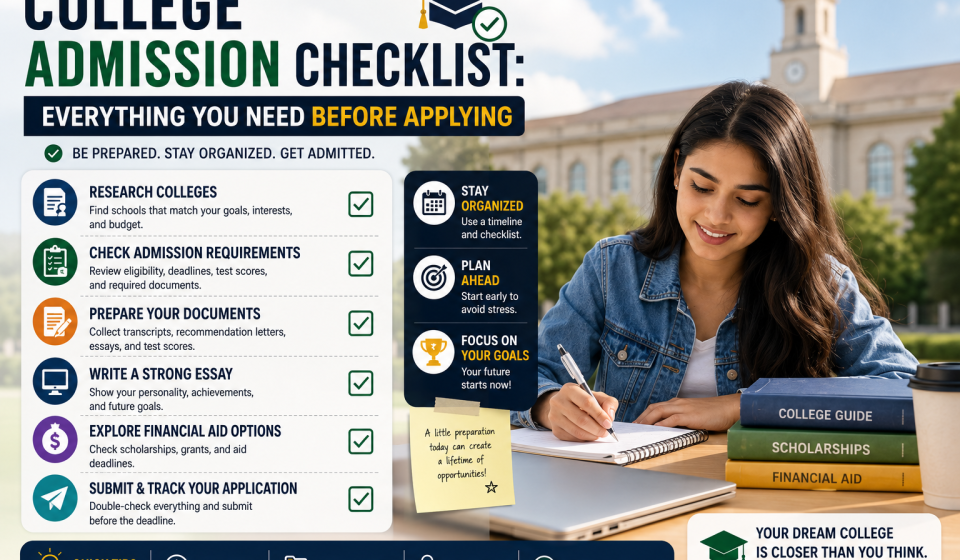
Ultimate College Admission Checklist 2026: Everything You Need Before Applying for College in India

The college admission process in India has become increasingly competitive and technology-driven. Most colleges and universities now use online application systems, digital document verification, and centralized counseling procedures.
Applying for college is one of the most important steps in a student’s academic journey. Whether you are planning to pursue engineering, medicine, management, commerce, arts, science, law, or any other professional course, the admission process requires careful planning and preparation. Every year, thousands of students miss opportunities simply because they forget important documents, overlook eligibility requirements, miss deadlines, or fail to prepare adequately for entrance examinations. A well-organized admission checklist can help students avoid these common mistakes and ensure a smooth application process. Students must therefore stay informed, organized, and proactive throughout the admission cycle. Having a complete checklist before applying not only reduces stress but also improves the chances of securing admission to a preferred institution. This comprehensive guide covers everything students need before applying to college, including academic requirements, entrance exams, documents, financial planning, counseling preparation, and expert admission tips.
Why a College Admission Checklist Is Important
College admissions involve multiple stages and deadlines. Missing even a single requirement can delay or jeopardize your admission.
Benefits of using a college admission checklist include:
- Better organization
- Reduced stress
- Timely application submissions
- Improved admission chances
- Easier document management
- Better financial planning
- More confidence throughout the process
Students who follow a structured checklist are more likely to complete every admission step successfully.
Step 1: Define Your Career Goals
Before applying to any college, students should clearly identify their career interests and long-term goals.
Ask yourself:
- Which subjects interest me the most?
- What type of career do I want?
- Which industries would I like to work in?
- Do I want a professional degree or an academic degree?
- Am I interested in higher studies later?
A clear career goal helps narrow down suitable courses and institutions.
Step 2: Choose the Right Course
Many students focus on selecting a college without deciding on the right course.
Popular options after Class 12 include:
Science Stream
- B.Tech
- MBBS
- BDS
- B.Sc
- B.Pharm
- Nursing
- Biotechnology
Commerce Stream
- B.Com
- BBA
- Economics
- Finance
- CA
- CS
Arts Stream
- BA
- Journalism
- Psychology
- Law
- Fine Arts
- Social Work
Selecting the right course should be the foundation of your admission strategy.
Step 3: Prepare a List of Colleges
Create a shortlist of colleges based on:
- Academic reputation
- Course quality
- Faculty
- Placement records
- Infrastructure
- Fees
- Accreditation
- Location
Prepare three categories:
Dream Colleges
Highly competitive institutions.
Target Colleges
Institutions matching your academic profile.
Safe Colleges
Colleges where admission chances are high.
This approach minimizes admission risks.
Step 4: Verify Eligibility Criteria
Every college has specific eligibility requirements.
Check:
- Minimum marks required
- Subject requirements
- Age limits
- Entrance exam requirements
- Reservation eligibility
Never assume eligibility without verification.
Step 5: Understand Admission Methods
Different colleges use different admission processes.
Common admission methods include:
Merit-Based Admissions
Based on Class 12 marks.
Entrance Exam-Based Admissions
Based on national or institutional entrance exams.
Direct Admissions
Available in certain private institutions.
Counseling-Based Admissions
Common in engineering, medical, and government institutions.
Understanding the process helps avoid confusion later.
Step 6: Register for Required Entrance Exams
Many colleges require entrance examination scores.
Popular exams include:
JEE Main
For engineering admissions.
JEE Advanced
For IIT admissions.
NEET UG
For medical and dental admissions.
CUET UG
For central university admissions.
CLAT
For law admissions.
NIFT Entrance Exam
For fashion education.
NID Entrance Exam
For design programs.
Register before deadlines and keep confirmation details secure.
Step 7: Prepare for Entrance Examinations
Entrance exam scores significantly impact admission opportunities.
Preparation checklist:
- Create a study schedule
- Solve previous year papers
- Attempt mock tests
- Strengthen weak subjects
- Practice time management
Consistent preparation improves performance.
Step 8: Collect Academic Documents
Document preparation is one of the most important admission tasks.
Keep multiple copies ready.
Essential Academic Documents
- Class 10 Marksheet
- Class 10 Passing Certificate
- Class 12 Marksheet
- Class 12 Passing Certificate
- School Leaving Certificate
- Transfer Certificate
- Migration Certificate (if applicable)
Ensure all documents are accurate and updated.
Step 9: Prepare Identification Documents
Most colleges require identity verification.
Important documents include:
- Aadhaar Card
- PAN Card (if available)
- Passport (if available)
- Voter ID (if eligible)
Keep scanned copies ready for online applications.
Step 10: Arrange Passport-Size Photographs
Most applications require recent photographs.
Checklist:
- Passport-size photographs
- Digital photograph copies
- White background photographs if required
Keep both printed and digital versions available.
Step 11: Gather Category Certificates
Students claiming reservation benefits should prepare relevant certificates.
Examples include:
- SC Certificate
- ST Certificate
- OBC Certificate
- EWS Certificate
- PwD Certificate
Certificates should be valid and issued by authorized authorities.
Step 12: Prepare Income Certificates
Income certificates may be required for:
- Scholarships
- Fee concessions
- Financial aid programs
Ensure documents are current and properly verified.
Step 13: Create a Digital Document Folder
Most admissions now occur online.
Prepare a folder containing:
- Academic documents
- Identification proofs
- Certificates
- Photographs
- Entrance exam scorecards
Store files in PDF and image formats.
Step 14: Monitor Important Admission Dates
Students often miss opportunities due to forgotten deadlines.
Track:
- Entrance exam registration dates
- Admit card releases
- Examination dates
- Result announcements
- Application deadlines
- Counseling schedules
Use reminders and calendars.
Step 15: Prepare a Budget Plan
College expenses include more than tuition fees.
Consider:
- Admission fees
- Tuition fees
- Hostel fees
- Transportation costs
- Books and materials
- Personal expenses
Financial planning helps avoid future difficulties.
Step 16: Research Scholarships
Many students fail to take advantage of available scholarships.
Common scholarship types include:
- Merit-based scholarships
- Need-based scholarships
- Government scholarships
- Sports scholarships
- Minority scholarships
Apply early whenever possible.
Step 17: Review Placement Records
Placement opportunities should influence college selection.
Evaluate:
- Placement percentage
- Average salary package
- Highest package
- Recruiting companies
- Internship opportunities
Reliable placement data indicates career potential.
Step 18: Evaluate Infrastructure and Facilities
Check whether colleges provide:
- Modern classrooms
- Laboratories
- Libraries
- Computer centers
- Hostels
- Sports facilities
- Medical facilities
A strong learning environment supports student success.
Step 19: Understand Counseling Procedures
Many admissions involve counseling rounds.
Prepare for:
- Registration
- Choice filling
- Seat allotment
- Document verification
- Fee payment
Understanding counseling procedures improves admission outcomes.
Step 20: Keep Backup Options Ready
Even excellent students may not secure admission to their first-choice college.
Always maintain:
- Alternative colleges
- Alternative courses
- Backup admission plans
Flexibility reduces stress and uncertainty.
Common Admission Documents Checklist
Before applying, ensure you have:
- Class 10 Marksheet
- Class 12 Marksheet
- Passing Certificates
- Transfer Certificate
- Migration Certificate
- Aadhaar Card
- Passport-size Photographs
- Category Certificate
- Income Certificate
- Entrance Exam Scorecard
- Domicile Certificate
- Medical Certificate (if required)
Keeping everything ready prevents last-minute problems.
Mistakes to Avoid Before Applying
Avoid these common errors:
- Missing deadlines
- Incorrect application details
- Incomplete documents
- Ignoring eligibility criteria
- Poor college research
- Delayed entrance exam preparation
- Lack of financial planning
Awareness helps prevent costly mistakes.
Source Links
https://www.ugc.gov.in
https://www.aicte-india.org
https://www.nta.ac.in
https://www.education.gov.in
https://www.nirfindia.org
Conclusion
Applying for college requires careful preparation, organization, and attention to detail. A complete college admission checklist helps students stay on track and ensures that no important requirement is overlooked. From selecting the right course and researching colleges to preparing documents, registering for entrance exams, monitoring deadlines, and planning finances, every step plays a crucial role in admission success. Students who follow a structured checklist can approach the admission process with confidence and significantly improve their chances of securing admission to their preferred institution. Proper planning today can lay the foundation for a successful academic and professional future.
FAQ
1- Why is a college admission checklist important?
A checklist helps students stay organized and ensures that no important admission requirement is missed.
2- When should students start preparing for college admissions?
Students should ideally begin planning during Class 11 or early Class 12.
3- Which documents are most important for college admissions?
Class 10 and 12 marksheets, transfer certificate, Aadhaar card, photographs, and entrance exam scorecards are commonly required.
4- Do all colleges require entrance exams?
No, some colleges offer merit-based admissions while others require entrance examination scores.
5- Why should students research scholarships before applying?
Scholarships can reduce educational expenses and provide financial support during studies.
6- What is the purpose of counseling in college admissions?
Counseling helps allocate seats based on merit, rank, preferences, and availability.
7- How many colleges should students apply to?
Students should apply to a balanced mix of dream, target, and safe colleges.
8- What happens if a deadline is missed?
Missing deadlines may result in losing admission opportunities or participation in counseling rounds.
9- Why are placement records important?
Placement records indicate employment opportunities and industry confidence in graduates.
10- How can students improve their admission chances?
Students should prepare early, meet eligibility requirements, submit accurate applications, and stay updated on admission schedules.