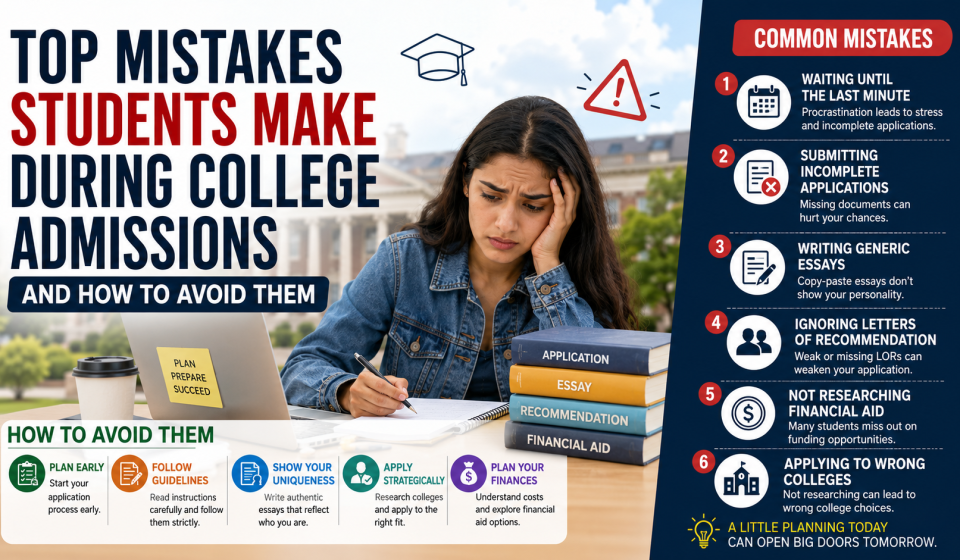
Top 15 College Admission Mistakes Students Make in 2026 and How to Avoid Them for Guaranteed Success

Understanding the most common college admission mistakes and learning how to avoid them can significantly improve the likelihood of securing admission to the right institution.
The college admission process is one of the most significant milestones in a student’s academic journey. Every year, millions of students apply to colleges and universities across India with the hope of securing admission to their dream institutions. However, despite having strong academic records and impressive achievements, many students make avoidable mistakes during the admission process that can negatively impact their chances of acceptance. From missing deadlines to choosing the wrong courses, these errors often lead to unnecessary stress, missed opportunities, and poor admission outcomes. With increasing competition and evolving admission procedures, students must be well-informed and strategic when applying to colleges. Whether admissions are based on entrance examinations, merit lists, counseling rounds, or direct applications, careful planning is essential.This comprehensive guide highlights the top mistakes students make during college admissions and provides practical solutions to help applicants navigate the process successfully.
Why Avoiding Admission Mistakes Is Important
College admissions involve multiple stages, including researching colleges, meeting eligibility requirements, filling application forms, appearing for entrance examinations, participating in counseling rounds, and submitting documents. A single mistake at any stage can result in rejection, loss of opportunities, or delays in the admission process.
Benefits of avoiding admission mistakes include:
- Increased chances of acceptance
- Better college selection
- Reduced stress and confusion
- Improved scholarship opportunities
- Better career planning
- Smooth admission experience
Students who stay organized and informed are more likely to achieve their educational goals.
Mistake 1: Starting the Admission Process Too Late
One of the biggest mistakes students make is delaying their preparation for college admissions.
Many students begin researching colleges only after Class 12 results are announced. By that time, important deadlines, entrance exam registrations, and scholarship opportunities may already have passed.
How to Avoid It
- Start researching colleges during Class 11 or early Class 12.
- Create a timeline of important admission dates.
- Monitor official college websites regularly.
- Register for entrance examinations on time.
Early planning provides more options and reduces last-minute pressure.
Mistake 2: Not Researching Colleges Properly
Many students choose colleges based on advertisements, social media trends, or recommendations from friends without conducting proper research.
This often results in selecting institutions that do not align with academic or career goals.
How to Avoid It
Research factors such as:
- Accreditation
- Faculty quality
- Placement records
- Course curriculum
- Infrastructure
- Student reviews
- Alumni success
Compare multiple colleges before making a decision.
Mistake 3: Choosing a College Based Only on Rankings
Rankings can provide useful information, but relying solely on them is a common mistake.
A highly ranked college may not necessarily offer the best course or opportunities for every student.
How to Avoid It
Evaluate:
- Program quality
- Faculty expertise
- Industry exposure
- Internship opportunities
- Personal career goals
Use rankings as one factor among many.
Mistake 4: Ignoring Eligibility Requirements
Some students apply to colleges without carefully checking eligibility criteria.
Common issues include:
- Insufficient marks
- Incorrect subject combinations
- Age restrictions
- Missing entrance exam qualifications
How to Avoid It
Read official eligibility requirements carefully before applying.
Verify:
- Academic qualifications
- Required subjects
- Minimum percentage criteria
- Entrance exam requirements
Mistake 5: Missing Important Deadlines
Admission deadlines are strictly enforced by most institutions.
Missing even one deadline can result in losing an admission opportunity.
How to Avoid It
Create a checklist including:
- Entrance exam registrations
- Application submissions
- Counseling dates
- Fee payment deadlines
- Document verification schedules
Use reminders and calendars to stay organized.
Mistake 6: Filling Application Forms Incorrectly
Errors in application forms can lead to rejection or complications during verification.
Common mistakes include:
- Incorrect personal information
- Spelling errors
- Wrong academic details
- Invalid document uploads
How to Avoid It
Review every application thoroughly before submission.
Double-check:
- Name spelling
- Date of birth
- Contact details
- Academic scores
- Uploaded documents
Mistake 7: Applying to Too Few Colleges
Many students apply only to their dream colleges.
While ambition is important, limiting applications can reduce admission chances.
How to Avoid It
Create a balanced list including:
- Dream colleges
- Target colleges
- Safe colleges
Applying to multiple institutions increases options.
Mistake 8: Ignoring Course Quality
Some students focus entirely on college reputation while ignoring the quality of the specific course they intend to study.
How to Avoid It
Review:
- Course syllabus
- Faculty expertise
- Industry relevance
- Internship opportunities
- Placement support
The quality of the program matters as much as the institution itself.
Mistake 9: Not Preparing Adequately for Entrance Exams
Entrance examinations play a crucial role in admissions to many colleges.
Poor preparation can significantly limit options.
How to Avoid It
- Create a study schedule.
- Practice previous years’ papers.
- Take mock tests.
- Focus on weak areas.
- Maintain consistency.
Strong entrance exam scores improve admission opportunities.
Mistake 10: Ignoring Financial Planning
Many students overlook the total cost of education until after admission.
Unexpected expenses may create financial difficulties later.
How to Avoid It
Consider:
- Tuition fees
- Hostel charges
- Transportation costs
- Books and materials
- Living expenses
Compare affordability before finalizing a college.
Mistake 11: Not Exploring Scholarships
Numerous scholarships remain unused because students fail to apply.
How to Avoid It
Research:
- Government scholarships
- Merit-based scholarships
- Need-based financial aid
- Institution-specific awards
Apply as early as possible.
Mistake 12: Choosing a College Due to Peer Pressure
Many students select colleges because friends or relatives are attending them.
This may not align with personal goals.
How to Avoid It
Focus on:
- Individual interests
- Career aspirations
- Academic strengths
- Long-term objectives
Your educational journey should be based on your own needs.
Mistake 13: Ignoring Placement Records
Students often overlook placement statistics while choosing colleges.
Strong placements indicate industry recognition and employability.
How to Avoid It
Review:
- Placement percentages
- Average salary packages
- Top recruiters
- Internship opportunities
Ask colleges for recent placement reports.
Mistake 14: Neglecting Campus Visits
Some students finalize colleges without visiting campuses.
Online information may not always reflect reality.
How to Avoid It
Whenever possible:
- Visit the campus
- Observe facilities
- Interact with students
- Meet faculty members
Campus visits provide valuable firsthand insights.
Mistake 15: Poor Choice Filling During Counseling
Students participating in counseling often make strategic mistakes while filling preferences.
Improper choice selection can reduce admission opportunities.
How to Avoid It
- Research all available options.
- Arrange preferences carefully.
- Include realistic choices.
- Understand counseling rules.
Strategic choice filling can significantly improve outcomes.
Importance of Document Preparation
Admission procedures require multiple documents.
Common documents include:
- Class 10 Marksheet
- Class 12 Marksheet
- Transfer Certificate
- Aadhaar Card
- Entrance Exam Scorecard
- Category Certificate
- Passport-size Photographs
Keeping documents ready prevents delays and stress.
Benefits of Proper Admission Planning
Students who plan effectively enjoy several advantages:
- Better college options
- Reduced anxiety
- Stronger applications
- Increased scholarship chances
- Improved admission outcomes
Preparation remains one of the most important factors in admission success.
Technology and Modern Admissions
Today’s admission systems increasingly rely on digital platforms.
Students should become familiar with:
- Online applications
- Digital document uploads
- Counseling portals
- Admission dashboards
- Email notifications
Digital readiness can prevent technical issues during admissions.
Role of Parents in College Admissions
Parents play an important role by:
- Providing guidance
- Assisting with research
- Supporting financial planning
- Encouraging realistic decision-making
However, students should remain actively involved in every step of the process.
How to Build an Effective Admission Strategy
An effective strategy includes:
- Identifying career goals.
- Selecting suitable courses.
- Researching colleges.
- Tracking deadlines.
- Preparing for entrance exams.
- Applying broadly.
- Participating actively in counseling.
- Completing documentation early.
This structured approach increases admission success rates.
Source Links
https://www.ugc.gov.in
https://www.aicte-india.org
https://www.nta.ac.in
https://www.education.gov.in
https://www.nirfindia.org
Conclusion
College admissions can be challenging, but most mistakes are completely avoidable with proper planning and awareness. Common errors such as missing deadlines, ignoring eligibility requirements, poor research, inadequate entrance exam preparation, and choosing colleges based on peer pressure can significantly affect admission outcomes. Students who begin early, stay organized, verify information carefully, and make informed decisions are more likely to secure admission to institutions that align with their academic and career goals. By understanding and avoiding these common mistakes, students can approach the admission process with confidence and maximize their chances of long-term success.
FAQ
1- What is the most common college admission mistake?
The most common mistake is starting the admission process too late and missing important deadlines.
2- Why is researching colleges important?
Research helps students compare institutions based on academics, placements, infrastructure, and career opportunities.
3- Should students apply to multiple colleges?
Yes, applying to multiple colleges increases admission opportunities and provides backup options.
4- How can students avoid application form errors?
Students should carefully review all details before submitting applications and verify uploaded documents.
5- Why are entrance exams important?
Entrance exams determine eligibility and admission opportunities for many competitive programs.
6- How important are placement records?
Placement records provide insights into employment opportunities and industry acceptance of graduates.
7- Can scholarships help reduce education costs?
Yes, scholarships can significantly reduce tuition and overall educational expenses.
8- Why should students visit college campuses?
Campus visits help evaluate facilities, environment, faculty accessibility, and student experiences.
9- What documents are commonly required for admissions?
Students typically need academic marksheets, identification documents, certificates, photographs, and entrance exam scorecards.
10- How can students improve their chances of admission?
Students should start early, prepare thoroughly, stay organized, apply strategically, and meet all deadlines.