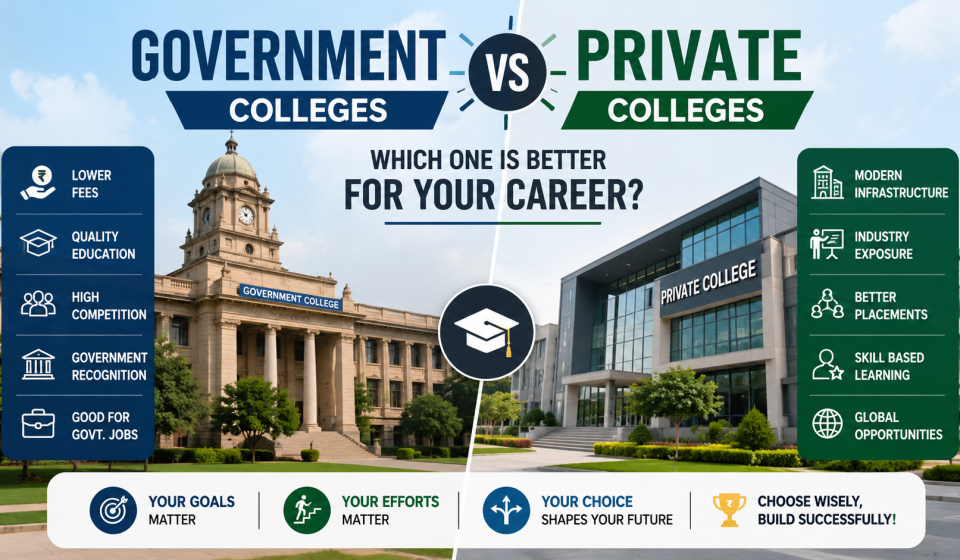
Government vs Private Colleges in India 2026: Which One Is Better for Your Career and Future Success?

The debate between government and private colleges has existed for years because each option serves different student needs.
Choosing between a government college and a private college is one of the biggest decisions students face after completing their higher secondary education. Every year, millions of students across India apply for undergraduate and professional courses and often find themselves confused about which type of institution can provide better education, career opportunities, affordability, and long-term growth. Since both government and private colleges have their own advantages and limitations, making the right choice requires careful evaluation of multiple factor. Government colleges are often known for affordable fees, experienced faculty, and strong academic reputation, while private colleges are recognized for modern infrastructure, industry-oriented programs, and flexible admission processes. Understanding the differences between these two types of institutions can help students choose the best option based on their academic goals, financial situation, and career aspirations. This comprehensive guide explores government and private colleges in detail and helps determine which one may be better for your career.
Understanding Government Colleges
Government colleges are educational institutions funded and managed by central or state governments. These colleges receive financial support from public funds and often maintain lower tuition fees compared to private institutions.
Examples of government institutions include:
- Central Universities
- State Universities
- IITs
- NITs
- AIIMS
- Government Medical Colleges
- Government Engineering Colleges
Government colleges generally admit students through merit-based systems and competitive entrance examinations.
Understanding Private Colleges
Private colleges are educational institutions owned and managed by private organizations, trusts, societies, or educational groups.
Examples include:
- Private Universities
- Deemed Universities
- Private Engineering Colleges
- Private Medical Colleges
- Private Management Institutes
Private colleges primarily depend on student fees and private funding for operations and development.
Government Colleges vs Private Colleges: Key Differences
Ownership and Funding
Government colleges are funded by state or central governments, whereas private colleges are financed through private investments, tuition fees, and institutional funding.
Admission Process
Government colleges usually have highly competitive admission processes based on entrance examinations and merit rankings.
Private colleges may offer:
- Entrance-based admissions
- Merit-based admissions
- Direct admissions
- Management quota admissions
Tuition Fees
One of the biggest differences is cost.
Government colleges typically charge lower fees because they receive government subsidies.
Private colleges generally charge significantly higher fees due to operational expenses and infrastructure investments.
Cost Comparison
Government Colleges
Benefits include:
- Affordable tuition fees
- Lower hostel expenses
- Government scholarships
- Financial aid opportunities
Students from economically weaker backgrounds often prefer government institutions because of affordability.
Private Colleges
Private colleges usually involve:
- Higher tuition fees
- Additional infrastructure charges
- Hostel and transportation costs
However, many private institutions also provide scholarships and educational loan support.
Quality of Education
Government Colleges
Many government colleges have established academic reputations built over decades.
Advantages include:
- Experienced faculty
- Strong academic culture
- Research opportunities
- National recognition
Institutions such as IITs, AIIMS, and central universities consistently maintain high educational standards.
Private Colleges
The quality of education varies widely among private institutions.
Top private universities often offer:
- Industry-oriented curriculum
- Modern teaching methods
- Global collaborations
- International exposure
Students should carefully evaluate academic quality before selecting a private institution.
Faculty Comparison
Government Colleges
Government institutions often employ faculty members with:
- Extensive teaching experience
- Research expertise
- Doctoral qualifications
- Academic achievements
Faculty recruitment processes are usually highly competitive.
Private Colleges
Many top private institutions also recruit highly qualified faculty members.
Advantages may include:
- Industry professionals as faculty
- Visiting professors
- International faculty collaborations
Faculty quality depends significantly on the institution’s reputation and investment in academics.
Infrastructure and Facilities
Government Colleges
Many government colleges have excellent infrastructure, particularly premier institutions.
However, some colleges may face challenges related to:
- Outdated facilities
- Budget limitations
- Slower modernization
Private Colleges
Private institutions often invest heavily in:
- Smart classrooms
- Modern laboratories
- Digital libraries
- Advanced computer centers
- Sports complexes
Infrastructure is frequently one of the strongest advantages of private colleges.
Placement Opportunities
Government Colleges
Top government institutions generally enjoy excellent placement records.
Recruiters often prefer graduates from:
- IITs
- NITs
- AIIMS
- Government universities
Benefits include:
- Strong alumni networks
- High placement rates
- Competitive salary packages
Private Colleges
Placement opportunities vary significantly among private colleges.
Leading private universities frequently attract:
- Multinational corporations
- Technology companies
- Consulting firms
- Startups
Students should review placement statistics carefully before admission.
Industry Exposure
Government Colleges
Industry exposure may depend on the institution.
Some government colleges offer:
- Internships
- Research collaborations
- Industrial visits
However, industry integration may not always be as extensive.
Private Colleges
Many private institutions actively collaborate with industries.
Students often benefit from:
- Industry projects
- Internship programs
- Guest lectures
- Skill development workshops
These opportunities improve employability.
Research Opportunities
Government Colleges
Government institutions often excel in research.
Advantages include:
- Government-funded projects
- Research grants
- Advanced laboratories
- Academic publications
Students interested in higher education and research careers often prefer government colleges.
Private Colleges
Research quality varies among private institutions.
Leading private universities increasingly invest in:
- Research centers
- Innovation labs
- Startup incubation facilities
Research opportunities continue to improve in the private sector.
Student Diversity
Government Colleges
Students from diverse socioeconomic backgrounds often study together due to affordable fees.
This diversity enhances:
- Cultural understanding
- Networking opportunities
- Social development
Private Colleges
Private institutions also attract students from different regions and countries, especially prestigious universities with international programs.
Campus Life Comparison
Government Colleges
Government institutions often provide:
- Rich academic traditions
- Cultural festivals
- Student organizations
- Competitive environments
Private Colleges
Private colleges typically focus on:
- Modern campus experiences
- Student engagement activities
- Leadership development
- Extracurricular programs
Campus life quality varies by institution.
Global Exposure
Government Colleges
Some premier government institutions maintain international collaborations and exchange programs.
Private Colleges
Many leading private universities emphasize:
- International partnerships
- Global certifications
- Student exchange opportunities
- International internships
Students seeking global exposure may find attractive options in private institutions.
Scholarship Opportunities
Government Colleges
Government colleges provide:
- Government scholarships
- Merit scholarships
- Category-based financial aid
- State-sponsored assistance
Private Colleges
Private institutions frequently offer:
- Merit scholarships
- Need-based scholarships
- Sports scholarships
- Special achievement scholarships
Scholarship availability differs among colleges.
Competition Level
Government Colleges
Admission competition is usually intense.
Examples include:
- JEE Advanced
- NEET
- CUET
- GATE
Students often require exceptional scores.
Private Colleges
Private colleges generally offer more admission flexibility.
Students may have multiple pathways for admission.
Career Growth and Employability
The quality of career outcomes depends more on:
- Individual performance
- Skills development
- Internships
- Networking
- Practical experience
Rather than simply choosing government or private institutions.
Students from both sectors have achieved outstanding career success.
Who Should Choose Government Colleges?
Government colleges may be ideal for students who:
- Want affordable education
- Prefer strong academic environments
- Are interested in research
- Can compete in entrance examinations
- Seek long-term academic credibility
Who Should Choose Private Colleges?
Private colleges may be suitable for students who:
- Want modern infrastructure
- Prefer industry-focused learning
- Seek global exposure
- Need flexible admission options
- Value practical skill development
Important Factors to Consider Before Choosing
Before making a final decision, evaluate:
- Course quality
- Accreditation
- Placement records
- Faculty expertise
- Infrastructure
- Fees
- Scholarships
- Industry exposure
- Location
- Career goals
The best college is not necessarily government or private—it is the institution that aligns with your personal objectives.
Myths About Government and Private Colleges
Myth 1: All Government Colleges Are Better
Reality: Some private institutions outperform many government colleges.
Myth 2: Private Colleges Guarantee Placements
Reality: Placement outcomes depend on both student performance and institutional quality.
Myth 3: Government Colleges Have Poor Infrastructure
Reality: Many premier government institutions have world-class facilities.
Myth 4: Private Colleges Are Only for Wealthy Students
Reality: Many private institutions offer substantial scholarships and financial aid.
The Future of Higher Education in India
The Indian education landscape is rapidly evolving.
Emerging trends include:
- Digital learning
- Artificial Intelligence programs
- Industry-integrated curriculum
- Startup incubation centers
- International collaborations
- Skill-based education
Both government and private institutions are adapting to these developments to enhance student outcomes.
Source Links
https://www.ugc.gov.in
https://www.aicte-india.org
https://www.education.gov.in
https://www.nirfindia.org
https://www.naac.gov.in
Conclusion
The choice between a government college and a private college depends on individual priorities, career goals, financial circumstances, and academic performance. Government colleges generally offer affordable education, strong academic reputations, and excellent research opportunities, while private colleges often provide modern infrastructure, industry-oriented learning, and greater flexibility. Neither option is universally superior; the right choice depends on how well a college aligns with a student’s aspirations and future plans. By evaluating factors such as accreditation, placements, faculty quality, infrastructure, affordability, and career opportunities, students can make an informed decision that supports long-term success.
FAQ
1- Which is better for placements: government or private colleges?
Top government and top private colleges both offer excellent placements. Placement quality depends on the institution and student performance.
2- Are government colleges cheaper than private colleges?
Yes, government colleges generally charge significantly lower tuition fees due to government funding.
3- Do private colleges provide good education?
Many reputed private colleges offer high-quality education, industry-focused curricula, and modern learning environments.
4- Which colleges have better infrastructure?
Private colleges often invest more heavily in modern infrastructure and technology.
5- Are government colleges better for research?
Many government institutions have stronger research ecosystems and greater access to government-funded projects.
6- Can private college students get good jobs?
Yes, students from reputed private colleges frequently secure excellent job opportunities and salary packages.
7- Are scholarships available in private colleges?
Yes, many private institutions provide merit-based and need-based scholarships.
8- Which type of college has tougher admissions?
Government colleges usually have more competitive admissions due to limited seats and lower fees.
9- Does college type determine career success?
No, career success depends largely on skills, knowledge, internships, networking, and personal effort.
10- How should students choose between government and private colleges?
Students should compare accreditation, faculty, placements, fees, infrastructure, scholarships, and career goals before making a decision.