
Bachelor of Commerce (BCom) is one of the most popular undergraduate degrees among students interested in finance, accounting, taxation, economics, banking, and business management.
Every year, thousands of students complete their BCom degree and face an important question: what should they do next? Choosing the right course after BCom can significantly impact career growth, salary potential, and long-term professional success. With industries evolving rapidly and employers seeking specialized skills, selecting a career-oriented course has become more important than ever. The good news is that BCom graduates have a wide range of options available. From traditional professional programs such as Chartered Accountancy (CA) and Master of Commerce (MCom) to modern fields like Data Analytics, Digital Marketing, Financial Technology, and Business Analytics, students can choose courses based on their interests and career goals. This comprehensive guide explores the best courses after BCom, their benefits, eligibility requirements, career opportunities, and future prospects.
Why Pursue a Course After BCom?
While a BCom degree provides a strong foundation in commerce and business studies, additional qualifications help students gain specialized expertise and improve employability. Employers increasingly prefer candidates with industry-relevant certifications and advanced knowledge.
Benefits of pursuing a course after BCom include:
Better job opportunities
Higher salary potential
Specialized industry knowledge
Improved professional credibility
Enhanced career growth
Global employment opportunities
Competitive advantage in the job market
By choosing the right course, graduates can accelerate their professional journey and secure rewarding career opportunities.
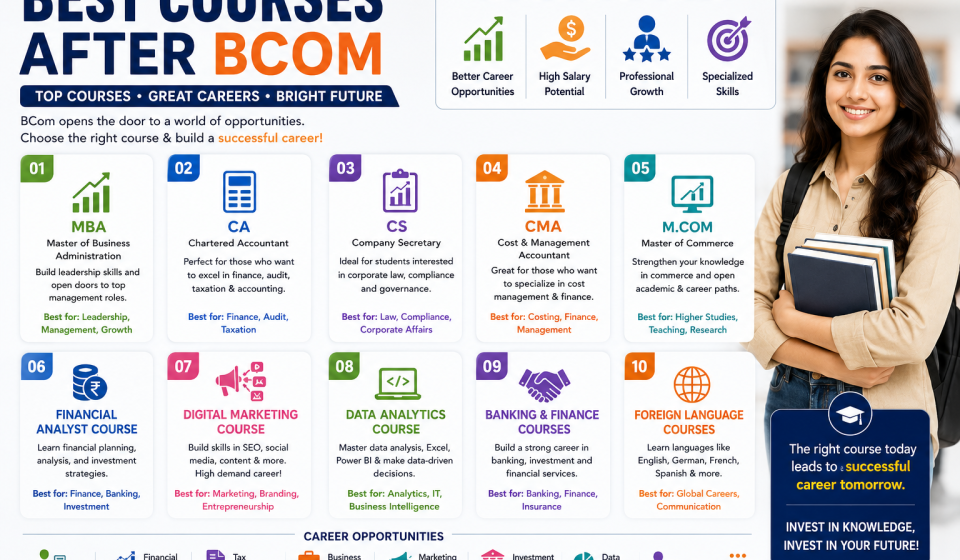
Best Courses After BCom
1. Chartered Accountancy (CA)
Chartered Accountancy remains one of the most prestigious and sought-after professional qualifications for commerce graduates.
Why Choose CA?
High professional recognition
Excellent salary packages
Global opportunities
Strong demand in finance and accounting sectors
Core Subjects:
Accounting
Taxation
Auditing
Corporate Laws
Financial Management
Career Opportunities:
Chartered Accountant
Tax Consultant
Auditor
Financial Advisor
Chief Financial Officer
CA professionals are highly valued across industries and often occupy leadership positions.
2. Master of Commerce (MCom)
MCom is a popular postgraduate degree for students who wish to deepen their knowledge of commerce and finance.
Benefits of MCom:
Advanced academic knowledge
Eligibility for teaching and research roles
Preparation for competitive exams
Foundation for PhD programs
Career Opportunities:
Lecturer
Financial Analyst
Research Associate
Accountant
Corporate Consultant
MCom is ideal for students interested in academics and advanced commerce studies.
3. Master of Business Administration (MBA)
MBA is among the most popular career options after BCom because it combines business management with leadership development.
Popular MBA Specializations:
Finance
Marketing
Human Resources
International Business
Operations Management
Business Analytics
Career Opportunities:
Business Manager
Marketing Manager
Financial Manager
Project Manager
Operations Head
An MBA from a reputed institution can significantly enhance career prospects.
4. Company Secretary (CS)
The Company Secretary course focuses on corporate governance, legal compliance, and company law.
Why Choose CS?
Strong corporate demand
Excellent career growth
Professional recognition
Specialized legal expertise
Career Opportunities:
Company Secretary
Compliance Officer
Legal Advisor
Corporate Governance Consultant
CS professionals play a crucial role in organizational management.
5. Cost and Management Accounting (CMA)
CMA is a professional course specializing in cost accounting, financial planning, and business strategy.
Key Areas:
Cost management
Financial analysis
Budgeting
Risk management
Career Opportunities:
Cost Accountant
Finance Manager
Budget Analyst
Internal Auditor
The CMA qualification is highly respected in manufacturing and corporate sectors.
6. Certified Financial Analyst (CFA)
CFA is one of the world’s most recognized credentials in investment management and financial analysis.
Why Pursue CFA?
Global recognition
High salary potential
Strong demand in finance
International career opportunities
Career Opportunities:
Investment Banker
Portfolio Manager
Financial Analyst
Risk Analyst
Equity Research Analyst
CFA is particularly beneficial for students interested in capital markets and investments.
7. Digital Marketing Course
Digital marketing has emerged as one of the fastest-growing career fields.
Topics Covered:
Search Engine Optimization (SEO)
Social Media Marketing
Google Ads
Content Marketing
Email Marketing
Analytics
Career Opportunities:
Digital Marketing Executive
SEO Specialist
Social Media Manager
Content Strategist
Digital Marketing Manager
Digital marketing offers freelancing, entrepreneurship, and corporate employment opportunities.
8. Data Analytics Course
Businesses increasingly rely on data-driven decision-making, making data analytics a lucrative field.
Skills Learned:
Excel
SQL
Python
Power BI
Tableau
Data Visualization
Career Opportunities:
Data Analyst
Business Analyst
Market Research Analyst
Reporting Specialist
Data analytics combines commerce knowledge with modern technology skills.
9. Business Analytics
Business Analytics focuses on using data to solve business challenges and improve organizational performance.
Key Skills:
Statistical Analysis
Data Modeling
Business Intelligence
Predictive Analytics
Career Opportunities:
Business Analyst
Analytics Consultant
Strategy Analyst
Operations Analyst
This field is experiencing significant growth globally.
10. Banking and Finance Certification Programs
Specialized banking courses prepare students for careers in financial institutions.
Popular Certifications:
NISM Certifications
NCFM Certifications
Banking Operations Courses
Investment Banking Programs
Career Opportunities:
Bank Officer
Relationship Manager
Financial Advisor
Investment Consultant
Banking remains a stable and rewarding career path.
11. Financial Modeling Course
Financial modeling involves creating financial representations of businesses for decision-making purposes.
Skills Covered:
Excel Modeling
Forecasting
Valuation
Investment Analysis
Career Opportunities:
Financial Analyst
Investment Banker
Equity Research Analyst
Corporate Finance Professional
This specialization is highly valued in finance and investment sectors.
12. Certified Public Accountant (CPA)
CPA is an internationally recognized accounting qualification, particularly valuable for those seeking global opportunities.
Benefits:
International recognition
High earning potential
Global mobility
Career Opportunities:
CPA
Financial Controller
Accounting Manager
Tax Consultant
Many multinational companies prefer CPA-qualified professionals.
13. Law (LLB)
Students interested in legal careers can pursue an LLB after BCom.
Career Opportunities:
Corporate Lawyer
Legal Advisor
Compliance Officer
Tax Lawyer
Business knowledge provides a strong advantage in corporate law practice.
14. FinTech Courses
Financial Technology combines finance and technology to create innovative financial solutions.
Topics Include:
Digital Payments
Blockchain
Financial Innovation
Cryptocurrency Fundamentals
Career Opportunities:
FinTech Analyst
Product Manager
Financial Technology Consultant
The FinTech industry continues to expand rapidly worldwide.
15. Entrepreneurship and Startup Management
Students with entrepreneurial ambitions can pursue specialized programs focused on business creation and management.
Benefits:
Practical business knowledge
Innovation skills
Leadership development
Business planning expertise
This option is ideal for aspiring entrepreneurs.
Emerging Career-Oriented Courses After BCom
Artificial Intelligence for Business
Blockchain and Cryptocurrency
Supply Chain Management
International Business Management
E-commerce Management
Wealth Management
Financial Planning
Risk Management
Cybersecurity for Finance
Sustainability and ESG Management
These emerging fields offer promising future opportunities.
Factors to Consider Before Choosing a Course
Career Goals
Personal Interests
Industry Demand
Salary Potential
Course Duration
Cost of Education
Global Opportunities
Skill Requirements
Selecting a course aligned with long-term objectives increases career satisfaction and success.
High-Paying Career Options After BCom
Investment Banker
Chartered Accountant
Financial Analyst
Business Analyst
Digital Marketing Manager
Data Analyst
Corporate Lawyer
Company Secretary
Finance Manager
Portfolio Manager
Risk Consultant
These careers often provide excellent compensation and growth opportunities.
Skills Required for Career Success After BCom
Technical Skills:
Accounting
Financial Analysis
Data Analytics
Taxation
Business Intelligence
Digital Marketing
Communication Skills
Soft Skills:
Leadership
Problem Solving
Critical Thinking
Teamwork
Time Management
Adaptability
Developing both technical and interpersonal skills is essential for long-term career growth.
Future Scope After BCom
The future for BCom graduates remains highly promising due to increasing demand for professionals in finance, accounting, business management, analytics, and technology-driven sectors. Emerging industries such as FinTech, Business Analytics, Artificial Intelligence, Digital Marketing, and Wealth Management are creating new opportunities for commerce graduates. Students who continuously upgrade their skills through professional courses and certifications can enjoy strong career growth, competitive salaries, and international opportunities.
Source
https://www.coursera.org/articles/career-options-after-bcom
https://www.cfainstitute.org
https://www.icai.org
https://www.aicpa-cima.com
Conclusion
Choosing the right course after BCom is one of the most important decisions for building a successful career. Whether students prefer traditional professional qualifications such as CA, CS, CMA, and MCom or modern fields like Data Analytics, Digital Marketing, Business Analytics, and FinTech, numerous opportunities are available. The ideal course depends on individual interests, career goals, and industry trends. By acquiring specialized skills, gaining practical experience, and staying updated with market demands, BCom graduates can achieve long-term professional success and financial growth.
FAQ
1. Which is the best course after BCom?
CA, MBA, CFA, CMA, CS, Data Analytics, and Digital Marketing are among the best courses after BCom depending on career goals.
2. Is MBA a good option after BCom?
Yes, MBA is an excellent choice for students seeking management and leadership positions across industries.
3. What are the highest-paying careers after BCom?
Investment Banking, Chartered Accountancy, Financial Analysis, Corporate Law, and Business Analytics are among the highest-paying career options.
4. Can BCom graduates enter Data Analytics?
Yes, BCom graduates can pursue Data Analytics by learning tools such as Excel, SQL, Power BI, Tableau, and Python.
5. Is CFA better than MBA?
Both have unique advantages. CFA is ideal for finance and investment careers, while MBA offers broader management opportunities.
6. Which professional course is best for accounting careers?
CA, CMA, CPA, and ACCA are among the most respected accounting qualifications.
7. Are digital marketing courses useful after BCom?
Yes, digital marketing offers strong demand, diverse career opportunities, freelancing options, and entrepreneurial potential.
8. What is the future scope for BCom graduates?
The future is bright due to growing opportunities in finance, analytics, management, technology, banking, and entrepreneurship.