Top Career Options in Artificial Intelligence: High-Paying AI Careers, Skills, Salaries, and Future Opportunities

Artificial Intelligence (AI) has emerged as one of the most transformative technologies of the 21st century, reshaping industries, businesses, and everyday life.
From virtual assistants and recommendation systems to autonomous vehicles and advanced healthcare diagnostics, AI is driving innovation across countless sectors. As organizations increasingly adopt AI-powered solutions to improve efficiency and gain competitive advantages, the demand for skilled AI professionals continues to rise worldwide.
The rapid expansion of artificial intelligence has created numerous career opportunities for students, graduates, and professionals seeking future-proof and high-paying jobs. Whether you have a background in computer science, mathematics, engineering, data science, or even business, there are diverse pathways to enter the AI industry. Understanding the top career options in artificial intelligence can help individuals choose the right specialization and build a successful long-term career in this dynamic field.
What is Artificial Intelligence?
Artificial Intelligence refers to the simulation of human intelligence by machines and computer systems. AI enables machines to perform tasks that typically require human intelligence, including learning, reasoning, decision-making, problem-solving, speech recognition, and language understanding.
Modern AI technologies include:
Machine Learning
Deep Learning
Natural Language Processing
Computer Vision
Robotics
Generative AI
Expert Systems
Predictive Analytics
These technologies are revolutionizing industries and creating significant employment opportunities globally.
Why Artificial Intelligence is a Promising Career
Artificial intelligence has become one of the fastest-growing sectors in the technology industry. Organizations across healthcare, finance, manufacturing, education, retail, transportation, and entertainment are investing heavily in AI solutions.
Reasons AI is a promising career include:
High demand for professionals.
Competitive salaries.
Global job opportunities.
Continuous innovation.
Strong career growth.
Cross-industry applications.
Future-proof employment prospects.
As AI adoption expands, the need for specialized professionals is expected to grow substantially.
Top Career Options in Artificial Intelligence
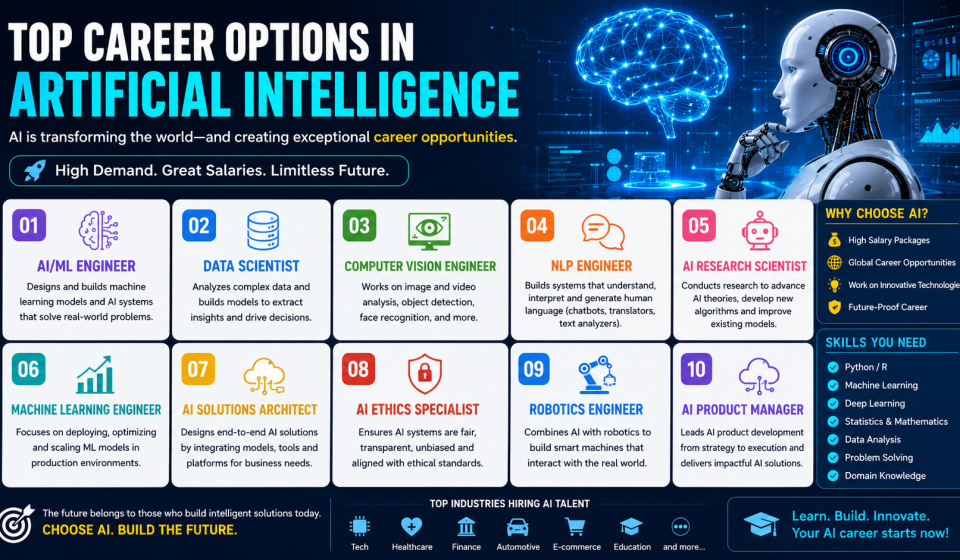
1. Machine Learning Engineer
Machine Learning Engineers design and develop algorithms that enable systems to learn from data and improve performance over time without explicit programming.
Responsibilities:
Building machine learning models.
Training algorithms.
Data preprocessing.
Model optimization.
Performance evaluation.
Required Skills:
Python
TensorFlow
PyTorch
Scikit-learn
Statistics
Data structures
Machine learning engineers are among the highest-paid professionals in the AI industry.
2. Data Scientist
Data Scientists analyze large datasets to uncover patterns, trends, and insights that help organizations make informed decisions.
Key Responsibilities:
Data collection.
Data cleaning.
Statistical analysis.
Predictive modeling.
Business intelligence reporting.
Essential Skills:
Python
R
SQL
Machine Learning
Data Visualization
Statistics
Data Scientists play a crucial role in AI-driven organizations.
3. AI Research Scientist
AI Research Scientists focus on advancing artificial intelligence technologies through innovation and experimentation.
Responsibilities:
Conducting research.
Developing new algorithms.
Publishing scientific papers.
Improving existing AI models.
Exploring emerging technologies.
Educational Requirements:
Master’s degree or PhD is often preferred.
Research scientists contribute significantly to the future development of AI.
4. Natural Language Processing Engineer
Natural Language Processing (NLP) Engineers develop systems that enable machines to understand, interpret, and generate human language.
Applications Include:
Chatbots.
Virtual assistants.
Translation systems.
Speech recognition.
Text analysis.
Required Skills:
Python
Linguistics
Deep Learning
Transformer Models
Large Language Models
NLP specialists are increasingly valuable due to the rise of conversational AI.
5. Computer Vision Engineer
Computer Vision Engineers create systems capable of interpreting and analyzing visual information from images and videos.
Applications Include:
Facial recognition.
Medical imaging.
Autonomous vehicles.
Security surveillance.
Industrial automation.
Key Skills:
OpenCV
Python
Deep Learning
Image Processing
Neural Networks
Computer vision continues to be a rapidly expanding AI specialization.
6. Robotics Engineer
Robotics Engineers combine AI, software, and hardware technologies to develop intelligent machines and autonomous systems.
Responsibilities:
Robot design.
Automation programming.
Sensor integration.
System testing.
Performance optimization.
Industries Hiring Robotics Engineers:
Manufacturing.
Healthcare.
Defense.
Logistics.
Agriculture.
Robotics represents one of the most exciting areas within artificial intelligence.
7. AI Software Developer
AI Software Developers create applications and software solutions that incorporate artificial intelligence capabilities.
Tasks Include:
Developing AI-powered applications.
Integrating machine learning models.
Testing software performance.
Improving user experiences.
Required Skills:
Python
Java
C++
Software Engineering
Machine Learning Frameworks
AI developers are essential for translating research into practical applications.
8. Deep Learning Engineer
Deep Learning Engineers specialize in neural networks and advanced machine learning architectures.
Responsibilities:
Building neural networks.
Training deep learning models.
Optimizing algorithms.
Managing large datasets.
Applications:
Image recognition.
Speech processing.
Generative AI.
Recommendation systems.
Deep learning expertise is highly sought after across industries.
9. AI Product Manager
AI Product Managers oversee the development and implementation of AI-driven products and services.
Responsibilities:
Product planning.
Strategy development.
Cross-functional coordination.
Market analysis.
Performance tracking.
Required Skills:
Business knowledge.
Technical understanding.
Leadership.
Communication.
Project management.
This role combines technology expertise with business strategy.
10. AI Ethics Specialist
As artificial intelligence becomes more influential, ethical considerations have gained importance.
Responsibilities:
Ensuring fairness.
Preventing bias.
Promoting transparency.
Developing responsible AI policies.
Monitoring compliance.
Organizations increasingly seek professionals who can address ethical AI challenges.
11. Business Intelligence Analyst
Business Intelligence Analysts leverage AI-powered tools to transform data into actionable insights.
Responsibilities:
Data reporting.
Dashboard creation.
Performance analysis.
Business forecasting.
Tools Used:
Power BI
Tableau
SQL
Python
This career combines business strategy with data analytics.
12. AI Consultant
AI Consultants help organizations implement artificial intelligence solutions effectively.
Responsibilities:
Assessing business needs.
Recommending AI strategies.
Managing AI projects.
Improving operational efficiency.
Consultants work with diverse industries and often enjoy excellent earning potential.
13. AI Trainer
AI Trainers improve machine learning systems by labeling data, evaluating outputs, and refining model performance.
Responsibilities:
Data annotation.
Quality assurance.
Model testing.
Feedback generation.
The growth of generative AI has increased demand for AI training professionals.
14. Generative AI Specialist
Generative AI Specialists work on technologies capable of creating text, images, videos, audio, and code.
Popular Technologies:
Large Language Models.
Generative Adversarial Networks.
Diffusion Models.
Applications Include:
Content generation.
Marketing automation.
Software development.
Creative industries.
Generative AI is currently one of the fastest-growing segments in technology.
15. Autonomous Systems Engineer
Autonomous Systems Engineers develop intelligent systems capable of operating independently.
Applications:
Self-driving vehicles.
Industrial automation.
Drone technology.
Smart manufacturing.
Required Skills:
Artificial Intelligence.
Computer Vision.
Sensor Fusion.
Machine Learning.
This field offers significant long-term growth opportunities.
Skills Required for AI Careers
Technical Skills
Programming Languages
Python
Java
R
C++
Machine Learning
Deep Learning
Statistics
Mathematics
Data Analysis
Cloud Computing
Database Management
Big Data Technologies
Soft Skills
Problem Solving
Critical Thinking
Communication
Collaboration
Creativity
Adaptability
Leadership
Combining technical expertise with strong interpersonal skills improves employability.
Educational Pathways for AI Careers
Bachelor’s Degrees:
Computer Science
Artificial Intelligence
Data Science
Information Technology
Software Engineering
Electrical Engineering
Advanced Education:
Master’s in AI
Master’s in Data Science
Machine Learning Specialization
PhD in Artificial Intelligence
Certifications:
Google AI Certifications
Microsoft AI Certifications
IBM AI Certifications
AWS Machine Learning Certifications
DeepLearning.AI Programs
Professional certifications enhance career opportunities significantly.
Industries Hiring AI Professionals
Healthcare
Finance
Banking
Retail
Manufacturing
Education
Transportation
E-commerce
Telecommunications
Cybersecurity
Entertainment
Government Organizations
Virtually every industry now utilizes artificial intelligence in some capacity.
Salary Potential in Artificial Intelligence
AI careers are among the highest-paying jobs in technology.
Factors Affecting Salary:
Experience level.
Technical expertise.
Location.
Industry.
Educational background.
Certifications.
Specialized skills such as deep learning, computer vision, and generative AI often command premium salaries.
Future Scope of Artificial Intelligence Careers
The future of artificial intelligence careers appears exceptionally bright. Emerging technologies such as generative AI, autonomous systems, quantum computing integration, AI-powered healthcare, smart cities, and advanced robotics are expected to create millions of new jobs worldwide. Organizations continue investing heavily in AI research and implementation, ensuring sustained demand for skilled professionals. Individuals who continuously learn and adapt to evolving technologies can build highly successful and rewarding careers in the AI ecosystem.
Source
https://www.ibm.com/topics/artificial-intelligence
https://cloud.google.com/learn/what-is-artificial-intelligence
https://www.microsoft.com/en-us/ai
https://www.coursera.org/articles/artificial-intelligence-career-path
Conclusion
Artificial Intelligence has become one of the most influential and rapidly growing fields in the modern world. From machine learning and data science to robotics, computer vision, and generative AI, numerous career opportunities are available for individuals interested in technology and innovation. With high salaries, strong demand, global opportunities, and continuous advancements, AI offers a promising future for professionals across various backgrounds. By developing the right technical skills, gaining practical experience, and staying updated with industry trends, aspiring professionals can successfully establish themselves in the exciting world of artificial intelligence.
FAQ
1. What is the best career option in Artificial Intelligence?
Machine Learning Engineer, Data Scientist, AI Research Scientist, and Generative AI Specialist are among the most sought-after AI careers.
2. Is Artificial Intelligence a good career choice?
Yes, AI offers excellent job growth, competitive salaries, global opportunities, and strong future demand across industries.
3. Which programming language is most important for AI?
Python is the most widely used programming language in artificial intelligence due to its extensive libraries and frameworks.
4. Do I need a degree to work in AI?
While a degree is beneficial, many professionals enter AI through certifications, online courses, and practical project experience.
5. What industries hire AI professionals?
Healthcare, finance, retail, manufacturing, education, transportation, cybersecurity, and e-commerce are major recruiters of AI talent.
6. How can beginners start a career in AI?
Beginners should learn programming, mathematics, machine learning fundamentals, build projects, and earn relevant certifications.
7. What is the future scope of Artificial Intelligence?
The future is highly promising, with growing demand in generative AI, robotics, autonomous systems, healthcare, and smart technologies.
8. Which AI specialization offers the highest salary?
Machine Learning Engineering, AI Research, Deep Learning, Computer Vision, and Generative AI are among the highest-paying specializations.