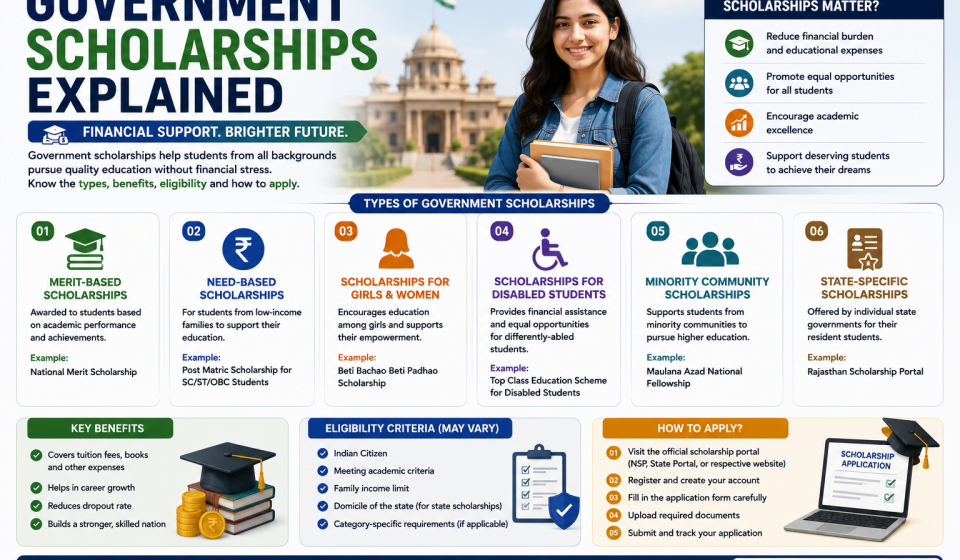
Government Scholarships Explained: Complete Guide to Eligibility, Benefits, Application Process, and Financial Support for Students

Government scholarships play a crucial role in promoting educational equality and encouraging students to pursue higher studies without worrying about financial constraints.
Education is one of the most powerful tools for personal growth, career development, and social progress. However, the rising cost of education often creates financial challenges for students and their families. To ensure that deserving students can continue their education without financial barriers, governments around the world offer various scholarship programs. These scholarships provide financial assistance to students based on academic merit, financial need, category-specific eligibility, talent, and other criteria.For many students, understanding the different types of government scholarships, eligibility requirements, application procedures, and benefits can be confusing. Numerous scholarship schemes are available at national, state, and local levels, each designed to support specific groups of students. Whether a student belongs to an economically weaker section, excels academically, comes from a minority community, or wishes to pursue higher education in a specialized field, there may be a suitable government scholarship available. This comprehensive guide explains government scholarships, their benefits, eligibility criteria, application processes, and tips for maximizing scholarship opportunities.
What Are Government Scholarships?
Government scholarships are financial aid programs funded by government authorities to support students in their educational journey.
The primary objectives include:
Promoting education
Reducing financial barriers
Supporting deserving students
Encouraging academic excellence
Increasing access to higher education
Scholarships help students focus on learning rather than financial challenges.
Why Government Scholarships Are Important
Scholarships contribute significantly to educational development.
Major benefits include:
Reduced financial burden
Increased educational access
Improved academic motivation
Lower student debt
Support for disadvantaged communities
Encouragement of higher education participation
Government scholarships create opportunities for students from diverse backgrounds.
Types of Government Scholarships
Government scholarship programs are designed for various student categories.
Common types include:
Merit-based scholarships
Need-based scholarships
Minority scholarships
Scholarships for girls
Research scholarships
Sports scholarships
Disability scholarships
Category-based scholarships
Each scholarship serves specific educational objectives.
Merit-Based Scholarships
Merit scholarships reward academic excellence.
Selection criteria often include:
High examination scores
Outstanding academic achievements
Competitive examination performance
Leadership accomplishments
These scholarships encourage students to maintain strong academic performance.
Need-Based Scholarships
Need-based scholarships support students facing financial difficulties.
Eligibility is typically determined by:
Family income
Economic background
Financial documentation
These programs ensure education remains accessible regardless of economic circumstances.
Scholarships for Minority Students
Many governments provide scholarships for minority communities to promote educational inclusion.
Objectives include:
Educational empowerment
Equal opportunities
Social development
Higher education participation
Minority scholarships support diverse student populations.
Scholarships for Female Students
Governments frequently introduce scholarship programs specifically for girls and women.
Benefits include:
Increased enrollment
Gender equality
Educational empowerment
Career development
These programs encourage female participation in education.
Scholarships for Students with Disabilities
Students with disabilities may receive specialized financial support.
Scholarships may cover:
Tuition fees
Assistive technologies
Accommodation
Educational resources
Such initiatives promote inclusive education.
Sports Scholarships
Talented athletes often receive scholarship opportunities.
Eligibility may depend on:
Sports achievements
Competition performance
National or regional representation
Sports scholarships support both education and athletic development.
Research and Higher Education Scholarships
Governments encourage advanced studies through research scholarships.
Supported areas may include:
Master’s programs
Doctoral studies
Research projects
Innovation initiatives
These scholarships contribute to academic advancement and knowledge creation.
Benefits of Government Scholarships
Scholarship recipients may receive various forms of support.
Common benefits include:
Tuition fee assistance
Living allowances
Book allowances
Research funding
Travel support
Academic incentives
Benefits vary depending on the specific program.
Eligibility Criteria for Government Scholarships
Eligibility requirements differ among programs.
Common factors include:
Academic performance
Family income
Nationality
Educational level
Category eligibility
Institution recognition
Students should carefully review program guidelines.
Documents Required for Scholarship Applications
Applicants generally need:
Academic transcripts
Identity proof
Income certificates
Address proof
Photographs
Bank account details
Category certificates (if applicable)
Accurate documentation is essential for successful applications.
How to Apply for Government Scholarships
Step 1: Identify Suitable Scholarships
Students should research available programs carefully.
Step 2: Verify Eligibility
Review all eligibility requirements before applying.
Step 3: Gather Required Documents
Prepare all supporting documentation in advance.
Step 4: Complete Application Forms
Provide accurate and complete information.
Step 5: Submit Before Deadlines
Timely submission is critical for consideration.
Following these steps improves application success.
Importance of Scholarship Portals
Many governments use online platforms to manage scholarship applications.
Advantages include:
Easy access
Transparency
Faster processing
Application tracking
Students should regularly monitor official scholarship portals.
Common Mistakes During Scholarship Applications
Applicants often make avoidable errors.
Examples include:
Missing deadlines
Submitting incomplete forms
Providing inaccurate information
Failing to upload required documents
Ignoring eligibility criteria
Careful preparation reduces application risks.
Tips for Winning Government Scholarships
Successful applicants often:
Maintain strong academic performance
Apply early
Prepare documents carefully
Follow instructions precisely
Research multiple opportunities
Attention to detail improves selection chances.
Scholarship Renewal Requirements
Many scholarships require ongoing eligibility.
Requirements may include:
Minimum academic performance
Regular enrollment
Attendance standards
Progress reports
Students should understand renewal conditions.
Scholarships for Undergraduate Students
Undergraduate scholarships support students pursuing bachelor’s degrees.
Benefits often include:
Tuition assistance
Academic support
Financial aid
Undergraduate funding improves educational accessibility.
Scholarships for Postgraduate Students
Postgraduate scholarships help students pursue advanced studies.
Areas supported may include:
Master’s programs
Professional courses
Research activities
Advanced education
These programs encourage specialization and professional growth.
Scholarships for Study Abroad
Some government programs support international education.
Benefits may include:
Tuition funding
Travel assistance
Living expenses
Research support
International scholarships promote global learning opportunities.
Impact of Scholarships on Career Development
Scholarships positively influence career outcomes.
Benefits include:
Reduced financial stress
Access to quality institutions
Academic focus
Enhanced credentials
Professional opportunities
Financial support often contributes to educational success.
Role of Scholarships in Educational Equality
Government scholarships help reduce educational disparities.
They promote:
Social mobility
Equal opportunities
Inclusive education
Community development
Educational equity strengthens societies and economies.
Government Scholarship Portals in India
Students can explore opportunities through official platforms such as:
National Scholarship Portal (NSP)
State scholarship portals
University scholarship systems
Official government websites provide the most reliable information.
Importance of Financial Planning Alongside Scholarships
While scholarships provide valuable support, students should also practice effective financial planning.
Recommendations include:
Budget management
Expense tracking
Savings habits
Additional funding exploration
Responsible financial behavior enhances scholarship benefits.
Challenges in Scholarship Programs
Common challenges include:
High competition
Limited funding
Documentation requirements
Awareness gaps
Application complexity
Students should prepare thoroughly to overcome these challenges.
Future Trends in Government Scholarships
Governments are increasingly using digital platforms, artificial intelligence, automated verification systems, and data-driven processes to improve scholarship administration. Future scholarship programs may become more accessible, transparent, and personalized to student needs. As educational costs continue to rise, scholarship initiatives will remain essential for promoting educational access, supporting academic excellence, and developing skilled professionals capable of contributing to economic and social progress.
Source
https://scholarships.gov.in
https://www.education.gov.in
https://www.ugc.gov.in
https://www.aicte-india.org
Conclusion
Government scholarships play a vital role in making education affordable and accessible for students from diverse backgrounds. By providing financial support based on merit, need, category eligibility, talent, and academic achievement, these programs help reduce barriers to educational success. Understanding scholarship types, eligibility requirements, application procedures, and renewal conditions allows students to maximize available opportunities and pursue their educational goals confidently. With proper planning, timely applications, and strong academic performance, students can benefit significantly from government scholarship programs and build brighter futures through quality education.
FAQ
1. What is a government scholarship?
A government scholarship is financial assistance provided by government authorities to support students in their educational pursuits.
2. Who can apply for government scholarships?
Eligibility depends on factors such as academic performance, family income, educational level, category status, and specific program requirements.
3. Are government scholarships only for economically weaker students?
No, scholarships may be based on merit, talent, research interests, sports achievements, category eligibility, or financial need.
4. How can students find government scholarship opportunities?
Students can visit official government scholarship portals, educational institution websites, and ministry websites.
5. Do government scholarships require repayment?
No, scholarships are generally financial grants that do not need to be repaid.
6. What documents are commonly required for scholarship applications?
Academic records, identity proof, income certificates, address proof, photographs, and bank account details are commonly required.
7. Can students receive multiple scholarships?
This depends on program rules. Some scholarships allow additional funding while others impose restrictions.
8. Why are government scholarships important?
They reduce financial barriers, promote educational access, encourage academic achievement, and support student success.