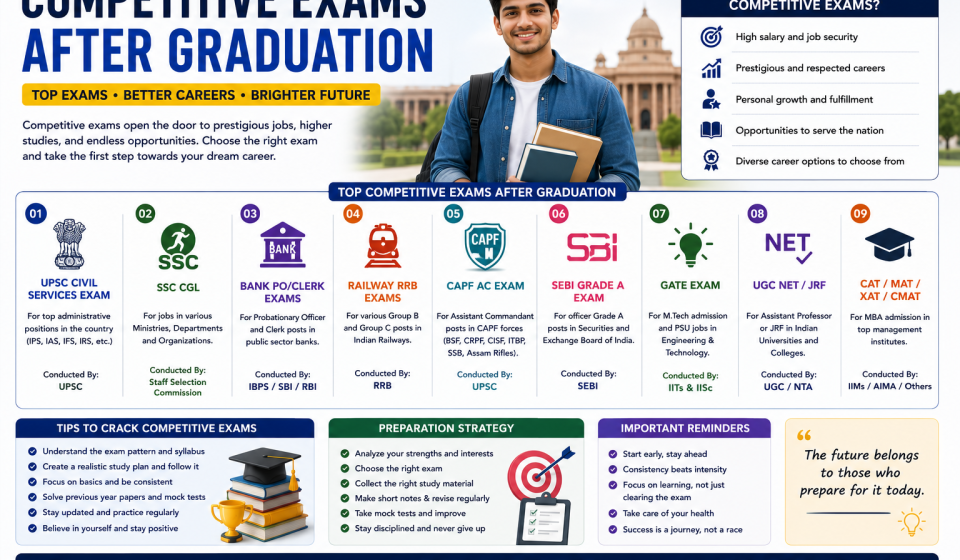
Competitive Exams After Graduation: Complete Guide to the Best Career Opportunities, Government Jobs, Higher Studies, and Professional Success

The increasing competition in the job market has made competitive exams an attractive choice for graduates seeking stable careers, financial security, professional growth, and social recognition.
Graduation is a significant milestone in a student’s academic journey, opening the door to numerous career opportunities and professional pathways. After completing a bachelor’s degree, many graduates face the important question of what to do next. While some choose to enter the workforce directly, others pursue higher education, professional certifications, or competitive examinations. Competitive exams are particularly popular because they provide access to prestigious government jobs, public sector opportunities, management programs, research careers, banking positions, defense services, and various specialized professions. Preparing for these examinations requires dedication, strategic planning, and a clear understanding of available options. Whether a student aspires to become a civil servant, bank officer, researcher, management professional, teacher, engineer, or defense officer, there are numerous examinations designed to support these goals. Understanding the eligibility criteria, exam patterns, career opportunities, and preparation strategies associated with different competitive exams can help graduates make informed decisions. This comprehensive guide explores the most important competitive exams after graduation and provides valuable insights into building a successful career.
Why Consider Competitive Exams After Graduation?
Competitive examinations offer numerous advantages for graduates.
Major benefits include:
Career stability
Professional growth
Attractive salaries
Government benefits
Social prestige
Leadership opportunities
Structured career progression
These exams open pathways to highly respected professions.
Civil Services Examination (UPSC CSE)
The Civil Services Examination conducted by the Union Public Service Commission is among India’s most prestigious competitive exams.
Successful candidates can join services such as:
Indian Administrative Service (IAS)
Indian Police Service (IPS)
Indian Foreign Service (IFS)
Indian Revenue Service (IRS)
Civil servants play critical roles in governance and public administration.
Eligibility
Bachelor’s degree from a recognized university.
Benefits
High social status
Leadership responsibilities
Nation-building opportunities
Career security
UPSC remains a dream career option for many graduates.
State Public Service Commission Exams
Every state conducts examinations for administrative positions.
Examples include:
State Administrative Services
State Police Services
Revenue Services
Development Services
These exams offer opportunities to serve at the state level.
Staff Selection Commission Combined Graduate Level Examination
SSC CGL is one of the most popular exams for graduates.
Recruitment areas include:
Income Tax Department
Central Secretariat
Customs Department
Audit Services
Ministries and departments
SSC CGL provides diverse government career opportunities.
Banking Sector Examinations
The banking industry recruits graduates through competitive examinations.
Popular exams include:
IBPS PO
IBPS Clerk
SBI PO
SBI Clerk
RBI Grade B
Banking careers offer excellent growth opportunities.
Benefits
Job stability
Attractive salaries
Promotional opportunities
Financial sector exposure
Banking remains a preferred career option for graduates.
Reserve Bank of India Grade B Examination
The RBI Grade B examination is highly respected.
Career opportunities include:
Central banking
Economic policy
Financial regulation
Research
RBI officers enjoy excellent professional growth and compensation.
Insurance Sector Examinations
Insurance organizations recruit graduates through competitive exams.
Examples include:
LIC AAO
NICL AO
UIIC AO
Insurance careers combine financial services and public engagement.
Railway Recruitment Examinations
Indian Railways is one of the largest employers in the country.
Popular graduate-level exams include:
Railway NTPC
Railway management positions
Administrative roles
Technical services
Railway careers provide stability and growth.
Defense Services Examinations
Graduates interested in serving the nation can explore defense careers.
Major examinations include:
Combined Defence Services (CDS)
Air Force Common Admission Test (AFCAT)
Defense recruitment examinations
Defense careers offer leadership, discipline, and adventure.
Combined Defence Services Examination
CDS recruits officers for:
Indian Army
Indian Navy
Indian Air Force
Officer Training Academy
The examination is conducted by UPSC.
Air Force Common Admission Test
AFCAT provides opportunities in:
Flying Branch
Ground Duty Technical Branch
Ground Duty Non-Technical Branch
The Indian Air Force offers dynamic career opportunities.
Graduate Aptitude Test in Engineering (GATE)
GATE is important for engineering and science graduates.
Benefits include:
Admission to postgraduate programs
Research opportunities
Public sector recruitment
Technical career advancement
Many prestigious institutions accept GATE scores.
Common Admission Test (CAT)
CAT is the most popular MBA entrance examination in India.
Admission opportunities include:
Indian Institutes of Management (IIMs)
Leading business schools
Management education institutions
An MBA can significantly enhance career prospects.
Management Aptitude Tests
Other management entrance examinations include:
XAT
CMAT
MAT
SNAP
NMAT
These exams support admission to various business schools.
Common University Entrance Test for Postgraduate Programs
CUET PG provides admission opportunities to postgraduate programs across participating universities.
Benefits include:
Centralized admissions
Multiple program options
Higher education opportunities
The examination has gained significant popularity.
National Eligibility Test (NET)
The UGC NET examination supports careers in academia and research.
Successful candidates may qualify for:
Assistant Professor positions
Research fellowships
Academic careers
NET is important for aspiring educators and researchers.
CSIR NET Examination
Science graduates can pursue research careers through CSIR NET.
Supported fields include:
Life Sciences
Chemical Sciences
Physical Sciences
Mathematical Sciences
Research opportunities continue to expand.
Teacher Eligibility and Recruitment Exams
Graduates interested in teaching can pursue:
CTET
State Teacher Eligibility Tests
School recruitment examinations
Teaching remains a respected and rewarding profession.
Law Entrance Examinations
Law graduates may pursue specialized legal education through examinations such as:
CLAT PG
AILET
Law entrance exams support advanced legal careers.
Chartered Accountancy and Professional Certifications
Commerce graduates often pursue:
Chartered Accountancy (CA)
Company Secretary (CS)
Cost and Management Accountancy (CMA)
These qualifications offer excellent career prospects.
Public Sector Undertaking Recruitment
Many PSUs recruit graduates through competitive examinations.
Examples include:
Energy companies
Oil corporations
Infrastructure organizations
Engineering enterprises
PSU careers provide stability and attractive benefits.
Research and Fellowship Examinations
Research-oriented graduates can pursue opportunities through:
Research fellowships
Doctoral entrance tests
Academic recruitment exams
Research careers contribute to innovation and knowledge development.
Data Science and Technology Certifications
Technology-focused graduates increasingly pursue certifications in:
Artificial Intelligence
Machine Learning
Cybersecurity
Cloud Computing
Data Analytics
These certifications complement traditional competitive exams.
Factors to Consider When Choosing an Exam
Students should evaluate:
Career interests
Educational background
Long-term goals
Salary expectations
Work-life balance
Personal strengths
Choosing the right examination improves motivation and success.
Preparation Strategies for Competitive Exams
Effective preparation includes:
Understanding the syllabus
Creating study schedules
Practicing mock tests
Managing time effectively
Reviewing previous papers
Maintaining consistency
Strategic preparation significantly improves performance.
Importance of Time Management
Competitive examinations require disciplined preparation.
Benefits of good time management include:
Improved productivity
Reduced stress
Balanced preparation
Better revision
Efficient learning
Time management is a critical success factor.
Role of Current Affairs
Many competitive examinations test awareness of current events.
Students should regularly follow:
National news
International developments
Economic updates
Government policies
Current affairs preparation enhances overall performance.
Importance of Mock Tests
Mock tests help candidates:
Assess readiness
Identify weaknesses
Improve speed
Build confidence
Develop exam strategies
Regular practice improves outcomes.
Career Benefits of Competitive Exams
Successful candidates often enjoy:
Job security
Professional prestige
Structured career growth
Financial stability
Leadership opportunities
Competitive examinations continue to attract millions of aspirants.
Challenges of Competitive Exam Preparation
Common challenges include:
Intense competition
Large syllabi
Time pressure
Stress management
Consistency requirements
Proper planning helps overcome these obstacles.
Future Trends in Competitive Examinations
Technology, digital assessment systems, artificial intelligence, online learning platforms, and changing workforce requirements are transforming competitive examination preparation. Increasing emphasis is being placed on analytical thinking, problem-solving, communication skills, and technological competence. Graduates who combine traditional exam preparation with continuous skill development and professional learning will be better positioned to succeed in evolving career landscapes.
Source
https://www.upsc.gov.in
https://ssc.nic.in
https://ibps.in
https://gate2026.iitr.ac.in
https://ugcnet.nta.ac.in
https://cat2026.iimcat.ac.in
Conclusion
Competitive examinations provide graduates with numerous opportunities for career advancement, professional development, higher education, and public service. From civil services and banking careers to management education, research positions, defense services, and public sector employment, graduates can choose from a wide variety of pathways based on their interests and aspirations. Success in these examinations requires dedication, strategic planning, disciplined preparation, and continuous learning. By selecting the right examination and following a structured preparation strategy, graduates can achieve their career goals and build successful futures.
FAQ
1. Which is the best competitive exam after graduation?
The best exam depends on individual career goals. UPSC, SSC CGL, CAT, GATE, IBPS PO, and UGC NET are among the most popular options.
2. Can graduates from any stream apply for UPSC?
Yes, graduates from recognized universities across all academic disciplines can apply for UPSC Civil Services Examination.
3. Which exam is best for banking careers?
IBPS PO, SBI PO, RBI Grade B, and IBPS Clerk are among the most popular banking examinations.
4. Is CAT only for management students?
No, graduates from any discipline can appear for the CAT examination if they meet eligibility requirements.
5. What is the purpose of GATE?
GATE supports admission to postgraduate programs, research opportunities, and recruitment by public sector organizations.
6. Why are mock tests important?
Mock tests help improve speed, accuracy, confidence, time management, and exam readiness.
7. What competitive exams are available for teaching careers?
UGC NET, CSIR NET, CTET, and state-level teacher eligibility examinations support teaching and academic careers.
8. How should graduates choose the right competitive exam?
Students should evaluate career interests, strengths, educational background, professional goals, and job preferences before choosing an examination.