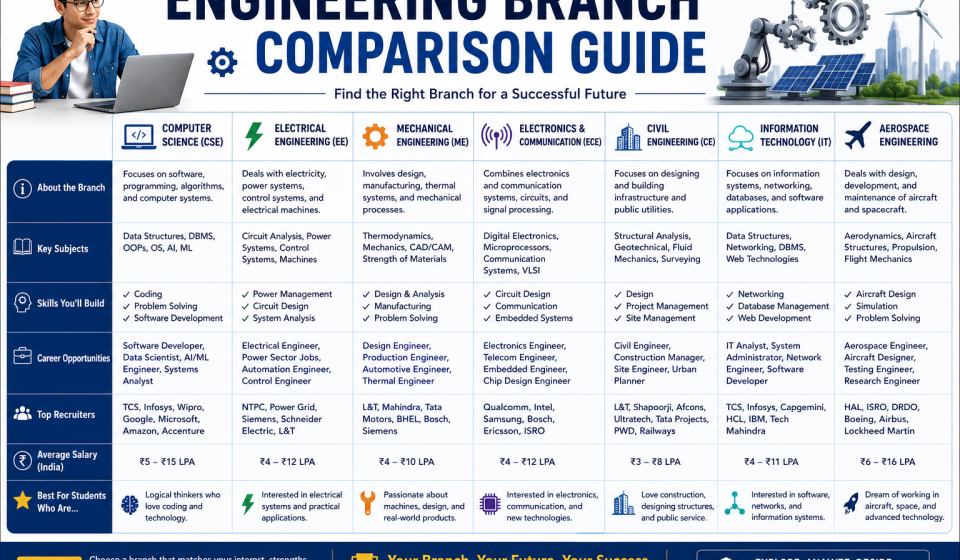
Engineering Branch Comparison Guide 2026: Choose the Best Engineering Stream for a Successful Career

This comprehensive engineering branch comparison guide will help students understand the strengths, opportunities, and challenges associated with major engineering disciplines.
Engineering remains one of the most popular career choices among students in India and across the world. Every year, millions of students appear for engineering entrance examinations with dreams of building successful careers in technology, innovation, manufacturing, infrastructure, and research. However, selecting the right engineering branch is often one of the most challenging decisions students face after completing higher secondary education. With numerous specializations available, understanding the differences between various engineering streams is essential for making an informed choice.The engineering field has evolved significantly over the years. Traditional branches such as Civil, Mechanical, Electrical, and Chemical Engineering continue to offer excellent career opportunities, while modern disciplines like Computer Science, Artificial Intelligence, Data Science, Cyber Security, and Robotics are experiencing unprecedented growth. Each branch has its own curriculum, skill requirements, career prospects, salary potential, and future scope.
Why Choosing the Right Engineering Branch Matters
Your engineering branch determines the subjects you study, the skills you develop, internship opportunities, job roles, and long-term career growth. While college reputation is important, selecting a branch that aligns with your interests and strengths is equally crucial.
Benefits of choosing the right engineering branch include:
- Better academic performance
- Higher job satisfaction
- Strong career growth
- Better salary opportunities
- Increased motivation and learning
- Long-term professional success
Factors to Consider Before Choosing an Engineering Branch
Personal Interest
Students should choose a branch based on genuine interest rather than market trends alone.
Career Opportunities
Evaluate employment demand and industry growth before making a decision.
Salary Potential
Different branches offer varying salary packages depending on industry demand.
Higher Education Opportunities
Some branches provide broader options for postgraduate studies and research.
Future Industry Trends
Technological advancements continue to reshape engineering careers worldwide.
Computer Science Engineering (CSE)
Computer Science Engineering is currently one of the most sought-after engineering branches.
Core Subjects
- Programming
- Data Structures
- Algorithms
- Database Management
- Artificial Intelligence
- Machine Learning
- Operating Systems
Career Opportunities
- Software Developer
- Data Scientist
- AI Engineer
- Cloud Engineer
- Cyber Security Specialist
- Full Stack Developer
Advantages
- High salary potential
- Global demand
- Remote work opportunities
- Rapid career growth
Challenges
- Continuous skill upgrading required
- Highly competitive field
Future Scope
Excellent due to advancements in AI, cloud computing, automation, and digital transformation.
Information Technology (IT)
Information Technology focuses on software applications, networking, databases, and business technology solutions.
Career Roles
- IT Consultant
- System Administrator
- Network Engineer
- Software Engineer
- Database Administrator
Benefits
- Strong employment opportunities
- Growing technology sector
- Attractive salary packages
Future Scope
Very strong as businesses continue adopting digital technologies.
Artificial Intelligence and Data Science
AI and Data Science are among the fastest-growing engineering disciplines.
Subjects Covered
- Machine Learning
- Deep Learning
- Data Analytics
- Neural Networks
- Big Data Technologies
Career Opportunities
- AI Engineer
- Data Scientist
- Machine Learning Engineer
- Research Scientist
Advantages
- High demand worldwide
- Premium salary packages
- Excellent future prospects
Future Scope
Exceptional due to increasing AI adoption across industries.
Electronics and Communication Engineering (ECE)
ECE combines electronics, communication systems, and digital technologies.
Core Areas
- Communication Systems
- Embedded Systems
- VLSI Design
- Signal Processing
- Wireless Technologies
Career Opportunities
- Electronics Engineer
- Embedded Systems Engineer
- Telecom Engineer
- Semiconductor Specialist
Advantages
- Diverse career paths
- Opportunities in core and software industries
Future Scope
Strong growth driven by 5G, IoT, semiconductor manufacturing, and communication technologies.
Electrical Engineering (EE)
Electrical Engineering focuses on power generation, transmission, electrical systems, and automation.
Subjects
- Power Systems
- Electrical Machines
- Control Systems
- Renewable Energy
Career Opportunities
- Electrical Engineer
- Power Plant Engineer
- Energy Consultant
- Automation Engineer
Advantages
- Stable industry demand
- Government sector opportunities
Future Scope
Promising due to renewable energy and smart grid developments.
Mechanical Engineering (ME)
Mechanical Engineering is one of the oldest and broadest engineering branches.
Core Subjects
- Thermodynamics
- Fluid Mechanics
- Manufacturing Processes
- Machine Design
Career Opportunities
- Design Engineer
- Production Engineer
- Automotive Engineer
- Maintenance Engineer
Advantages
- Versatile career options
- Foundation for multiple industries
Challenges
- Requires strong practical understanding
Future Scope
Growing through automation, robotics, electric vehicles, and advanced manufacturing.
Civil Engineering
Civil Engineering focuses on infrastructure development and construction projects.
Subjects Covered
- Structural Engineering
- Transportation Engineering
- Environmental Engineering
- Construction Management
Career Opportunities
- Structural Engineer
- Site Engineer
- Project Manager
- Urban Planner
Advantages
- Essential industry
- Significant government projects
Future Scope
Excellent due to urbanization and infrastructure expansion.
Chemical Engineering
Chemical Engineering applies chemistry, physics, and engineering principles to industrial processes.
Career Opportunities
- Process Engineer
- Production Engineer
- Quality Control Specialist
- Petrochemical Engineer
Industries
- Pharmaceuticals
- Oil and Gas
- Chemicals
- Food Processing
Future Scope
Strong demand in manufacturing and pharmaceutical sectors.
Aerospace Engineering
Aerospace Engineering focuses on aircraft and spacecraft design.
Subjects
- Aerodynamics
- Propulsion Systems
- Aircraft Structures
Career Opportunities
- Aerospace Engineer
- Aircraft Design Engineer
- Space Research Scientist
Advantages
- Prestigious career path
- High-tech work environment
Future Scope
Growing due to advancements in aviation and space exploration.
Biotechnology Engineering
Biotechnology integrates biology and technology for healthcare and agricultural innovation.
Career Opportunities
- Research Scientist
- Biotech Engineer
- Clinical Research Associate
Industries
- Healthcare
- Pharmaceuticals
- Agriculture
Future Scope
Strong growth in healthcare and genetic research.
Cyber Security Engineering
Cyber Security has emerged as a highly specialized engineering discipline.
Subjects
- Ethical Hacking
- Network Security
- Cryptography
- Digital Forensics
Career Opportunities
- Cyber Security Analyst
- Ethical Hacker
- Security Consultant
Future Scope
Exceptional due to increasing cyber threats worldwide.
Robotics Engineering
Robotics combines mechanical, electrical, and software engineering.
Career Roles
- Robotics Engineer
- Automation Specialist
- AI Robotics Developer
Future Scope
Rapid growth driven by industrial automation and AI integration.
Engineering Branch Comparison Table
| Branch | Job Demand | Salary Potential | Future Scope |
|---|---|---|---|
| Computer Science | Very High | Very High | Excellent |
| IT | High | High | Excellent |
| AI & Data Science | Very High | Very High | Excellent |
| ECE | High | High | Strong |
| Electrical | Moderate to High | Good | Strong |
| Mechanical | Moderate | Good | Strong |
| Civil | Moderate | Good | Strong |
| Chemical | Moderate | Good | Strong |
| Aerospace | Specialized | High | Growing |
| Biotechnology | Growing | Good | Strong |
| Cyber Security | Very High | Very High | Excellent |
| Robotics | Growing | High | Excellent |
Highest Paying Engineering Branches
Based on current industry trends:
- Computer Science Engineering
- Artificial Intelligence
- Data Science
- Cyber Security
- Robotics Engineering
- Software Engineering
- Electronics and Communication Engineering
Best Engineering Branches for Government Jobs
Students aiming for government careers may prefer:
- Civil Engineering
- Mechanical Engineering
- Electrical Engineering
- Electronics Engineering
These branches offer opportunities through UPSC Engineering Services, PSUs, Railways, and state government departments.
Best Engineering Branches for Higher Studies
Popular choices for postgraduate education include:
- Computer Science
- Artificial Intelligence
- Mechanical Engineering
- Biotechnology
- Aerospace Engineering
Future Trends in Engineering
Several emerging technologies are expected to transform engineering careers:
- Artificial Intelligence
- Machine Learning
- Quantum Computing
- Renewable Energy
- Robotics
- Smart Manufacturing
- Cyber Security
- Space Technology
- Electric Vehicles
- Internet of Things (IoT)
Students choosing branches aligned with these technologies may enjoy stronger career growth over the coming decades.
Source Links
https://www.aicte-india.org
https://www.nirfindia.org
https://www.iitb.ac.in
https://www.iitm.ac.in
Conclusion
Choosing the right engineering branch is one of the most important academic and career decisions a student will make. While Computer Science, Artificial Intelligence, Data Science, and Cyber Security currently dominate industry demand, traditional branches such as Mechanical, Civil, Electrical, and Chemical Engineering continue to offer stable and rewarding careers. Students should consider their interests, strengths, career aspirations, and future industry trends before making a decision. A well-informed choice can lead to academic success, professional growth, and long-term career satisfaction in the ever-evolving world of engineering.
FAQ
Which engineering branch has the highest salary?
Computer Science Engineering, Artificial Intelligence, Data Science, and Cyber Security generally offer the highest salary packages.
Which engineering branch is best for the future?
AI, Data Science, Cyber Security, Robotics, and Computer Science are considered among the best branches for future growth.
Is Mechanical Engineering still a good career option?
Yes, Mechanical Engineering remains valuable due to its applications in manufacturing, automotive, robotics, and energy sectors.
Which engineering branch is easiest?
The difficulty level varies based on individual interests and strengths rather than the branch itself.
Can Civil Engineers get government jobs?
Yes, Civil Engineers have excellent opportunities in government departments, public sector undertakings, and infrastructure projects.
Is Electronics and Communication Engineering a good choice?
Yes, ECE offers diverse career opportunities in telecommunications, semiconductors, embedded systems, and software industries.
Which engineering branch has the highest demand abroad?
Computer Science, AI, Data Science, Cyber Security, Electrical Engineering, and Mechanical Engineering are highly demanded globally.
Should I choose a branch based only on salary?
No, students should consider personal interests, skills, aptitude, and long-term career goals along with salary prospects.