Top Competitive Exams After Graduation in India 2026: Complete Career Guide for Government, Banking, Management, and Higher Studies

Understanding the eligibility criteria, exam pattern, preparation strategy, and career prospects associated with each examination is crucial for making the right decision.
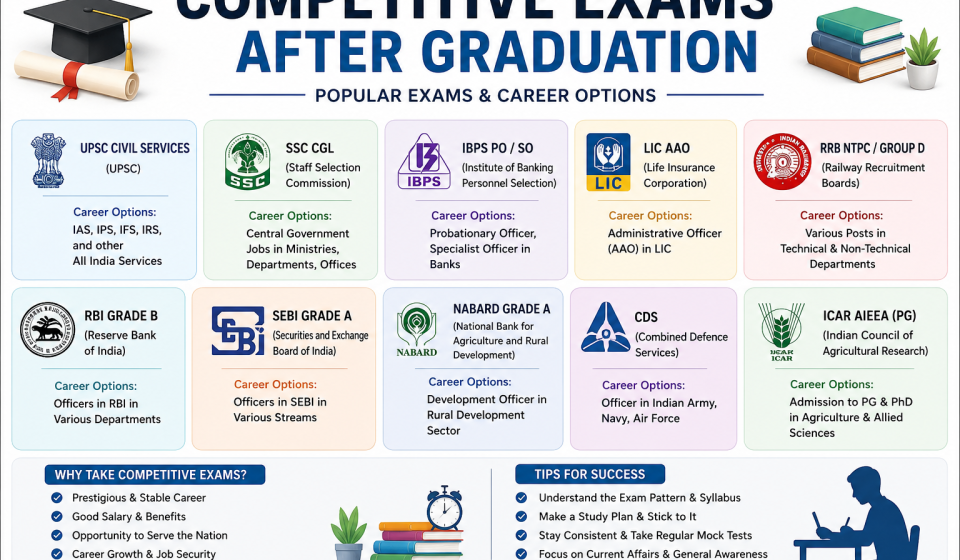
Graduation is an important milestone that opens the door to numerous career opportunities. However, in today’s highly competitive job market, earning a degree alone may not be enough to secure a rewarding career. Many graduates choose to appear for competitive examinations to gain access to prestigious government jobs, banking positions, management programs, civil services, defense careers, and higher education opportunities. These examinations not only help candidates achieve financial stability but also provide professional growth, social recognition, and long-term career security.
India offers a wide range of competitive exams for graduates from different educational backgrounds. Whether you belong to commerce, science, arts, engineering, law, or management, there are several examinations designed to help you reach your career goals.This comprehensive guide explores the most popular competitive exams after graduation and helps you identify the best option based on your interests and aspirations.
Why Choose Competitive Exams After Graduation?
Competitive examinations provide a structured path toward professional success. They are designed to assess a candidate’s aptitude, knowledge, analytical abilities, communication skills, and subject expertise. Success in these examinations often leads to stable careers with attractive salaries, job security, and growth opportunities.
Some major advantages include:
- High-paying career opportunities
- Job security in government sectors
- Opportunities for promotions and career advancement
- Social prestige and recognition
- Attractive benefits and allowances
- Opportunities to serve society and the nation
- Access to higher education and specialized professional courses
UPSC Civil Services Examination (CSE)
The Civil Services Examination conducted by the Union Public Service Commission is considered India’s most prestigious competitive examination. It recruits candidates for elite services such as IAS, IPS, IFS, and IRS.
Eligibility
- Bachelor’s degree from a recognized university
- Age between 21 and 32 years for General category candidates
- Age relaxation available for reserved categories
Selection Process
- Preliminary Examination
- Main Examination
- Personality Test (Interview)
Career Opportunities
- Indian Administrative Service (IAS)
- Indian Police Service (IPS)
- Indian Foreign Service (IFS)
- Indian Revenue Service (IRS)
Why Choose UPSC?
UPSC offers opportunities to participate directly in policy-making, governance, administration, and national development.
SSC Combined Graduate Level Examination (SSC CGL)
SSC CGL is one of the most sought-after examinations for graduates seeking central government jobs.
Eligibility
- Graduation from a recognized university
- Specific posts may require additional qualifications
Popular Posts
- Income Tax Inspector
- Assistant Section Officer
- Central Excise Inspector
- Auditor
- Accountant
Benefits
- Stable government career
- Good salary packages
- Work-life balance
- Pension benefits
IBPS PO and SBI PO Examinations
Banking remains one of the most preferred career sectors among graduates. Probationary Officer examinations conducted by IBPS and SBI attract lakhs of candidates every year.
Eligibility
- Bachelor’s degree in any discipline
- Basic computer knowledge
Selection Process
- Preliminary Examination
- Main Examination
- Interview
Career Growth
Bank Probationary Officers can rise to senior management positions including Branch Manager, Regional Manager, and General Manager.
Advantages
- Attractive salary
- Job security
- Fast promotions
- Performance-based incentives
RBI Grade B Examination
The Reserve Bank of India Grade B examination is among the most prestigious banking sector exams.
Eligibility
- Graduation with minimum qualifying marks
- Some positions require postgraduate qualifications
Job Responsibilities
- Monetary policy implementation
- Financial regulation
- Economic analysis
- Banking supervision
Benefits
- Excellent salary package
- Prestigious position
- Professional development opportunities
CAT (Common Admission Test)
CAT is the gateway to India’s premier management institutions including IIMs.
Eligibility
- Bachelor’s degree with minimum required percentage
Subjects Covered
- Quantitative Aptitude
- Verbal Ability
- Logical Reasoning
- Data Interpretation
Career Opportunities
After completing an MBA from top institutions, candidates can secure positions in:
- Consulting
- Finance
- Marketing
- Operations
- Human Resources
Why Choose CAT?
Graduates can access high-paying corporate careers and leadership roles.
GATE (Graduate Aptitude Test in Engineering)
GATE is highly popular among engineering and science graduates.
Eligibility
- Engineering graduates
- Science graduates
- Final-year students
Benefits
- Admission to M.Tech programs
- PSU recruitment
- Research opportunities
- Scholarships
Popular Recruiters
Many Public Sector Undertakings recruit through GATE scores, offering excellent salary packages.
CDS (Combined Defence Services Examination)
The UPSC conducts the CDS examination for recruitment into the Indian Armed Forces.
Eligibility
- Graduation from a recognized university
- Specific educational qualifications for different academies
Academies
- Indian Military Academy
- Indian Naval Academy
- Air Force Academy
- Officers Training Academy
Benefits
- Respectable career
- Adventure and leadership opportunities
- Attractive salary and allowances
AFCAT (Air Force Common Admission Test)
AFCAT provides graduates an opportunity to join the Indian Air Force.
Eligibility
- Graduation with required percentage
- Technical and non-technical entries available
Career Benefits
- Leadership opportunities
- Attractive compensation
- National service
- Excellent lifestyle and benefits
LIC AAO Examination
Life Insurance Corporation of India conducts the Assistant Administrative Officer examination.
Eligibility
- Graduation from a recognized university
Advantages
- Government-backed organization
- Stable employment
- Competitive salary
- Career growth opportunities
NABARD Grade A and Grade B Examinations
The National Bank for Agriculture and Rural Development recruits officers through these examinations.
Responsibilities
- Rural development
- Agricultural financing
- Policy implementation
- Economic development projects
Benefits
- Prestigious position
- Good salary package
- Contribution to rural growth
Railway Recruitment Board (RRB) Exams
The Railway Recruitment Board conducts various examinations for graduates.
Popular Posts
- Station Master
- Traffic Assistant
- Commercial Apprentice
- Goods Guard
Benefits
- Government job security
- Housing benefits
- Medical facilities
- Pension schemes
State Public Service Commission Exams
Every state conducts examinations similar to UPSC for administrative positions.
Popular Examples
- GPSC
- MPSC
- UPPSC
- RPSC
- BPSC
Career Opportunities
- Deputy Collector
- Deputy Superintendent of Police
- Block Development Officer
- State Tax Officer
UGC NET Examination
UGC NET is ideal for graduates who wish to pursue academic and research careers after post-graduation.
Benefits
- Assistant Professor eligibility
- Junior Research Fellowship
- Academic career opportunities
Career Options
- Teaching
- Research
- Higher education institutions
CLAT PG Examination
Law graduates can pursue higher legal education through CLAT PG.
Opportunities
- LLM admissions
- Research positions
- Academic careers
- Public sector legal jobs
NIFT and Design Entrance Examinations
Graduates interested in design and fashion management can appear for design-related entrance examinations.
Career Opportunities
- Fashion Design
- Product Design
- Interior Design
- Creative Management
Preparation Strategy for Competitive Exams
Understand the Syllabus
A clear understanding of the syllabus helps candidates focus on important topics and avoid unnecessary study material.
Create a Study Plan
Develop a realistic timetable that includes daily study goals, revision sessions, and practice tests.
Focus on Current Affairs
Many competitive examinations emphasize current events, economic developments, and national issues.
Practice Mock Tests
Regular mock tests improve speed, accuracy, and time management skills.
Strengthen Basics
A strong foundation in mathematics, reasoning, English, and general knowledge is essential.
Revise Consistently
Frequent revision helps retain information and improves exam performance.
Common Mistakes to Avoid
- Ignoring the syllabus
- Lack of revision
- Overdependence on multiple study materials
- Poor time management
- Neglecting mock tests
- Inconsistent preparation
Choosing the Right Competitive Exam
Before selecting an examination, evaluate:
- Personal interests
- Career goals
- Educational background
- Strengths and weaknesses
- Long-term aspirations
Candidates interested in administration may choose UPSC or State PSC examinations. Those seeking banking careers can focus on IBPS, SBI, RBI, or NABARD. Engineering graduates may prefer GATE, while management aspirants can target CAT.
Source Links
https://www.sbi.co.in
https://www.rbi.org.in
https://iimcat.ac.in
https://gate2026.iitr.ac.in
https://ugcnet.nta.ac.in
https://www.joinindianarmy.nic.in
Conclusion
Competitive examinations after graduation provide a gateway to some of the most respected and rewarding careers in India. Whether your goal is to become a civil servant, banker, defense officer, management professional, researcher, or government officer, there is an examination suited to your aspirations. Success requires careful planning, consistent preparation, disciplined study habits, and a clear understanding of your career objectives. By selecting the right examination and dedicating sufficient effort toward preparation, graduates can build a secure, fulfilling, and successful future.
FAQ
1.Which is the best competitive exam after graduation?
The best exam depends on your career goals. UPSC is ideal for administrative services, CAT for management careers, GATE for engineering opportunities, and IBPS/SBI PO for banking jobs.
2.Can I prepare for multiple competitive exams simultaneously?
Yes, many exams share common subjects such as reasoning, aptitude, English, and general awareness, making simultaneous preparation possible.
3.Which competitive exam offers the highest salary?
UPSC services, RBI Grade B, and MBA programs through top IIMs generally provide some of the highest salary packages and career growth opportunities.
4.Is coaching necessary for competitive exams?
Coaching is not mandatory. Many successful candidates clear examinations through self-study, proper planning, and consistent practice.
5.How many hours should I study daily?
Most successful candidates study between 4 and 8 hours daily depending on the examination and preparation stage.
6.Which exam is easier after graduation?
SSC CGL, IBPS Clerk, and certain state-level examinations are often considered comparatively easier than UPSC and CAT.
7.Can arts graduates appear for competitive exams?
Yes, arts graduates are eligible for UPSC, SSC, banking exams, state PSC examinations, CAT, and several other competitive exams.
8.What is the age limit for UPSC Civil Services?
Generally, the age limit is 21 to 32 years for General category candidates, with relaxations available for reserved categories.