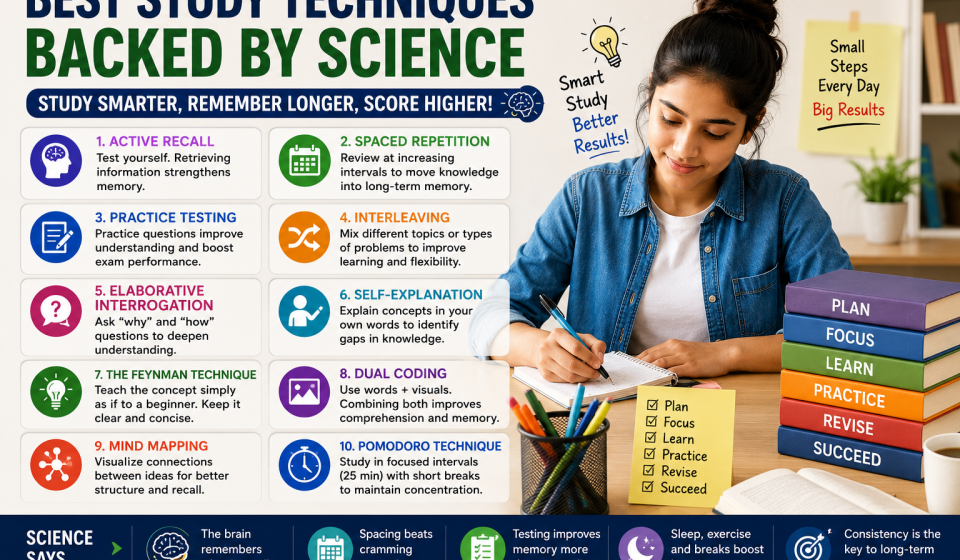

Discover the best study techniques backed by science, including active recall, spaced repetition, and proven learning strategies to improve memory and exam performance.
Many students spend long hours studying but still struggle to remember information during exams. The problem is not always lack of effort. Often, it is the use of ineffective study methods. Reading the same chapter again and again, highlighting too much text, or studying only one night before the exam may feel productive, but these methods do not always lead to strong learning.
Science shows that the brain learns better when students actively recall information, revise at spaced intervals, test themselves, connect ideas, and get enough sleep. These methods help move knowledge from short-term memory to long-term memory.
This article explains the best study techniques backed by science. These strategies can help school students, college students, and competitive exam aspirants study smarter, remember longer, and perform better in exams.
Active Recall
Active recall is one of the most powerful study techniques. Instead of simply reading notes, students close the book and try to remember what they studied. This process forces the brain to retrieve information, making memory stronger.
For example, after reading a topic, ask yourself: What are the main points? Can I explain this without looking? What questions can be asked from this topic?
Active recall works because exams require students to remember and apply knowledge. The more you practice recalling, the easier it becomes to remember information during tests.
Spaced Repetition
Spaced repetition means reviewing information at increasing time intervals. Instead of studying everything in one long session, students revise the topic after one day, then after three days, then after one week, and later after two weeks.
This technique helps fight forgetting. The brain naturally forgets information over time, but spaced revision reminds the brain before the memory becomes weak.
Students can use flashcards, revision calendars, or spaced repetition apps to follow this method. It is especially useful for formulas, definitions, vocabulary, historical dates, and science concepts.
Practice Testing
Practice testing is another science-backed technique that improves exam performance. It includes solving sample papers, quizzes, previous year papers, and self-made questions.
Testing yourself helps identify what you know and what you still need to improve. It also reduces exam fear because students become familiar with question patterns and time limits.
Practice testing is not only for checking knowledge; it is also a learning method. Every test strengthens memory and improves confidence.
Interleaving
Interleaving means mixing different types of problems or topics during study instead of studying only one topic for a long time. For example, instead of solving only algebra problems for two hours, a student can mix algebra, geometry, and word problems.
This method trains the brain to choose the right strategy for different questions. It is especially useful for mathematics, science, languages, and competitive exams.
At first, interleaving may feel difficult, but it improves problem-solving skills and long-term understanding.
Elaborative Interrogation
Elaborative interrogation means asking “why” and “how” questions while studying. Instead of memorizing facts blindly, students try to understand the reason behind them.
For example, instead of only remembering that plants need sunlight, ask: Why do plants need sunlight? How does sunlight help in photosynthesis?
This technique helps students connect new information with existing knowledge. When concepts are understood deeply, they become easier to remember.
Self-Explanation
Self-explanation means explaining a concept to yourself in simple words. After learning a topic, students should try to say or write what they understood without copying from the textbook.
For example, after solving a math problem, explain each step: Why did I use this formula? What was the logic behind this step?
Self-explanation improves understanding and reveals gaps in knowledge. If you cannot explain something clearly, it means you need to revise that part again.
The Feynman Technique
The Feynman Technique is a simple learning method based on explaining a topic as if teaching it to a beginner. Choose a concept, explain it in simple language, find weak areas, and then improve your explanation.
This method is useful because it removes confusion and makes learning clear. If you can explain a topic to a younger student, friend, or family member, you truly understand it.
The Feynman Technique is especially helpful for science, economics, history, and complex theoretical subjects.
Dual Coding
Dual coding means learning with both words and visuals. The brain remembers information better when text is combined with diagrams, charts, mind maps, timelines, or flowcharts.
For example, biology students can use diagrams to remember body systems. History students can use timelines. Geography students can use maps. Business students can use flowcharts.
Visual learning makes revision faster and helps students understand relationships between ideas.
Mind Mapping
Mind mapping is a technique where students write the main topic in the center and connect related ideas around it. It helps organize information visually.
Mind maps are useful for subjects with many subtopics, such as history, biology, political science, and literature. They help students see the full structure of a chapter in one place.
Mind mapping is also helpful before exams because students can revise large chapters quickly.
Pomodoro Technique
The Pomodoro Technique improves focus and reduces mental fatigue. In this method, students study for 25 minutes and then take a 5-minute break. After four sessions, they take a longer break.
This technique works because the brain performs better with short, focused study sessions. It also prevents distractions and helps students avoid burnout.
Students who struggle with concentration can use this method to build discipline and consistency.
Retrieval Practice With Flashcards
Flashcards are excellent tools for retrieval practice. Write a question on one side and the answer on the other. Try to answer before checking.
Flashcards are useful for definitions, formulas, vocabulary, dates, theories, and key terms. Digital flashcard apps can also follow spaced repetition, making learning more effective.
However, flashcards should not be used only for memorization. Students can also create concept-based questions to improve understanding.
Avoid Passive Rereading
Many students believe rereading the textbook multiple times is enough. While rereading can help with familiarity, it does not always improve memory.
Passive reading makes students feel like they know the topic, but they may forget it during exams. Instead of only rereading, students should combine reading with active recall, practice questions, and self-testing.
Reading should be the first step, not the entire study method.
Use Short Notes for Revision
Short notes help students revise faster and more effectively. After studying a topic, write key points, formulas, definitions, dates, diagrams, and examples in a simple format.
Good notes should not be too long. They should help you quickly remember the chapter before exams.
Using short notes with active recall is a powerful combination.
Sleep and Memory
Sleep plays an important role in learning. During sleep, the brain organizes and stores information. Students who sleep well often remember better and concentrate more effectively.
Studying all night before an exam can reduce focus and increase mistakes. Instead, students should maintain a regular sleep schedule, especially before exams.
A fresh brain learns faster than a tired brain.
Exercise and Brain Function
Physical activity improves blood flow, mood, and concentration. Even a short walk, stretching, or light exercise can refresh the mind.
Students do not need intense workouts. Simple daily movement can improve energy levels and reduce stress. A healthy body supports a healthy brain.
Reduce Distractions While Studying
Science-backed techniques work best when students study with full attention. Mobile phones, social media, television, and noise can reduce learning quality.
Students should create a clean study environment, keep the phone away, and study at a fixed time. Focused study for one hour is better than distracted study for three hours.
Create a Weekly Revision Plan
A weekly revision plan helps students stay consistent. Instead of waiting for exams, revise small portions every week.
For example, Monday can be for science revision, Tuesday for math practice, Wednesday for language writing, and so on. Weekly revision prevents last-minute pressure and improves long-term memory.
source
https://sl1nk.com/5tn13eo
https://sl1nk.com/w9nmsux
https://l1nq.com/cyb4arm
https://l1nq.com/r8rtued
Conclusion
The best study techniques backed by science focus on active learning, regular revision, and strong memory habits. Active recall, spaced repetition, practice testing, interleaving, self-explanation, dual coding, and the Feynman Technique help students understand concepts deeply and remember them for longer.
Students should avoid depending only on passive rereading or last-minute cramming. Instead, they should use smart techniques that improve focus, memory, and exam performance.
Studying effectively does not always mean studying longer. With the right science-backed methods, students can learn faster, revise better, and score higher with less stress.
Frequently Asked Questions
1. What is the best study technique backed by science?
Active recall and spaced repetition are among the most effective science-backed study techniques because they strengthen memory and improve long-term retention.
2. Is rereading notes a good study method?
Rereading can help with basic understanding, but it is less effective than active recall, practice testing, and spaced revision.
3. How can I remember what I study for a long time?
Use spaced repetition, self-testing, short notes, flashcards, and regular revision to remember information longer.
4. Does the Pomodoro Technique really help?
Yes. The Pomodoro Technique can improve focus by dividing study time into short, manageable sessions with breaks.
5. How can I study smarter instead of longer?
Study smarter by focusing on active recall, practice questions, important topics, proper revision, and distraction-free study sessions.