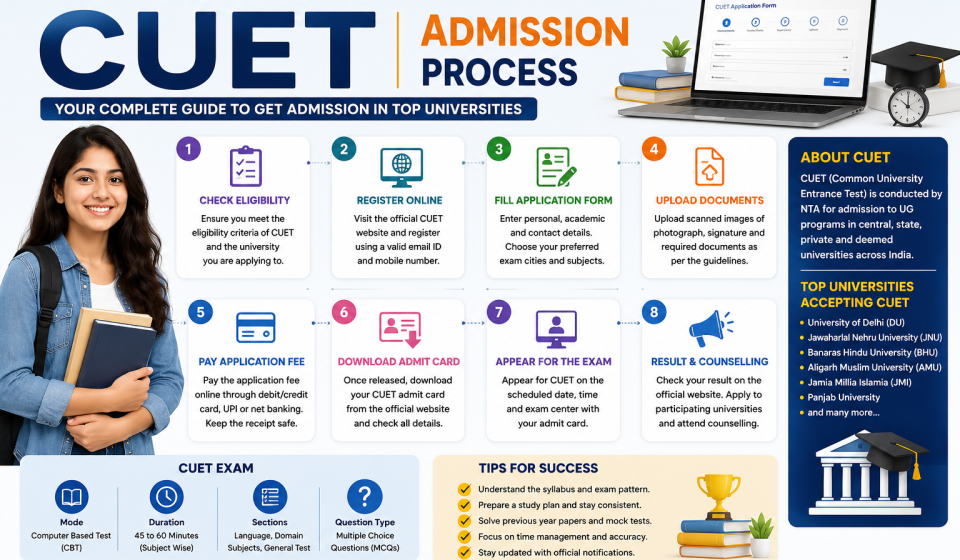
Everything About CUET Admission Process 2026: Complete Step-by-Step Guide for Students

The Common University Entrance Test (CUET) has become one of the most important entrance examinations for students seeking admission to undergraduate programs in India.
Introduced to create a standardized admission process across universities, CUET provides equal opportunities to students from different educational boards and backgrounds. Instead of relying solely on Class 12 marks, universities now use CUET scores to evaluate candidates, making admissions more transparent and merit-based.
With the growing number of participating universities, understanding the CUET admission process has become essential for students aiming to secure seats in top institutions. From registration and eligibility criteria to counseling and final admission, every step requires careful attention. This comprehensive guide covers everything students need to know about the CUET admission process, helping them navigate the journey smoothly and improve their chances of admission.
What is CUET?
The Common University Entrance Test (CUET) is a national-level entrance examination conducted by the National Testing Agency (NTA) for admission to undergraduate courses offered by participating central, state, private, and deemed universities across India. The examination was introduced to simplify the admission process and ensure fairness in student selection.
Before CUET, universities followed different admission procedures and cut-off systems based primarily on board examination results. This often created disparities among students from different boards. CUET addresses this challenge by providing a common platform where all candidates are assessed through a standardized examination.
Why CUET Was Introduced
The Indian higher education system witnessed increasing competition for admissions to prestigious universities. Different educational boards followed varying evaluation standards, making it difficult to compare student performance fairly. CUET was introduced to solve this issue and create a level playing field.
Major objectives of CUET include:
Ensuring fairness in admissions.
Reducing dependency on board examination marks.
Providing equal opportunities to all students.
Creating a standardized evaluation system.
Simplifying university admission procedures.
Enhancing transparency in the admission process.
Benefits of CUET for Students
CUET offers several advantages that make it beneficial for students across India.
Single entrance examination for multiple universities.
Standardized evaluation criteria.
Reduced pressure from board examination cut-offs.
Wider access to prestigious institutions.
Fair competition among candidates.
Convenient online application process.
Better transparency in admission decisions.
Students can apply to numerous universities using one examination score, saving both time and effort.
Universities Participating in CUET
CUET scores are accepted by a large number of universities throughout India. These include central universities, state universities, deemed universities, and private institutions.
Some prominent universities accepting CUET scores include:
University of Delhi
Banaras Hindu University
Jawaharlal Nehru University
Aligarh Muslim University
University of Hyderabad
Central University of Rajasthan
Central University of Punjab
Assam University
Babasaheb Bhimrao Ambedkar University
Guru Ghasidas Vishwavidyalaya
Many state and private universities
The list of participating institutions continues to expand every year.
CUET Eligibility Criteria
Before applying, students must ensure they meet the eligibility requirements specified by both CUET and their preferred universities.
General Eligibility Conditions
Candidates must have passed Class 12 or equivalent examination from a recognized board.
Students appearing in the Class 12 examination may also apply.
Specific courses may require particular subject combinations.
Universities may prescribe minimum percentage requirements.
There is generally no upper age limit unless specified by individual universities.
Since eligibility varies among institutions and programs, students should carefully review university-specific requirements.
Step-by-Step CUET Admission Process
Step 1: Online Registration
The first stage involves registration on the official CUET portal. Candidates create an account using personal details such as name, date of birth, email address, and mobile number.
After successful registration, login credentials are generated for accessing the application form.
Step 2: Filling the Application Form
Students must complete the application form accurately by providing personal, academic, and contact details.
Information typically required includes:
Personal information
Educational qualifications
Category details
Preferred examination centers
Subject selections
University preferences
Errors in the application form can create problems during admission and verification.
Step 3: Selecting Subjects
Candidates must carefully choose subjects based on course requirements and university eligibility criteria.
CUET generally includes:
Language tests
Domain-specific subjects
General aptitude test
Selecting the correct subjects is crucial because universities evaluate candidates according to specific subject combinations.
Step 4: Uploading Documents
Applicants are required to upload scanned copies of necessary documents.
Documents generally include:
Passport-size photograph
Signature
Category certificate
PwD certificate
Identity proof
Students must ensure uploaded files meet specified format and size requirements.
Step 5: Payment of Application Fee
After completing the application form, candidates must pay the prescribed examination fee through online payment methods.
Accepted payment options include:
Credit cards
Debit cards
Net banking
UPI
Digital wallets
The fee amount depends on category and selected subjects.
Step 6: Confirmation of Application
After successful payment, candidates receive confirmation of their submitted application.
Students should download and save the confirmation page for future reference.
CUET Exam Pattern
Understanding the exam pattern is essential for effective preparation.
The examination generally consists of three sections.
Language Section
Tests language proficiency and comprehension abilities.
Topics include:
Reading comprehension
Vocabulary
Grammar
Verbal ability
Domain-Specific Subjects
These sections evaluate knowledge related to specific academic subjects.
Examples include:
Physics
Chemistry
Biology
Mathematics
Economics
Business Studies
Political Science
History
Geography
General Test
This section measures overall aptitude and reasoning abilities.
Topics include:
General knowledge
Current affairs
Logical reasoning
Quantitative aptitude
Analytical skills
The exact pattern may vary depending on university requirements.
CUET Syllabus
The syllabus is primarily based on NCERT Class 12 curriculum and related concepts.
Students should focus on:
NCERT textbooks
Subject-specific fundamentals
Current affairs
Logical reasoning
Quantitative aptitude
Language comprehension
A strong understanding of Class 12 concepts forms the foundation for success in CUET.
Preparation Strategy for CUET
Preparing systematically can significantly improve performance.
Understand the Exam Pattern
Students should familiarize themselves with question formats, marking schemes, and time limits.
Create a Study Plan
A structured study schedule helps cover all subjects efficiently.
Focus on NCERT Books
NCERT textbooks remain the primary source for domain-specific preparation.
Practice Mock Tests
Mock examinations help students improve speed, accuracy, and confidence.
Solve Previous Year Questions
Previous papers provide valuable insights into question trends and difficulty levels.
Improve Time Management
Learning to allocate time effectively across sections is crucial during the actual examination.
CUET Admit Card
The admit card is an essential document for appearing in the examination.
It contains:
Candidate details
Roll number
Exam date
Reporting time
Exam center information
Important instructions
Students should verify all information carefully after downloading the admit card.
Examination Day Guidelines
To avoid issues on exam day, candidates should follow all official instructions.
Arrive at the center early.
Carry a printed admit card.
Bring a valid photo identification document.
Follow examination hall rules.
Avoid prohibited items such as electronic gadgets.
Non-compliance may result in disqualification.
CUET Result and Scorecard
Results are declared online through the official portal.
The scorecard includes:
Subject-wise scores
Percentile rankings
Overall performance
Candidate details
Qualifying status
Students should preserve scorecards for admission procedures.
University Admission Process After CUET
After results are announced, participating universities initiate their admission procedures.
Universities generally require candidates to:
Register separately on university portals.
Submit course preferences.
Participate in counseling rounds.
Complete document verification.
Pay admission fees.
Each university follows its own admission schedule and guidelines.
Merit List Preparation
Universities prepare merit lists based on:
CUET scores
Course requirements
Reservation policies
Seat availability
Category-based criteria
Students with higher scores generally have better chances of securing admission.
Counseling Process
Unlike some entrance examinations, CUET counseling is conducted individually by participating universities.
Counseling generally involves:
Online registration
Preference submission
Seat allotment
Document verification
Fee payment
Final admission confirmation
Students must regularly check university websites for updates.
Seat Allocation Process
Seat allocation depends on multiple factors.
CUET score
Course preference
Category
Reservation policy
Availability of seats
University-specific criteria
Candidates must accept allotted seats within specified deadlines.
Document Verification
Document verification is a critical stage of admission.
Required documents usually include:
CUET scorecard
Admit card
Class 10 mark sheet
Class 12 mark sheet
Transfer certificate
Migration certificate
Category certificate
Identity proof
Passport-size photographs
Providing authentic documents is mandatory for admission confirmation.
Reservation Policy
Universities follow reservation policies prescribed by the Government of India.
Common reservation categories include:
Scheduled Castes (SC)
Scheduled Tribes (ST)
Other Backward Classes (OBC)
Economically Weaker Sections (EWS)
Persons with Disabilities (PwD)
Candidates must submit valid supporting certificates.
Common Mistakes to Avoid
Many students lose admission opportunities due to avoidable mistakes.
Filling incorrect information.
Choosing wrong subjects.
Missing deadlines.
Ignoring eligibility requirements.
Failing to participate in counseling.
Uploading incorrect documents.
Not checking university updates regularly.
Careful planning can prevent these issues.
Career Opportunities After Admission Through CUET
Students admitted through CUET gain access to diverse undergraduate programs that lead to excellent career opportunities.
Popular fields include:
Engineering
Computer Science
Commerce
Management
Economics
Law
Humanities
Sciences
Media and Journalism
International Relations
Quality education from reputed institutions can significantly enhance career prospects.
Future of CUET in India
CUET is expected to play an increasingly significant role in India’s higher education landscape. More universities are joining the admission framework each year, making the examination a central component of undergraduate admissions. The standardized evaluation process promotes transparency, fairness, and accessibility while helping institutions identify talented students based on merit.
Source
https://cuet.nta.nic.in
https://www.nta.ac.in
https://www.ugc.gov.in
https://www.education.gov.in
Conclusion
The CUET admission process has revolutionized undergraduate admissions in India by introducing a fair, transparent, and standardized evaluation system. From registration and subject selection to examination, counseling, and final admission, every stage is designed to ensure equal opportunities for students from diverse educational backgrounds. Understanding the complete process helps candidates avoid common mistakes, prepare effectively, and maximize their chances of securing admission to their preferred universities. As CUET continues to expand, it is becoming one of the most important gateways to higher education in India.
FAQ
1. What is CUET?
CUET is the Common University Entrance Test conducted by the National Testing Agency for admission to undergraduate programs in participating universities.
2. Who is eligible to apply for CUET?
Students who have passed or are appearing in Class 12 examinations from recognized boards are generally eligible.
3. Is CUET compulsory for all universities?
No, CUET is mandatory only for universities and courses that participate in the examination system.
4. How many universities accept CUET scores?
Hundreds of central, state, private, and deemed universities currently accept CUET scores.
5. Can I apply to multiple universities through CUET?
Yes, a single CUET score can be used to apply to multiple participating universities.
6. What documents are required during admission?
Students typically need their CUET scorecard, admit card, academic certificates, identity proof, photographs, and category certificates if applicable.
7. How is the CUET merit list prepared?
Universities prepare merit lists based on CUET scores, reservation policies, eligibility criteria, and seat availability.
8. What happens after the CUET result is declared?
Students must register on university portals, participate in counseling, complete document verification, and pay admission fees to secure seats.