
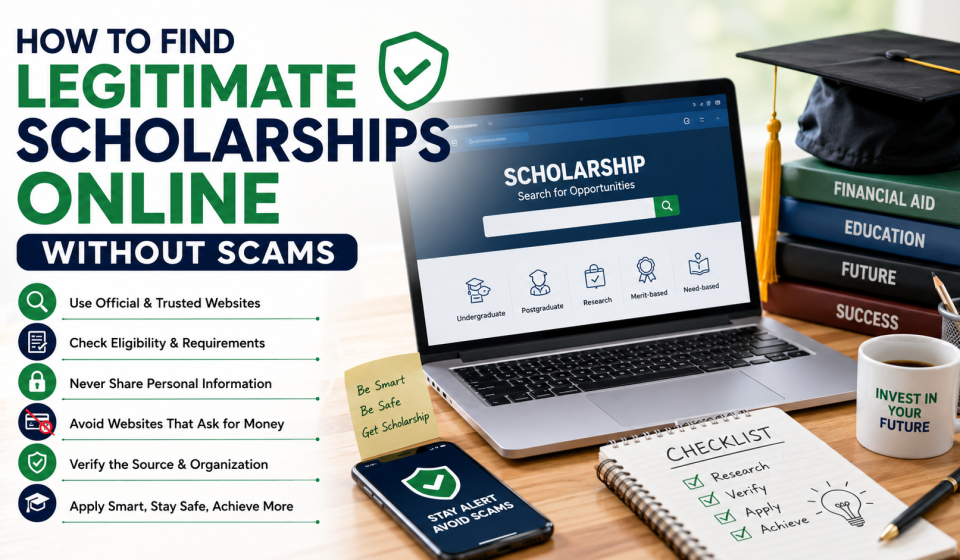

Many students become victims of scholarship scams because they are in a hurry, trust attractive offers too quickly, or do not know how to verify the source. A fake scholarship may ask for money, personal banking details, passwords, or unnecessary documents.
Finding scholarships online can be one of the best ways for students to reduce education costs and achieve their academic dreams. Today, thousands of scholarship opportunities are available through government portals, universities, private organizations, NGOs, foundations, and international education platforms. However, the internet also has many fake scholarship websites and scams that target students who are searching for financial help. To protect yourself, it is important to understand how to identify genuine scholarships, where to search safely, and what warning signs to avoid. With the right approach, students can find real scholarship opportunities online without falling into scams.
Understand What a Legitimate Scholarship Looks Like
A legitimate scholarship is usually offered by a trusted organization such as a government department, university, educational foundation, company, nonprofit organization, or recognized scholarship platform. Genuine scholarships clearly mention eligibility criteria, application deadline, required documents, selection process, scholarship amount, and official contact details.
A real scholarship does not guarantee selection to every applicant. It usually has a proper review process based on academic performance, financial need, leadership, skills, essay quality, or specific eligibility rules. If a scholarship claims that every student will definitely receive money, it may not be trustworthy.
Students should always read the complete scholarship details before applying. A genuine scholarship page will provide clear and professional information instead of vague promises.
Use Official Scholarship Websites
The safest way to find scholarships is through official websites. Students should first search government education portals, university websites, embassy pages, and official financial aid sections. These sources are generally more reliable than random advertisements or social media posts.
For university scholarships, visit the official website of the college or university where you want to apply. Most institutions have a separate scholarship or financial aid page. For government scholarships, use official government portals that end with trusted domain extensions such as .gov, .edu, or official country-specific education domains.
Avoid clicking unknown links shared through WhatsApp, Telegram, random emails, or pop-up ads unless you can verify the source.
Check the Website URL Carefully
One of the easiest ways to identify a scam is by checking the website URL. Fake scholarship websites often copy the names of famous organizations but use slightly different spellings, extra words, or strange domain names.
For example, a scam website may use a name similar to a real scholarship platform but add unnecessary words like “free-money-now,” “instant-scholarship,” or “guaranteed-fund.” Students should be careful with websites that have spelling mistakes in the domain or look unprofessional.
Always check if the website starts with “https,” but remember that https alone does not guarantee safety. It only means the connection is secure, not that the scholarship is real. Combine URL checking with other verification steps.
Never Pay to Apply for a Scholarship
A major warning sign of a scholarship scam is an application fee. Most legitimate scholarships do not ask students to pay money just to apply. If a website asks for processing fees, registration fees, verification charges, or advance payment to release scholarship funds, be very careful.
Scammers often use small payment requests to appear harmless. They may say the amount is refundable or required for document verification. In reality, genuine scholarship providers usually do not demand money from students before awarding scholarships.
Students should remember this simple rule: scholarships are meant to provide financial support, not take money from applicants.
Avoid “Guaranteed Scholarship” Promises
No genuine scholarship can guarantee approval without reviewing your application. If a website or person says, “You are 100% selected,” “Guaranteed scholarship for everyone,” or “Pay now and secure your scholarship,” it is likely a scam.
Real scholarships are competitive. They have eligibility rules, selection committees, review processes, and deadlines. Even strong students may not always be selected because many applicants apply for the same opportunity.
Students should avoid any offer that sounds too easy, too fast, or too good to be true.
Protect Your Personal Information
Scholarship applications may require basic personal details, academic documents, and sometimes financial information. However, students should never share sensitive details such as banking passwords, OTPs, credit card information, ATM PINs, or login passwords.
A genuine scholarship may ask for bank account details only after selection for fund transfer, and even then, it should be through an official and secure process. If a website asks for unnecessary private information at the beginning, do not proceed.
Students should also avoid uploading documents on unknown websites. Identity documents, income certificates, and academic records can be misused by scammers.
Research the Scholarship Provider
Before applying, research the organization offering the scholarship. Search the name of the provider online along with words like “official website,” “reviews,” “scam,” or “complaints.” Check whether the organization has a real address, contact number, email, social media presence, and history of offering scholarships.
If the scholarship is offered by a company or foundation, visit its official website directly instead of relying only on a third-party page. Genuine organizations usually have clear information about their mission, programs, past scholarship winners, and application process.
If you cannot find any reliable information about the provider, it is better to avoid applying.
Check for Clear Eligibility Criteria
Legitimate scholarships always explain who can apply. They mention details such as education level, subject, country, age, marks, income limit, course type, institution, category, or specific student group.
Scam scholarships often keep eligibility very vague. They may say “open to all students worldwide” without explaining any proper selection process. While some scholarships are broad, they still provide clear rules.
Before applying, students should ask: Am I eligible? What documents are required? How will winners be selected? When will results be announced? If these answers are missing, the scholarship may not be reliable.
Look for Professional Communication
Genuine scholarship providers usually communicate professionally. Their emails are clear, well-written, and sent from official email addresses. Scam emails often contain spelling mistakes, poor grammar, urgent language, fake congratulations, or suspicious links.
Be careful if you receive an email saying you won a scholarship you never applied for. Also, avoid emails that ask you to click links immediately, download unknown files, or send personal information urgently.
A real scholarship organization will not pressure you with threatening or overly emotional language.
Use Trusted Scholarship Search Platforms
Scholarship search platforms can help students discover many opportunities in one place. However, students should use only well-known and trusted platforms. A good scholarship platform will provide detailed scholarship information, official links, deadlines, and eligibility details.
Even when using scholarship platforms, students should always verify the final application page. Do not depend only on third-party information. Visit the official scholarship provider’s website before submitting personal details.
Trusted platforms can save time, but verification is still necessary.
Avoid Social Media Scholarship Traps
Many fake scholarships spread through social media platforms. They often use attractive posters, emotional messages, and urgent deadlines to get quick attention. Some posts may say, “Share this with 10 friends to receive scholarship money” or “Click this link to claim free student funds.”
Students should never trust a scholarship only because it is viral. Always check whether the post links to an official website. If the scholarship is real, it should also be available on the official website of the provider.
Social media can help you discover opportunities, but it should not be your final verification source.
Read Terms and Conditions
Before submitting an application, read the terms and conditions carefully. Some websites collect student data and sell it to third parties. Others may use scholarship forms only to generate leads for paid courses, loans, or services.
A legitimate scholarship should clearly explain how your data will be used, how winners will be selected, and what responsibilities applicants have. If the terms are missing, confusing, or hidden, think twice before applying.
Students should never agree to anything they do not understand.
Ask Teachers or Counselors for Help
If you are unsure whether a scholarship is real, ask a teacher, school counselor, college financial aid office, parent, or trusted mentor. Experienced people can often identify red flags quickly.
Many schools and colleges also share verified scholarship lists with students. College financial aid offices are especially useful because they can guide students toward genuine opportunities and help with applications.
Getting advice before applying can protect you from mistakes and scams.
Keep Records of Every Application
Students should maintain a record of all scholarships they apply for. Keep details such as scholarship name, official website, deadline, login ID, application number, submitted documents, and confirmation email.
This helps you track applications and avoid confusion. It also helps identify suspicious communication. For example, if someone contacts you about a scholarship you never applied for, you will know it may be fake.
A simple spreadsheet or notebook can make the scholarship search process safer and more organized.
Report Scholarship Scams
If you find a fake scholarship website or receive a scam message, do not ignore it. Report it to the platform where you found it, such as email provider, social media platform, or official cybercrime authority in your country.
Reporting scams can protect other students from becoming victims. Also, warn your classmates and friends if you see a suspicious scholarship link being shared.
Online safety is not only about protecting yourself but also helping others stay aware.
source
https://sl1nk.com/ctqbntu
https://sl1nk.com/607l00o
https://l1nq.com/1y3j6zk
Conclusion
Finding legitimate scholarships online is possible when students search carefully and verify every opportunity before applying. Genuine scholarships come from trusted organizations, have clear eligibility rules, do not demand application fees, and follow a proper selection process. On the other hand, scam scholarships often promise guaranteed money, ask for payment, collect sensitive personal details, or use urgent pressure tactics.
Students should use official websites, check URLs, research scholarship providers, protect personal information, avoid social media traps, and ask trusted mentors for guidance. A careful and organized approach can help students find real financial aid opportunities without falling into scams. Scholarships can support your education, but safety and verification should always come first.
FAQs
1.What is the easiest way to identify a scholarship scam?
The easiest way is to check whether the scholarship asks for money, guarantees selection, or requests sensitive personal information. These are major warning signs.
2.Are scholarship application fees normal?
Most genuine scholarships do not require application fees. If a scholarship asks for payment before applying or receiving funds, students should be very careful.
3.Can I trust scholarships shared on social media?
Not immediately. Social media posts can be fake or misleading. Always verify the scholarship through the official website of the provider before applying.
4.What personal information should I avoid sharing?
Never share banking passwords, OTPs, ATM PINs, credit card details, or login passwords. Only provide necessary documents through official and secure websites.
5.How do I know if a scholarship website is real?
Check the URL, official contact details, organization history, eligibility rules, application process, and whether the scholarship is listed on the provider’s official website.
