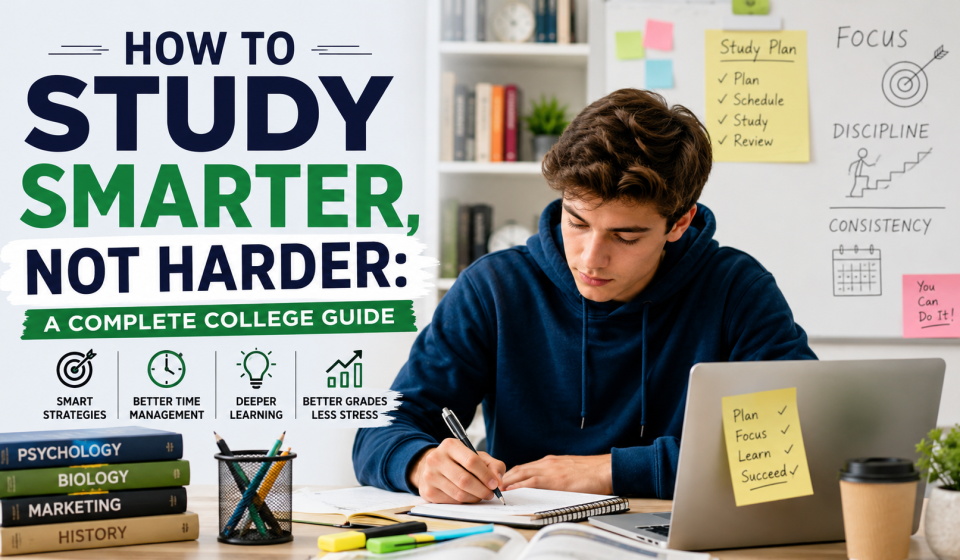

Learn how to study smarter, not harder, with proven college study techniques, time management strategies, and productivity tips to improve grades, reduce stress, and achieve academic success.
College life can be exciting, challenging, and sometimes overwhelming. Students often believe that studying for long hours is the only way to score better marks, but the truth is different. Success in college is not only about how much time you study, but how effectively you use that time. Studying smarter means using the right techniques, planning your schedule, understanding concepts deeply, and avoiding habits that waste energy.
Understand What Smart Studying Really Means
Smart studying means learning with purpose. Instead of randomly opening books and reading for hours, students should focus on clear goals. For example, instead of saying, “I will study biology today,” a smarter goal is, “I will understand cell division and solve five practice questions.”
This approach gives direction to study sessions. It helps students know what they need to complete and whether they truly understood the topic. Smart studying also includes choosing the best learning method for each subject. Some topics require memorization, while others need problem-solving, diagrams, discussions, or practical examples.
When students study with focus, they can achieve more in less time.
Create a Realistic Study Plan
A study plan is one of the most important tools for college success. Without a plan, students often waste time deciding what to study next. A good study plan organizes subjects, assignments, revision, and exam preparation.
Start by listing all subjects and important deadlines. Then divide topics into smaller parts. Instead of planning to complete an entire chapter in one day, break it into sections. This makes studying less stressful and more achievable.
A realistic study plan should also include breaks, meals, sleep, and personal time. Overloading the timetable can lead to frustration. The goal is consistency, not perfection. Even two focused hours daily can be more powerful than six distracted hours once a week.
Use Active Learning Techniques
One common mistake students make is passive studying. Passive studying includes simply reading notes, highlighting lines, or watching lectures without engaging with the material. These methods may feel easy, but they do not always help with deep learning.
Active learning means interacting with the topic. Students can ask questions, summarize concepts in their own words, create mind maps, teach a friend, or solve practice problems. When the brain actively works with information, it remembers better.
For example, after reading a chapter, close the book and explain the main points aloud. This simple method shows whether you truly understand the topic or only recognize it while reading.
Practice the Pomodoro Technique
The Pomodoro Technique is a popular time management method for students. It involves studying for 25 minutes and then taking a 5-minute break. After four study sessions, take a longer break of 15 to 30 minutes.
This technique works because the brain focuses better in short periods. Long study sessions without breaks can reduce concentration and increase tiredness. Short breaks refresh the mind and help students return with better energy.
During the 25-minute session, avoid checking your phone, social media, or messages. Focus only on one task. This simple habit can improve productivity quickly.
Focus on Understanding, Not Memorizing
Memorization is useful for formulas, definitions, and key terms, but college learning requires more than memory. Students must understand why something happens, how concepts connect, and where ideas can be applied.
When students only memorize, they may forget answers under exam pressure. But when they understand the concept, they can explain it in different ways. This is especially important for subjects like science, economics, law, engineering, business, and medicine.
To improve understanding, ask yourself questions like: Why is this important? How does this connect to previous topics? Can I explain this with an example? These questions help build deeper knowledge.
Take Better Notes in Class
Good notes make revision easier. Many students try to write every word the teacher says, but this can be stressful and ineffective. Instead, focus on key ideas, definitions, examples, formulas, and important explanations.
Use headings, bullet points, diagrams, and short summaries. Leave space for extra points that you can add later. After class, review your notes within 24 hours. This helps move information from short-term memory to long-term memory.
Students can also use the Cornell note-taking method. Divide the page into sections for notes, keywords, and summary. This structure makes revision faster and more organized.
Use Spaced Repetition for Long-Term Memory
Spaced repetition is one of the best study techniques for remembering information longer. Instead of revising a topic only once before exams, review it multiple times over a period of days or weeks.
For example, study a topic today, revise it after two days, then after one week, and again before the exam. Each revision strengthens memory. This method is better than last-minute cramming because it reduces stress and improves recall.
Flashcards are useful for spaced repetition. Students can use physical flashcards or digital apps to revise definitions, formulas, dates, and important facts.
Test Yourself Regularly
Practice testing is a powerful way to study smarter. Many students avoid tests because they fear mistakes, but mistakes during practice are helpful. They show what needs improvement before the real exam.
Use previous year papers, quizzes, mock tests, short-answer questions, and self-made questions. After completing a test, review wrong answers carefully. Do not just check the correct answer; understand why your answer was wrong.
Testing also improves confidence. The more you practice, the more familiar you become with exam patterns and time limits.
Remove Distractions While Studying
Distractions are one of the biggest reasons students study for hours but achieve little. Phones, notifications, social media, loud environments, and multitasking reduce focus.
Choose a clean and quiet study space. Keep only the required books, notebooks, and devices on the desk. Put your phone on silent mode or keep it away during study sessions. If you need a laptop, avoid opening unrelated tabs.
Studying with full focus for one hour is often better than studying with distractions for three hours.
Balance Study With Sleep and Health
Many college students sacrifice sleep to study more, especially before exams. However, lack of sleep affects memory, concentration, mood, and performance. A tired brain cannot learn effectively.
Students should aim for proper sleep, regular meals, hydration, and light physical activity. Even a short walk can refresh the mind. Healthy habits support academic success because the brain works better when the body is healthy.
Avoid relying too much on caffeine or late-night cramming. A balanced routine is more sustainable and effective.
Learn to Prioritize Important Tasks
Not every task has the same importance. Some assignments have close deadlines, some topics carry more marks, and some subjects need extra practice. Smart students learn to prioritize.
Use a simple priority system: urgent, important, and low priority. Complete urgent and important tasks first. Avoid spending too much time on easy topics just because they feel comfortable. Focus more on weak areas and high-value topics.
This approach helps students use their energy wisely.
Study With Friends the Right Way
Group study can be helpful when done properly. Students can explain concepts to each other, discuss difficult topics, and share useful resources. Teaching someone else is one of the best ways to strengthen understanding.
However, group study can become distracting if there is no goal. Before starting, decide what topic the group will cover and how much time will be spent. Keep discussions focused on studies.
A small group of serious students is usually better than a large group with too many distractions.
Use Digital Tools Wisely
Technology can make studying easier, but it should not become a distraction. Students can use digital tools for notes, flashcards, time management, online lectures, research, and collaboration.
Apps for calendars, reminders, document storage, and task management can help students stay organized. Educational videos can simplify difficult topics. However, students should avoid jumping from one app to another without actually studying.
The best digital tool is the one that supports your learning style and helps you stay consistent.
Source
https://shorturl.at/lMwrp
https://shorturl.at/PSOS4
Conclusion
Studying smarter, not harder, is about using effective strategies instead of simply spending long hours with books. College students can improve their performance by creating a realistic study plan, using active learning, practicing spaced repetition, testing themselves, reducing distractions, and maintaining good health.
Success in college does not come from pressure alone. It comes from discipline, smart habits, and consistent effort. When students understand how they learn best, they can save time, reduce stress, and achieve better academic results. By applying these techniques regularly, every college student can build confidence and move closer to academic success.
FAQs
1. What does it mean to study smarter, not harder?
Studying smarter means using effective learning methods such as active recall, spaced repetition, practice testing, and time management instead of studying for long hours without focus.
2. How many hours should a college student study daily?
It depends on the course and workload, but two to four focused hours daily can be effective if the student studies with proper planning and concentration.
3. What is the best study method for college students?
Active recall, spaced repetition, and practice testing are among the best methods because they improve understanding and long-term memory.
4. How can I avoid distractions while studying?
Choose a quiet place, keep your phone away, turn off notifications, study one task at a time, and use short focused sessions like the Pomodoro Technique.
5. Is group study good for college students?
Yes, group study can be helpful when students stay focused, discuss important topics, and teach concepts to each other. However, it should be planned properly to avoid distractions.