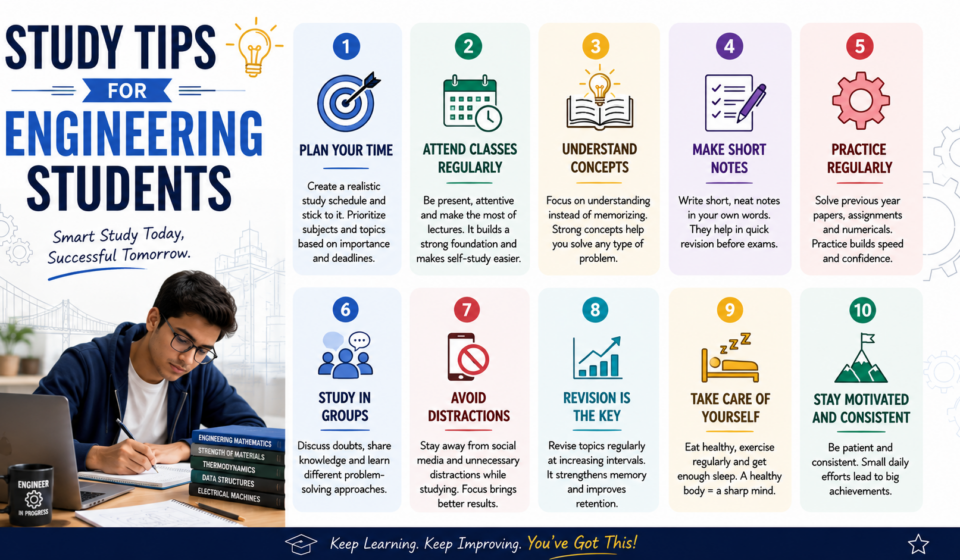

Discover the best study tips for engineering students to improve focus, manage time, score better marks, and reduce exam stress. Learn smart techniques for engineering success.
Engineering is one of the most challenging academic fields. Students often face tight deadlines, complex subjects, practical assignments, lab work, and continuous exams. Without proper planning and smart study methods, managing engineering studies can become stressful and overwhelming.
The good news is that engineering success is not only about intelligence. It is mostly about consistency, discipline, and using the right study strategies. By improving study habits and time management skills, engineering students can understand concepts better, retain information longer, and perform well in exams.
In this article, we will explore the most effective study tips for engineering students that can help boost productivity, improve concentration, and make learning easier.
Understand Concepts Instead of Memorizing
Engineering subjects are based on logic, formulas, calculations, and practical applications. Memorizing definitions without understanding the concepts can create problems during exams and projects.
Instead of learning answers word by word, focus on understanding how formulas work, why theories are important, and where concepts are applied in real-life engineering situations.
For example:
- In mechanical engineering, understand the working principle behind machines.
- In electrical engineering, learn how circuits function.
- In computer engineering, practice coding logic instead of memorizing programs.
When concepts become clear, solving numerical problems and writing theoretical answers becomes much easier.
Create a Proper Study Schedule
Time management is one of the biggest challenges for engineering students. A proper study timetable helps balance lectures, assignments, practical work, and self-study.
Create a daily schedule that includes:
- Study hours
- Revision time
- Breaks
- Assignment completion
- Practice sessions
- Sleep schedule
Avoid studying everything at the last moment before exams. Instead, study consistently every day for better retention and reduced stress.
A well-planned timetable improves productivity and prevents procrastination.
Use Active Learning Techniques
Reading textbooks for long hours is not always effective. Active learning techniques help improve understanding and memory.
Some effective active learning methods include:
- Solving problems regularly
- Teaching concepts to friends
- Creating short notes
- Using diagrams and flowcharts
- Watching educational videos
- Participating in group discussions
Engineering subjects become easier when students actively engage with the material instead of passively reading it.
Practice Numerical Problems Daily
Most engineering branches involve mathematics and numerical calculations. The only way to master numerical subjects is through regular practice.
Subjects like:
- Engineering Mathematics
- Physics
- Strength of Materials
- Thermodynamics
- Electrical Circuits
- Data Structures
require consistent problem-solving practice.
Start with basic problems and gradually move to advanced questions. Daily practice improves speed, accuracy, and confidence during exams.
Make Short Notes for Revision
Engineering syllabuses are usually lengthy. During exams, reading entire textbooks again becomes difficult.
Creating short notes can help in quick revision.
Your notes should include:
- Important formulas
- Key concepts
- Definitions
- Short explanations
- Diagrams
- Important derivations
Use colored pens, highlights, or sticky notes to make revision more effective.
Short notes save time and improve last-minute exam preparation.
Avoid Multitasking While Studying
Many students study while using social media, watching videos, or chatting online. Multitasking reduces concentration and decreases learning efficiency.
While studying:
- Keep your phone away
- Turn off unnecessary notifications
- Study in a quiet environment
- Focus on one subject at a time
Even 2 hours of focused study is more effective than 5 hours of distracted learning.
Use the Pomodoro Technique
The Pomodoro Technique is one of the best productivity methods for students.
This method works like this:
- Study for 25 minutes with full concentration.
- Take a 5-minute break.
- Repeat the cycle.
- After 4 sessions, take a longer break.
This technique helps reduce mental fatigue and improves focus during long study sessions.
It is especially useful for engineering students who spend many hours solving problems and working on projects.
Learn Through Practical Applications
Engineering is not only theoretical. Understanding practical applications makes learning more interesting and easier.
Try to connect topics with real-world examples.
For instance:
- Learn programming by building small projects.
- Understand electronics through practical circuits.
- Use simulation software for mechanical designs.
- Explore engineering experiments online.
Practical learning improves creativity and technical understanding.
Study From Multiple Resources
Do not depend only on classroom notes.
Use additional learning resources such as:
- Online tutorials
- Educational YouTube channels
- Reference books
- Engineering blogs
- Practice websites
- Digital notes
Different explanations from different sources can help clarify difficult concepts.
However, avoid collecting too many resources at once, as it can create confusion.
Improve Your Problem-Solving Skills
Engineering education focuses heavily on analytical thinking and problem-solving.
To improve these skills:
- Solve previous year question papers
- Attempt mock tests
- Practice case studies
- Analyze mistakes carefully
- Try different solving methods
The more problems you solve, the stronger your understanding becomes.
Join Group Study Sessions
Group study can be highly beneficial when done correctly.
Benefits of group study include:
- Sharing knowledge
- Solving doubts quickly
- Learning different approaches
- Improving communication skills
- Staying motivated
However, avoid groups that become distractions instead of productive discussions.
Choose serious and focused study partners.
Take Care of Your Health
Many engineering students ignore their health during exams and project submissions. Poor health directly affects concentration and memory.
Maintain a healthy lifestyle by:
- Sleeping 7–8 hours daily
- Drinking enough water
- Eating nutritious food
- Exercising regularly
- Avoiding excessive caffeine
A healthy body supports better academic performance.
Do Not Skip Classes and Practical Labs
Many important concepts are explained during lectures and practical sessions.
Attending classes regularly helps students:
- Understand difficult topics faster
- Stay updated with syllabus progress
- Learn important exam topics
- Build better relationships with professors
Practical labs are especially important because they provide hands-on experience.
Manage Exam Stress Effectively
Engineering exams can create pressure and anxiety.
To manage stress:
- Start preparation early
- Avoid comparing yourself with others
- Take regular breaks
- Practice meditation or deep breathing
- Stay positive and confident
Remember that stress management is equally important as studying.
Focus on Smart Study Instead of Long Hours
Studying for very long hours without proper understanding is not productive.
Smart study techniques include:
- Prioritizing important topics
- Understanding concepts deeply
- Practicing regularly
- Revising effectively
- Managing time properly
Quality study is always better than quantity study.
Use Technology for Better Learning
Technology can make engineering studies easier and more interactive.
Useful tools for engineering students include:
- Online calculators
- Coding platforms
- Simulation software
- Digital flashcards
- Productivity apps
- Note-taking applications
These tools help improve efficiency and organization.
Revise Regularly
Revision is extremely important for long-term memory retention.
Without revision, students often forget topics before exams.
Follow these revision tips:
- Revise weekly
- Practice formulas regularly
- Review class notes daily
- Solve old papers
- Test yourself frequently
Consistent revision reduces exam pressure significantly.
Develop Communication and Technical Skills
Engineering students should focus not only on academics but also on professional skills.
Important skills include:
- Communication skills
- Teamwork
- Coding knowledge
- Presentation skills
- Problem-solving ability
- Technical writing
These skills help students succeed in placements and future careers.
Stay Motivated and Consistent
Engineering can sometimes feel difficult and exhausting. Staying motivated is important for long-term success.
Ways to stay motivated:
- Set realistic goals
- Reward yourself after achievements
- Track your progress
- Learn from failures
- Stay connected with positive people
Consistency is the key to academic improvement.
Common Mistakes Engineering Students Should Avoid
Many students make avoidable mistakes that affect their performance.
Some common mistakes include:
- Studying only before exams
- Ignoring practical subjects
- Poor time management
- Excessive social media use
- Skipping revision
- Lack of sleep
- Avoiding difficult topics
Avoiding these mistakes can greatly improve academic performance.
Best Study Resources for Engineering Students
Here are some popular learning platforms useful for engineering students:
- NPTEL
- Coursera
- Udemy
- Khan Academy
- GeeksforGeeks
- MIT OpenCourseWare
These platforms provide high-quality educational content for various engineering subjects.
Conclusion
Engineering is challenging, but with the right study techniques, students can perform exceptionally well. Success in engineering does not depend only on intelligence; it depends on discipline, consistency, problem-solving ability, and smart study methods.
By understanding concepts clearly, practicing regularly, managing time wisely, and maintaining a healthy lifestyle, engineering students can reduce stress and improve academic performance.
Remember that engineering is a journey of continuous learning. Stay focused, stay motivated, and keep improving every day.
FAQs
How many hours should engineering students study daily?
Engineering students should focus on quality study rather than long hours. Around 4–6 focused study hours daily are usually effective along with regular classes.
What is the best study method for engineering students?
Understanding concepts, solving numerical problems regularly, revising frequently, and using active learning techniques are considered the best study methods.
How can engineering students improve concentration?
Students can improve concentration by avoiding distractions, following a study schedule, using the Pomodoro Technique, and maintaining good sleep habits.
Are group studies helpful for engineering students?
Yes, group studies can help students solve doubts, exchange ideas, and stay motivated if the group remains focused and disciplined.
Why is practical learning important in engineering?
Practical learning helps students understand real-world applications of engineering concepts and improves technical skills.