Top Skills Employers Want in Graduates: The Complete Guide to Career-Ready Skills for Academic and Professional Success

Graduating from college is an important achievement, but in today’s highly competitive job market, a degree alone is often not enough to secure the best career opportunities.
Employers are increasingly looking for graduates who possess a combination of technical knowledge, practical experience, and essential workplace skills that allow them to contribute effectively from day one. As industries continue to evolve due to technological advancements, globalization, and changing business needs, organizations are placing greater emphasis on hiring candidates who can adapt quickly, communicate effectively, solve problems, and work collaboratively. Understanding the skills employers value most can help students prepare themselves for successful careers and stand out in the recruitment process. The transition from academic life to professional employment can be challenging for many graduates. While colleges provide subject-specific education, employers often evaluate candidates based on a broader set of competencies that demonstrate workplace readiness. These skills influence hiring decisions, career progression, leadership potential, and long-term professional success. Graduates who actively develop these abilities through education, internships, extracurricular activities, volunteer work, and self-learning gain a significant advantage in the job market. This comprehensive guide explores the top skills employers want in graduates and explains how students can develop these competencies to improve employability and achieve career success.
Why Employer-Valued Skills Matter
Modern organizations seek employees who can contribute beyond technical expertise.
Benefits of developing employer-valued skills include:
Improved employability
Better job opportunities
Career advancement
Professional confidence
Leadership potential
Higher earning prospects
These skills help graduates adapt successfully to workplace expectations.
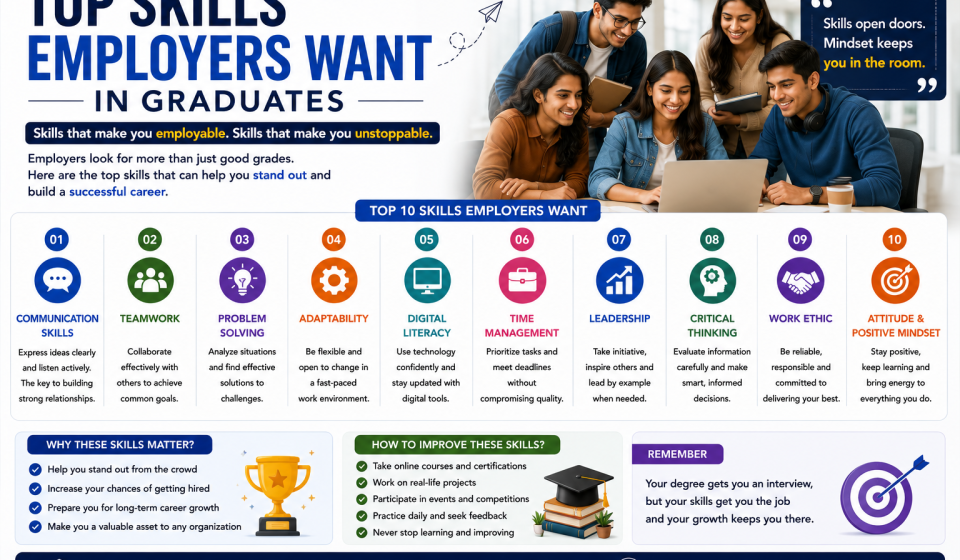
Communication Skills
Communication remains one of the most important skills employers seek.
Effective communication involves:
Speaking clearly
Writing professionally
Listening actively
Presenting ideas confidently
Interpersonal communication
Strong communicators collaborate effectively and build productive workplace relationships.
How to Improve Communication Skills
Participate in presentations.
Join debate clubs.
Practice public speaking.
Improve writing abilities.
Engage in group discussions.
Communication skills are valuable across all industries.
Problem-Solving Skills
Organizations value employees who can identify challenges and develop practical solutions.
Problem-solving involves:
Analyzing situations
Evaluating alternatives
Making decisions
Implementing solutions
Graduates with strong problem-solving abilities contribute to organizational success.
Benefits of Problem-Solving Skills
Improved productivity
Innovation
Decision-making confidence
Greater workplace efficiency
Problem solvers often become valuable team members.
Critical Thinking
Critical thinking enables graduates to assess information objectively and make informed decisions.
Key elements include:
Logical reasoning
Analysis
Evaluation
Independent thinking
Employers appreciate candidates who can think strategically and solve complex problems.
Teamwork and Collaboration
Most workplaces require employees to work effectively with others.
Teamwork involves:
Cooperation
Respect
Communication
Shared responsibility
Conflict resolution
Graduates who collaborate well contribute to positive workplace environments.
Why Teamwork Matters
Enhances productivity
Improves creativity
Supports innovation
Strengthens organizational culture
Team-oriented employees are highly valued.
Adaptability and Flexibility
Business environments change rapidly due to technology, market trends, and global developments.
Adaptable graduates can:
Learn new skills quickly
Handle change effectively
Adjust to different roles
Embrace innovation
Adaptability increases long-term employability.
Time Management
Employers seek individuals who can manage responsibilities efficiently.
Time management includes:
Prioritizing tasks
Meeting deadlines
Planning effectively
Managing workloads
Strong time management improves productivity and reliability.
Tips for Better Time Management
Use schedules and planners.
Set realistic goals.
Avoid procrastination.
Break tasks into manageable steps.
Efficient professionals consistently deliver results.
Leadership Skills
Leadership is valuable even in entry-level positions.
Leadership qualities include:
Initiative
Responsibility
Decision-making
Motivation
Accountability
Organizations often promote employees who demonstrate leadership potential.
Emotional Intelligence
Emotional intelligence refers to the ability to understand and manage emotions effectively.
Components include:
Self-awareness
Empathy
Self-control
Relationship management
Motivation
Employees with high emotional intelligence often perform well in team environments.
Digital Literacy
Technology plays a central role in modern workplaces.
Digital literacy includes:
Computer proficiency
Online collaboration
Data management
Software applications
Digital communication
Graduates must remain comfortable with evolving technologies.
Data Analysis Skills
Organizations increasingly rely on data-driven decision-making.
Relevant abilities include:
Data interpretation
Reporting
Analytical thinking
Basic statistical understanding
Data analysis skills are becoming valuable across industries.
Creativity and Innovation
Employers appreciate individuals who can generate new ideas and improve processes.
Creative thinking supports:
Problem-solving
Product development
Marketing strategies
Business growth
Innovation drives organizational success.
Decision-Making Skills
Effective decision-making involves:
Gathering information
Evaluating options
Assessing risks
Choosing appropriate actions
Employers value graduates who can make sound decisions independently.
Work Ethic and Professionalism
Professional behavior significantly impacts workplace success.
Important qualities include:
Reliability
Integrity
Responsibility
Punctuality
Accountability
Strong work ethics build trust and credibility.
Networking Skills
Professional relationships create opportunities for career growth.
Networking helps graduates:
Access job opportunities
Gain industry insights
Find mentors
Build professional reputations
Effective networking supports long-term success.
Project Management Skills
Project management skills help employees organize tasks and achieve objectives efficiently.
Core elements include:
Planning
Resource allocation
Scheduling
Coordination
Risk management
Project management knowledge is valuable across industries.
Customer Service Skills
Many roles require interaction with customers or clients.
Important abilities include:
Communication
Patience
Empathy
Problem-solving
Relationship building
Customer-focused employees contribute to organizational reputation.
Negotiation Skills
Negotiation skills assist professionals in reaching mutually beneficial outcomes.
Applications include:
Business discussions
Sales
Procurement
Conflict resolution
Partnership development
Strong negotiators often achieve better results.
Technical Skills
Technical expertise remains important alongside soft skills.
Examples include:
Programming
Engineering knowledge
Financial analysis
Graphic design
Healthcare competencies
Industry-specific technical skills improve employability.
Research Skills
Research abilities support informed decision-making and innovation.
Research skills include:
Information gathering
Analysis
Evaluation
Reporting
Employers value individuals who can identify and use reliable information.
Presentation Skills
Employees frequently present information to colleagues, clients, and management.
Effective presentations require:
Confidence
Clear communication
Organization
Visual support
Engagement
Strong presentation skills enhance professional impact.
Conflict Resolution Skills
Workplace conflicts occasionally occur and require effective management.
Conflict resolution involves:
Active listening
Empathy
Negotiation
Problem-solving
Diplomacy
Professionals who handle conflicts constructively contribute to positive work environments.
Self-Motivation
Employers appreciate graduates who demonstrate initiative and enthusiasm.
Self-motivated employees:
Take responsibility
Seek improvement opportunities
Work independently
Maintain productivity
Motivation supports career advancement.
Learning Agility
Industries evolve rapidly, making continuous learning essential.
Learning agility includes:
Curiosity
Adaptability
Skill development
Knowledge acquisition
Graduates who learn quickly remain competitive.
Global and Cultural Awareness
Modern workplaces often involve international collaboration.
Cultural awareness supports:
Communication
Diversity appreciation
Global teamwork
Professional relationships
Global competencies enhance career opportunities.
Entrepreneurial Mindset
Organizations increasingly value entrepreneurial thinking.
Characteristics include:
Innovation
Initiative
Problem-solving
Risk awareness
Business understanding
Entrepreneurial employees often drive growth and improvement.
Importance of Internships in Skill Development
Internships provide opportunities to develop employer-valued skills through practical experience.
Benefits include:
Professional exposure
Industry knowledge
Skill enhancement
Networking opportunities
Workplace readiness
Internships strengthen graduate employability.
How Students Can Develop These Skills
Students can improve employability through:
Internships
Volunteer work
Student organizations
Leadership roles
Online courses
Workshops
Networking events
Consistent effort leads to significant personal and professional growth.
Future Workplace Skill Requirements
Artificial intelligence, automation, digital transformation, and globalization are reshaping employment markets worldwide. While technical expertise remains important, uniquely human skills such as communication, creativity, emotional intelligence, leadership, adaptability, and critical thinking are becoming increasingly valuable. Employers will continue seeking graduates who can combine technical competence with interpersonal effectiveness and continuous learning abilities. Students who invest in skill development today will be better prepared for future workplace demands and long-term career success.
Source
https://www.indeed.com/career-advice
https://www.linkedin.com/learning
https://www.naceweb.org
https://www.coursera.org
Conclusion
The modern job market demands much more than academic qualifications alone. Employers increasingly seek graduates who possess a combination of technical expertise, communication abilities, problem-solving skills, teamwork capabilities, adaptability, leadership potential, and emotional intelligence. These competencies help employees perform effectively, contribute to organizational success, and adapt to changing workplace environments. By actively developing these skills through education, internships, extracurricular activities, and continuous learning, graduates can improve their employability, secure rewarding career opportunities, and build successful professional futures in an increasingly competitive world.
FAQ
1. What skill do employers value most in graduates?
Communication skills are consistently ranked among the most important skills employers seek in graduates.
2. Why are soft skills important for employability?
Soft skills improve teamwork, communication, leadership, adaptability, and workplace effectiveness.
3. How can students improve their employability skills?
Students can develop skills through internships, volunteer work, extracurricular activities, workshops, and continuous learning.
4. Do employers value technical skills more than soft skills?
Employers generally seek a balance of both technical expertise and soft skills.
5. Why is adaptability important in modern workplaces?
Adaptability helps employees respond effectively to technological changes, new processes, and evolving business requirements.
6. How does emotional intelligence help in the workplace?
Emotional intelligence improves communication, teamwork, leadership, and conflict resolution.
7. Are leadership skills important for fresh graduates?
Yes, employers value leadership potential even in entry-level candidates because it indicates future growth capability.
8. What role do internships play in skill development?
Internships provide practical experience, professional exposure, networking opportunities, and workplace skill development.